Our experts share in-depth analyses and practical classifications on EUDR, CSRD, HinSchG, CSDDD and sustainability.
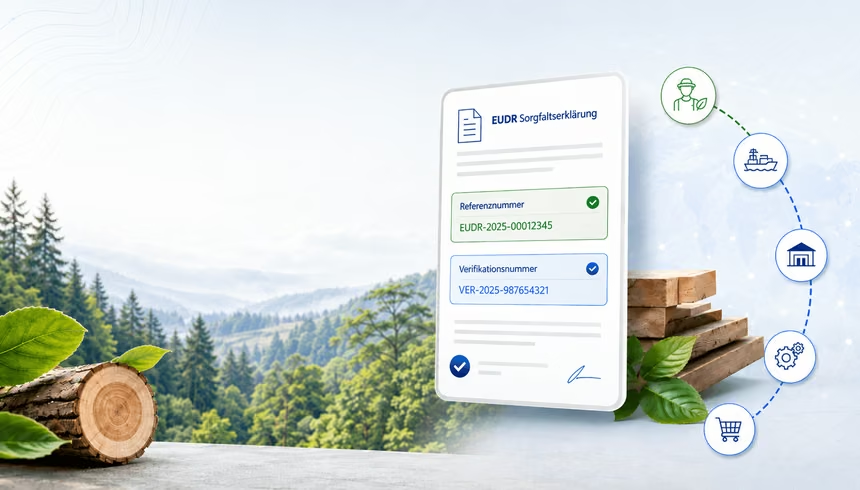
The EU regulation on deforestation-free products (EUDR) requires companies to provide complete traceability, from the production area to the European market. At the heart of this chain of custody are three terms that are regularly confused in practice: the reference number, the declaration identifier and the verification number. Who has to pass on which number, who only collects it and when it is used at all determines whether a product is released at customs or not. This article summarizes the roles, obligations and pitfalls.
Read now
The EU Deforestation Regulation (EUDR) has long focused attention on initial distributors. However, downstream companies, such as downstream operators and traders, also have a responsibility. The frequently cited FAQ 3.4 of the European Commission summarizes what these players must do in the inbound process, i.e. everything that must be documented when goods are received. This article explains the obligations step by step, including the important distinction between first and second downstream operators, the passive nature of the collection obligation and the special cases that are regularly overlooked in practice.

The EU regulation on deforestation-free products (EUDR) shifts part of the market surveillance to the supply chain itself. A central hinge for this is the concept of "Substantiated Concerns": a concrete, fact-based allegation that a product does not comply with the regulation. As soon as such concerns are raised, they trigger a clearly defined cascade of information, testing and, if necessary, distribution stop obligations, depending on whether a company is an operator, downstream player or distributor and whether it is classified as an SME or non-SME.

The EU Deforestation Regulation requires companies that place certain raw materials on the EU market or export them to comply with comprehensive due diligence obligations. The effort would have been almost impossible for micro and small producers. This is why the EU legislator created a separate sub-category at the end of 2025: the Micro or Small Primary Operator (MSPO) with significantly reduced obligations. This article explains who qualifies, which simplifications apply and what needs to be taken into account during implementation.
Environmental protection has become the central guideline for politics, business and society. Climate change, overexploitation of resources and species extinction show this: Ecological stability is the basis for prosperity, health and security. This article provides a technically sound overview - from individual measures and corporate strategies to international agreements.
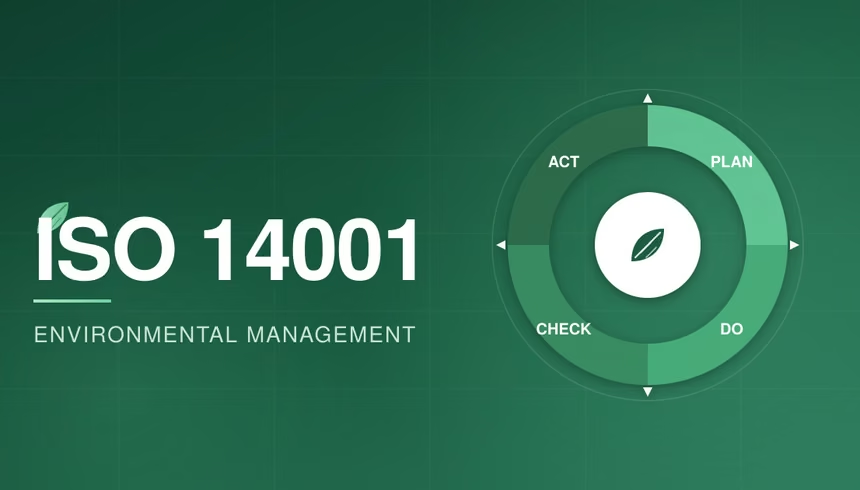
ISO 14001 is the world's leading standard for environmental management systems and provides companies with a structured framework for managing environmental aspects, minimizing risks and leveraging efficiency potential. This article explains what is behind the standard, how to implement it successfully and what is important during the audit.
DIN EN ISO 9001 is the world's leading standard for quality management systems - and has long been a decisive competitive factor for companies of all sizes and in all industries. It specifies how processes must be structured to ensure that products and services consistently meet the requirements of customers and legislators. This article shows what exactly is behind the standard, the benefits of certification and how the process actually works.
Data protection affects private individuals, companies and public bodies alike. Data scandals, cyberattacks and stricter legal frameworks - above all the GDPR - are increasing awareness when it comes to handling personal data. This article explains the legal basis, technical and organizational protective measures and current challenges posed by artificial intelligence, cloud services and big data.
Benchmarking is an indispensable tool in modern corporate management for increasing performance, innovative strength and competitiveness. Companies are realizing how valuable it is to orient themselves towards the best, identify development potential and initiate improvements. This article shows what benchmarking means, what types and methods there are, how the process works and how you can get started immediately.
The EU omnibus package brings movement to European sustainability regulation. The CSRD, EU taxonomy, CSDDD and CBAM remain central components, but will be more targeted, leaner and in some cases reorganized in terms of time. For companies, this means above all more clarity as to which obligations actually apply, where there is relief and which topics remain on the agenda despite all the simplifications.
9 of 63 articles

 DE
DE