 DE
DE
Important facts
- Who qualifies as an MSPO?
- Anyone who fulfills four conditions: Micro/small enterprise according to the Accounting Directive 2013/34/EU, registered office in a low-risk country, direct delivery to the EU market and own production.
- What is the main relief?
- A single simplified declaration (SD) instead of a DDS per delivery. It remains valid until significant changes occur.
- Can the postal address replace geocoordinates?
- Yes, if it corresponds to the actual production location. Pure business addresses are not sufficient.
- Do farmers have to draw up a balance sheet just to be an MSPO?
- No. Anyone who falls below the turnover and employee threshold is automatically deemed to be an MSPO, without having to prepare a balance sheet.
- What happens in the event of misclassification?
- The full EUDR sanctions apply: up to 4% annual turnover, confiscation, loss of market access.
Executive Summary
With the revision at the end of 2025, the EU Deforestation Regulation (EUDR) created a separate category for micro and small producers: the Micro or Small Primary Operator (MSPO). This sub-category of operator combines four cumulative requirements: natural person or micro/small enterprise in accordance with the Accounting Directive 2013/34/EU, registered office in a low-risk country, direct supply or export to the EU market and own production of the products. Those who meet all four conditions benefit from significantly reduced obligations without losing responsibility for deforestation-free supply chains.
The main simplifications range from a one-off simplified declaration (SD) instead of regular due diligence declarations to the postal address instead of precise geo-coordinates and the waiver of a full risk analysis. Where Member States link their national databases, the SD levy is even waived altogether. Cooperatives, associations or other EU-based players can act as authorized representatives. However, the responsibility remains with the MSPO itself.
Despite the administrative relief, the obligation to provide truthful information and to proactively pass on the declaration identifier to the first downstream actor remains in place. In the event of misclassification or inaccurate SD information, the regular EUDR sanctions will apply with fines of at least four percent of the EU-wide annual turnover, confiscation of the products and temporary loss of market access. The application date for MSPOs is June 30, 2027. Affected parties should use the time until TRACES goes back into operation in the second half of 2026 for role clarification and preparation.
Never miss an update on the EUDR again.
New specialist articles, regulatory updates and practical tips, straight to your inbox. Once a week, no spam.
What is an MSPO and who qualifies?
An MSPO is a sub-category of the operator (market participant) with simplified reporting obligations. In principle, the operator regulations apply to them, unless the regulation provides for special rules.
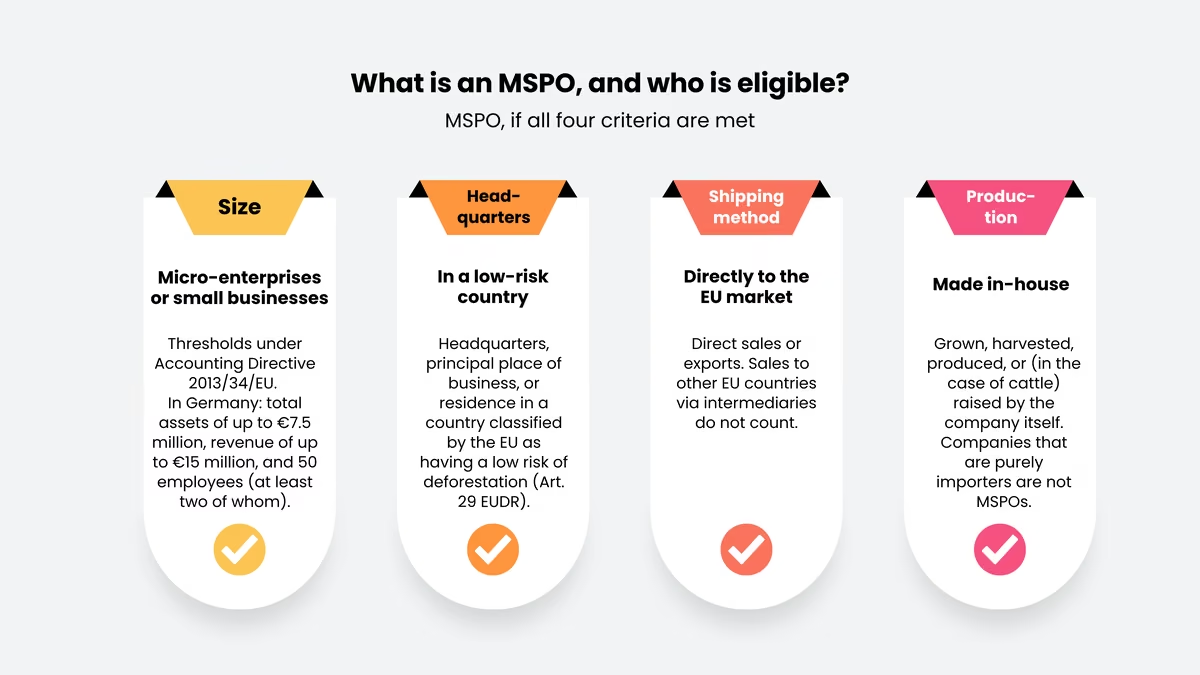
Qualification as an MSPO requires four cumulative prerequisites:
- Natural person or micro/small enterprise: The thresholds of the Accounting Directive 2013/34/EU are decisive, not the Commission's SME Recommendation of 2003 or special national thresholds. In Germany (Section 267 HGB), companies are considered "small" if they do not exceed at least two of the following three thresholds: € 7.5 million total assets, € 15 million revenue, 50 employees.
- Registered office in a low-risk country: The primary residence (for natural persons) or registered office, head office or principal place of business (for legal entities) must be located in a country that the Commission has classified as low deforestation risk in the benchmarking process (Art. 29 EUDR).
- Direct placing on the market or export to the EU market: The MSPO must place its products on the EU market or export them itself. Producers outside the EU who supply their goods to intermediaries who then export them to the EU are not covered by the definition.
- Own production of the products: The MSPO must have grown, harvested, obtained or (in the case of cattle) reared the products themselves on relevant land or in facilities. Pure importers who purchase products from other producers are not MSPOs, even if they otherwise meet the size criteria.
Note on mixed business models:
If a company has several business areas, only the balance sheet items, turnover and employees relating to the EUDR-relevant raw materials and products are used for the threshold calculation. Administration is allocated on a pro rata basis.
Prerequisite: reliable documentation of the internal cost centers or sales structure.
Dual role possible: A company can be both an MSPO (for self-produced products) and a regular operator (for imported products). The obligations then apply in parallel, depending on the product.
What applies to farmers and foresters without a balance sheet obligation?
One of the most important practical clarifications from FAQ version 5 concerns natural persons and companies without an accounting obligation. The thresholds of the Accounting Directive apply to everyone, regardless of legal form.
In practice, however, a complete balance sheet is usually not necessary:
- Companies that fall clearly below the other two thresholds (max. €10 million net turnover and max. 50 employees on average) are automatically considered MSPOs and do not need to prepare a balance sheet.
- Natural persons who produce themselves and supply directly to the EU market may assume in good faith that they are below the thresholds as long as they do not operate close to the thresholds. Additional administrative steps to prove size are not necessary.
For the traditional farmer or small forestry business, this means no accounting overhead just because of the EUDR. Only those who are approaching the thresholds must determine the values in accordance with Chapters 2 and 3 of the Accounting Directive, for example by estimating the production facilities and other assets, and be able to provide documentation in case an authority asks.
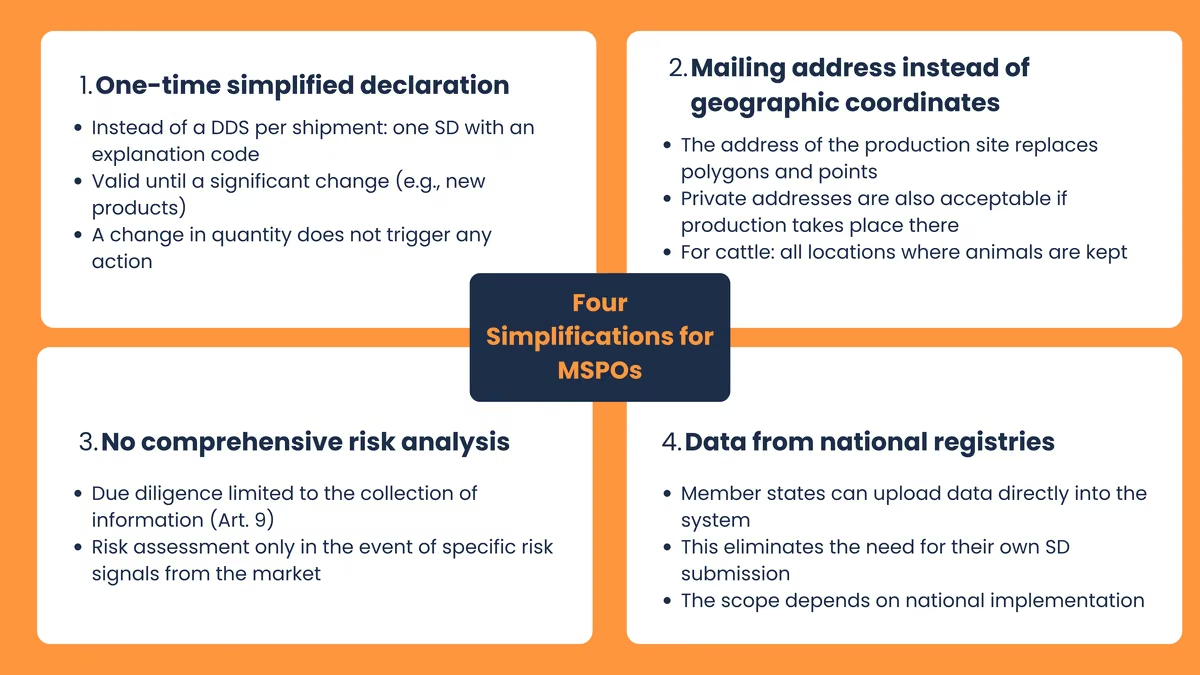
The four simplifications for MSPOs at a glance
1. one-off simplified declaration instead of regular DDS
Regular operators must submit a Due Diligence Statement (DDS) in the EU information system before each placing on the market or export. Instead, MSPOs submit a one-off Simplified Declaration (SD) and receive a Declaration Identifier to accompany their products.
The SD remains valid as long as nothing significant changes. An update is only necessary in the event of major business changes, for example if new products are added that are not covered by the original declaration. Pure quantity changes do not trigger an obligation to update.
Example from the EU Commission: Austrian farmer F has been managing a soybean and cattle farm for years and has submitted an SD. If he now acquires an adjacent forest and wants to market wood products, a new (or updated) SD is required because the wood products fall under a different HS code and are not covered by the original SD. In practice, F may use his old SD as a copy template to pre-fill fields.
2. postal address instead of geocoordinates
Regular operators must enter polygons with geocoordinates for areas over 4 hectares and a point for smaller areas, in each case with at least six decimal places. MSPOs may instead enter the postal address of the production area, including their own private address, provided it corresponds to the geographical location of the cultivation area or facility.
Cadastral information or equivalent details that allow the area to be identified are also permitted.
Important: A pure business address without an actual production reference is not sufficient. For cattle, the address refers to all places where the animal is kept during its life (Annex III point 3).
3. no complete risk analysis
As MSPOs are by definition from low-risk countries, they do not have to carry out a full risk assessment and risk mitigation in accordance with Art. 10 and 11 EUDR. Their due diligence obligation focuses on the collection of information in accordance with Art. 9.
Only when the MSPO becomes aware of specific information that indicates a non-negligible risk of non-compliance does the full risk assessment take effect.
4. data from national databases instead of own SD levy
In cases where the required information is already available in national databases of the Member States (e.g. agricultural or forestry registers), it can be provided directly in the EU information system in accordance with Art. 4a(4) EUDR. In this case, the MSPO does not have to submit its own SD, but automatically receives a declaration identifier.
However, the scope of this facilitation depends on the technical implementation in the individual Member States.
What MSPOs must specifically state in the SD
Even if the SD is simplified, the information obligations under Art. 9 EUDR remain in place. The MSPO must enter the following information once in the information system:
- Description of the product, CN code and quantity: including an estimate of the annual production volume (in case of irregular harvest, see above).
- Country of production and location: as postal address, cadastral information or equivalent identification of the production area or (in the case of cattle) the holding locations.
- Date or period of production: required in order to be able to track the absence of deforestation as of the reporting date 31.12.2020.
- Direct supplier and commercial customer: if available, with name, address and, if applicable, contact details.
- Proof of legality and freedom from deforestation: e.g. proof of ownership, harvesting rights, certificates or evidence of labor and land use rights in the country of production.
Important: The simplification only affects the format (one SD instead of many DDSs) and individual simplifications such as the postal address, not the content. By submitting the declaration, you confirm that the product was produced without deforestation and legally. This responsibility in terms of content remains unchanged.
Multiple products and fluctuating harvest volumes
MSPOs can declare several products in a single SD, such as cattle and wood at the same time. Several cultivation areas or facilities can also be bundled in one declaration.
Flexible rules apply to irregular harvests. Example: A forest owner who only harvests every 30 years and harvests 200-400 m³ of wood depending on the season does not have to specify an artificial "annual quantity" in the SD. Instead, he may use the actual harvest years as a guide or, in the case of multi-year harvest cycles, the highest estimated annual yield as a basis.
Attention: The information provided in the SD must be true at the time of submission and update. Estimates or statements made for the purpose of circumventing the EUDR or misclassifying oneself as an MSPO may be sanctioned by the competent authorities.
Authorized representatives and cooperatives: Two ways of support
MSPOs are not obliged to submit their SD themselves. They can appoint an authorized representative in accordance with Art. 6 EUDR to enter the data into the information system on their behalf.
Who can be an authorized representative? Any natural or legal person based in the EU, e.g. national or regional authorities (if not a competent authority themselves), associations, cooperatives or other supply chain partners. The authorized representative registers in the information system with the role "Representing Operator". A written mandate is mandatory (Art. 2(22) EUDR) and must be able to be presented at the request of the authorities.
Special case of cooperatives: A cooperative or association has two options:
- Option 1 - Cooperative as operator/MSPO: If the cooperative itself produces products and places them on the market (e.g. through logging, where it becomes the direct owner through the act of harvesting), it can act as operator or MSPO and make a single declaration for the entire production.
- Option 2 - Cooperative as authorized representative: The cooperative acts as authorized representative for its members and submits declarations on their behalf.
Responsibility remains with the MSPO: Even if an authorized representative submits the SD, the responsibility for EUDR compliance remains entirely with the MSPO itself. Incorrect information is the responsibility of the MSPO.
Differentiation from other players in the supply chain
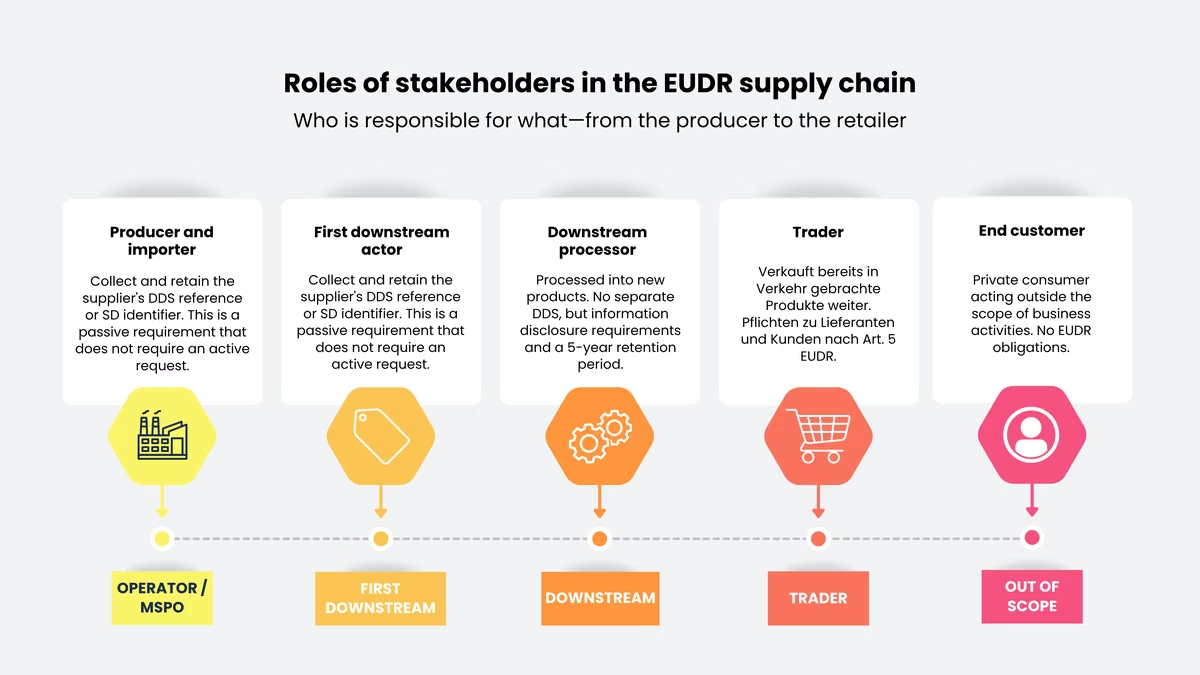
A comparison with the other EUDR roles helps to classify the special position of the MSPO.
Operator (market participant)
The operator places a relevant product on the EU market for the first time or exports it. He has the full due diligence obligation: information collection, risk assessment, risk mitigation and submission of a DDS for each delivery (or consolidated for up to one year). If the operator sources from a low-risk country without being an MSPO, a simplified due diligence obligation applies without risk assessment, but with full information obligation and DDS submission.
Downstream operator (downstream market participant)
The downstream operator processes products that have already been placed on the market (typically with HS code changes) into new relevant products and places these on the market, such as a chocolate manufacturer that produces chocolate from imported cocoa beans. It does not have to submit its own DDS, but fulfills information and retention obligations: documenting direct business partners, maintaining DDS reference numbers or SD identifiers and retaining them for five years. Non-SMEs must also register in the information system.
Trader (Trader)
The trader resells a product that has already been placed on the market (e.g. retail or wholesale). They do not submit their own DDS either, but fulfill information and reporting obligations to suppliers and customers - essentially the same basic obligations under Art. 5 EUDR as the downstream operator.
"First Downstream Operator/Trader"
Anyone directly down the chain from an operator (or MSPO) has the additional task of collecting and retaining the DDS reference number or SD identifier of their supplier. This obligation is passive; it does not have to be actively requested unless there are substantiated concerns.
Dual role: A legal entity can have several roles at the same time, e.g. operator (imported raw timber) and downstream operator (processed sawn timber from this raw timber). DDS reference numbers do not have to be passed on within the same legal entity.
Passing on the declaration identifier and sanction risks
Even if the SD itself is greatly simplified, the MSPO has an active duty towards its direct customer: it must proactively pass on the declaration identifier to the first downstream player in the chain. The "First Downstream Operator" or "First Trader" does not have to actively ask for it; he can rely on the fact that, if no identifier is supplied, he is not the "First Downstream" in the chain.
In practice, this means for the MSPO: the delivery bill, order confirmation or invoice should include the identifier as soon as the SD is stored in the information system.
Risk of sanctions in the event of incorrect information or misclassification
The information in the SD must be truthful at the time of submission and update. The EU Commission clarifies in the FAQ: If authorities determine that estimates or information have been made with the purpose of misclassifying as MSPO, circumventing EUDR requirements or affecting enforcement, the regular EUDR sanctions apply (Art. 25 EUDR):
- Fines with a statutory maximum of at least 4% of the EU-wide annual turnover of the previous year
- Confiscation of the products concerned and the proceeds generated
- Temporary exclusion from public contracts and EU funding
- In the event of serious infringements: temporary ban on placing on the market
- Publication of final judgments on a Commission list
The simplifications for MSPOs are therefore not a relaxation of the substantive obligation, they merely reduce the administrative burden. Anyone who barely meets the thresholds or submits estimates of the production volume should be able to document this reliably.
Three practical examples
Example 1: Small forest owner in Germany
Mr. Müller owns 8 hectares of forest in Germany and sells untreated logs (HS 4403) to a sawmill once a year. As a sole trader, he is well below the thresholds of the Accounting Directive.
Classification: MSPO - natural person, low-risk country, direct sale to an EU buyer, own production.
Obligations: One-time SD in the information system, postal address of the forestry operation instead of geocoordinates, proof of legality and freedom from deforestation (cut-off date 31.12.2020). The sawmill as "First Downstream Operator" stores the SD identifier provided by Mr. Müller.
Example 2: Small coffee farm in a low-risk third country
Ms. Garcia runs a 1.5-hectare coffee farm in a country that the Commission has classified as low-risk. She sells the beans (HS 0901) directly to an EU importer.
Classification: MSPO - low-risk country, thresholds met, own production, direct export to the EU.
Duties: One-time SD, mailing address of farm as location information.
Important restriction: If Ms. Garcia first sold her beans to an intermediary in the country of origin who then exported them to the EU, she would not be an MSPO. The EU importer would then be the operator with full due diligence.
Example 3: Small dairy farm in Austria
Mr. Schmidt runs a small farm and regularly sells cattle (HS 0102) to a slaughterhouse in the EU.
Classification: MSPO - low-risk land, small size, own animal husbandry.
Duties: SD with postal address of all holding locations where the animals were kept during their life.
Special case of feed: For cattle, the EUDR requires care with regard to the feed, but no geolocalization for the feed itself. Evidence of deforestation-free feed (e.g. invoices for soybean meal) is sufficient. If Mr. Schmidt imports the soy meal himself, he acts as a regular operator with a DDS obligation.
EFTA/EEA and EUDR: An important clarification for 2026
Norway, Liechtenstein, Iceland and Switzerland are considered third countries under the EUDR as of 2026. Although the regulation is marked as EEA-relevant, until it is formally incorporated into the EEA Agreement, producers from these countries are only covered as MSPOs or operators if they export directly to the EU.
What changes for MSPOs when the size changes
The size classification is reviewed annually. However, a change only occurs if the thresholds are exceeded or fallen short of in two consecutive financial years.
Scenario 1: An MSPO grows and exceeds the thresholds two years in a row. In the following financial year, it must submit full DDS. If it later falls below the thresholds again for two consecutive years, it may use its SD again from the following year (updated if necessary).
Scenario 2: A non-MSPO falls below the thresholds two years in a row. In the following year, it can switch to the SD rule. The SD remains valid until significant business changes occur.
Start of application: What MSPOs need to know now
The start of application of the EUDR is staggered:
- Large and medium-sized companies: from December 30, 2026
- Micro and small enterprises (incl. MSPOs): from June 30, 2027
A special rule applies to "EUTR products" (timber and timber products that were already covered by the old EU Timber Regulation 995/2010) for market participants established on 31.12.2024: The earlier start date of 30.12.2026 applies here.
The EU information system TRACES is offline for revision as of May 2026 and should be available again in the second half of 2026. As soon as the system is productive again, MSPOs should not postpone their registration and submission of the SD until the last minute, as technical bottlenecks and queries from the competent authorities are to be expected, especially at peak times shortly before the start of application. The additional time can be used to prepare role clarification, data flows and - if relevant - the selection of an authorized representative.
Concrete steps for potential MSPOs:
Recommendation for action
Use the threshold values of the Accounting Directive 2013/34/EU, not the national HGB values, not the SME recommendation of 2003. In the case of mixed business models, document the EUDR-relevant segments in a reliable manner.
Based in a country classified as low-risk? Keep an eye on the Commission's list.
Do I actually deliver directly to the EU market or do the goods go through an intermediary?
What information is required? Is the postal address sufficient, or are there special cases (cattle, several places of production)?
Cooperative, association or industry service could take over the SD levy.
Keep an eye on the Commission's FAQ versions, the delegated act on Annex I and national implementation instructions.
Conclusion
The MSPO category is one of the most important simplifications of the EUDR revision from the end of 2025. It significantly reduces the administrative burden for micro and small producers from low-risk countries: a one-off SD instead of regular DDS, postal address instead of geo-coordinates, no full risk assessment and - where available - even data directly from national registers.
However, these simplifications do not change the fact that the responsibility for the content of deforestation-free and legally produced products remains with the MSPO. False information in the SD or deliberate misclassification can also be sanctioned.
Frequently asked questions
The MSPO submits a one-time simplified declaration (SD) instead of a DDS for each delivery. He may use the postal address instead of geo-coordinates and does not have to carry out a full risk analysis as long as there are no specific risk indications.
No. The basic obligations to collect information in accordance with Art. 9 EUDR remain in place. Only the risk assessment and mitigation can be waived, and only as long as there are no indications of non-compliance.
In the event of major changes to business operations, for example if new products are added that are not covered by the original declaration. Pure changes in quantity are not grounds for updating.
Yes, anyone who produces their own products (MSPO activity) and at the same time imports products from third parties (operator activity) fulfills the relevant obligations for both roles.
A change in size only occurs after two consecutive financial years in which the thresholds are exceeded or undercut. Only then does the operator become a regular operator or vice versa back to MSPO
Yes, in two ways: Either the cooperative itself is the operator/MSPO (if it produces its own products and places them on the market), in which case it submits a single declaration for all members. Or it acts as an authorized representative in accordance with Art. 6 EUDR and submits on behalf of the members. It must be established in the EU and requires a written mandate.
No. The address must correspond to the actual production site. A purely business or administrative address without reference to the cultivation area or facility is not sufficient. Cadastral information or equivalent information is permitted.
In the case of irregular production (e.g. forest owners with harvest cycles spanning several decades), only the years in which products are actually placed on the market must be recorded. In the case of multi-year harvest cycles, the highest estimated annual yield may serve as the basis.

Karim Boukaouche
LinkedInESG compliance expert - lawcode GmbH
Karim Boukaouche advises companies on the implementation of the EU Deforestation Regulation (EUDR) and supports the implementation of digital solutions for legally compliant supply chains. His specialist articles on the lawcode blog combine regulatory depth with practical recommendations for action.