
 DE
DE

Important facts
- Who is the downstream operator under the EUDR?
- Anyone who supplies or exports relevant products to the EU market that are already covered by a DDS or SD from an upstream operator.
- Do downstream operators have to carry out their own due diligence?
- No, they do not carry out their own due diligence in accordance with Art. 8-11 EUDR and do not submit their own DDS. They collect and store information.
- Who must record DDS reference numbers?
- Only the first downstream operator, i.e. the one whose direct supplier is an upstream operator. All other players in the chain are not.
- How long must information be retained?
- At least five years from the date of placing on the market, making available or export.
- Who has to register in the EUDR information system (TRACES)?
- Only non-SME downstream operators and traders. SMEs are exempt from the registration requirement.
Executive Summary
Downstream operators and traders under the EU Deforestation Regulation (EUDR) have a much leaner obligation than first distributors: no due diligence of their own, no DDS submission. Instead, they must record the master data of their direct suppliers and customers and, if they are first downstream operators, i.e. they are supplied directly by an upstream operator, they must also record the DDS reference numbers and assign them to the incoming delivery. This collection obligation is passive: anyone who does not receive a reference number may assume in good faith that they are not a first downstream operator.
All information must be kept for five years. Non-SMEs must also register in the EUDR information system (TRACES) and, in the event of substantiated concerns, actively verify whether the upstream due diligence obligation has been fulfilled. SMEs are exempt from registration and verification, but are subject to the same reporting and retention obligations.
The obligations will apply to non-SMEs from December 30, 2026 and to micro and small enterprises from June 30, 2027. Violations could result in fines of at least 4% of annual EU-wide turnover, confiscation, distribution bans and public listing. Those who clarify roles, expand master data and establish an escalation process for justified concerns are compliant with manageable effort.
Never miss an update on the EUDR again.
New specialist articles, regulatory updates and practical tips, straight to your inbox. Once a week, no spam.
Everything important about the downstream operator
First or second downstream? Almost everything depends on it
With the EUDR simplification of December 2025, a distinction has come to the fore that many downstream companies do not yet have on their radar: Only the first downstream operator in the chain has to record DDS reference numbers. All other operators are exempt. FAQ 3.4 of the European Commission(5th version of the official FAQ) makes this clear and significantly reduces the inbound effort for most companies.
Who is a downstream operator and who is not?
The delimitation of roles is the basis for everything else. It results from Art. 2(15)-(15b) EUDR:
- Operator (Upstream Operator): Brings a relevant product to the EU market for the first time or exports it. the product was not previously covered by a DDS or SD. Full duty of care incl. DDS levy.
- Downstream operator: Provides or exports relevant products that are already covered by a DDS or SD of an upstream operator as part of a commercial activity. Example: An EU chocolate manufacturer that already processes certified cocoa beans.
- Trader: Any other actor who resells a product that has already been placed on the market (e.g. retail or wholesale). The obligations are essentially identical to those of a downstream operator.
Important for clarification: Downstream operators do not carry out their own due diligence in accordance with Art. 8-11 EUDR and do not submit their own DDS. Their obligations focus on traceability, documentation and, in the case of justified concerns, verification.
First vs. second downstream operator
This distinction is new and has been the key to the inbound process since the December 2025 simplification:
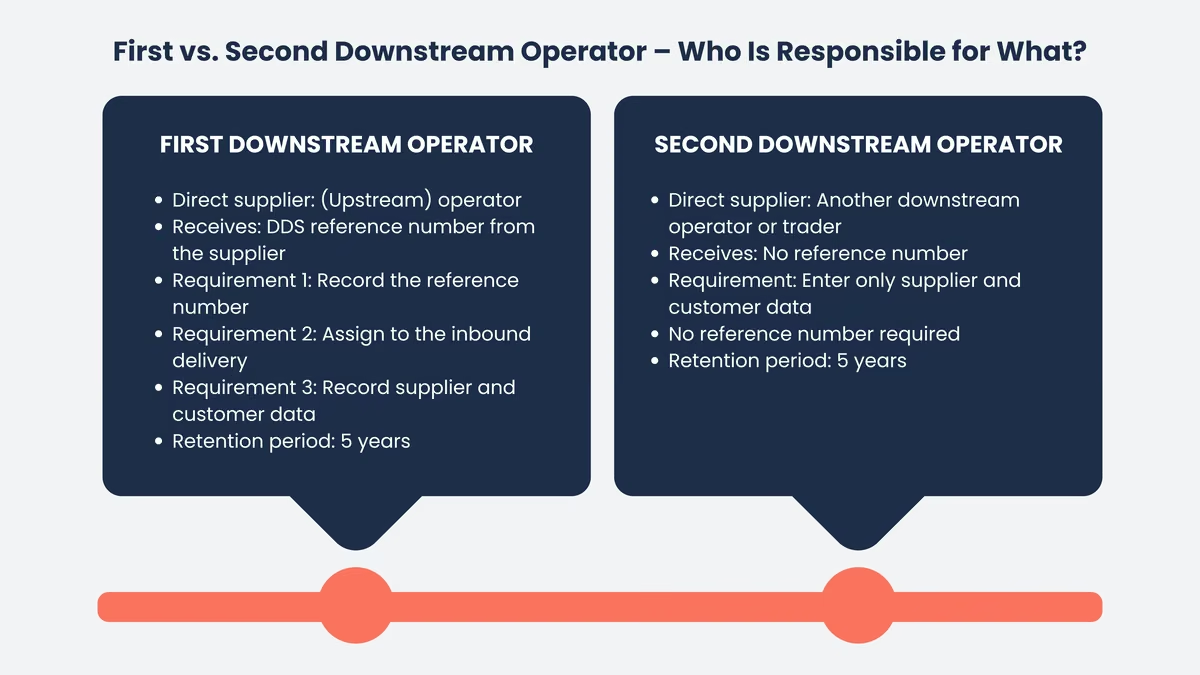
- First downstream operator: who is supplied directly by an (upstream) operator. Mandatory: Record the DDS reference number and assign it to the inbound delivery.
- Second downstream operator (or any other downstream operator in the chain): who is supplied by another downstream operator or trader. Mandatory: only record supplier and customer data, no reference number.
Example from the timber supply chain:
Forest owner A (operator) → chipboard plant B (first downstream) → furniture manufacturer C (second downstream) → dealer D (out of scope, if sold to end customers).
The core obligations of FAQ 3.4 at a glance
FAQ 3.4 structures the obligations into three modules. These apply equally to downstream operators and traders.
Collect information about business partners
The following data must be recorded for each direct supplier and each direct commercial customer:
- Name or registered trade name or trademark
- Postal address
- E-mail address
- Web address (if available)
DDS reference numbers - only for first downstream operators/traders
If the direct supplier is an upstream operator, additional costs are added:
- DDS reference numbers (for operators) or declaration identifiers (for MSPOs with SD)
These must be linked to incoming product flows, not outgoing ones. Storage in a specific system or database is not mandatory. The only decisive factor is that the data can be made available within a reasonable period of time if requested by the authorities.
Why this is a passive duty
This is the central point that FAQ 3.4 (in combination with 3.5) clarifies and which is often misunderstood in practice:
- The downstream operator does not have to proactively ask the supplier whether they are an upstream operator.
- He does not have to actively research his own position in the supply chain.
- The obligation to pass on the reference number lies with the upstream operator (Art. 4(7) EUDR): It proactively passes on the reference number to its direct recipient.
- If the Downstream Operator does not receive a reference number, it may assume in good faith that its supplier is not an Upstream Operator.
- Only if he knows positively that the supplier is an upstream operator and does not comply with his obligation to pass on the product must he withhold the product (Art. 5(1) EUDR).
Note on verification numbers: There is no legal obligation to pass on the verification number along the chain (see FAQ 3.6.1). It can be requested on a voluntary basis if there are substantiated concerns.
Registration in the information system - only for non-SMEs
- Non-SME downstream operators and distributors must register in the EUDR information system (TRACES) before placing on the market/exporting for the first time (Art. 5(2) EUDR).
- SMEs are exempt from registration.
The threshold values of the Accounting Directive 2013/34/EU are decisive, not the Commission's SME recommendation from 2003. Medium-sized companies do not exceed at least two of these three values: € 25 million balance sheet total, € 50 million net turnover, 250 employees.
All your EUDR documentation in one place
From geodata collection to risk assessment to the final due diligence statement: With our software, you can maintain a clear overview of your entire supply chain at all times.
When do these obligations take effect?
Following the recent postponements and the publication of the revised version in the Official Gazette on December 23, 2025, the following schedule applies:
- Non-SMEs (large and medium-sized enterprises): effective December 30, 2026
- Micro and small businesses: effective June 30, 2027
- Special case for EUTR products: Micro and small businesses that were subject to the old EU Timber Regulation (EUTR) will begin compliance as early as December 30, 2026, rather than six months later.
The extra time is not a break: clarifying roles, updating supplier master data, and setting up internal inbound processes usually take longer in practice than the legal review alone.
Retention period: at least five years
All information collected in accordance with Art. 5(3), master data of suppliers and customers as well as DDS reference numbers, if applicable, must be kept for at least five years from the date of placing on the market, making available or export (Art. 5(4) EUDR). Storage in a specific system is not mandatory; only rapid retrievability is required.
Reasonable concerns: reporting obligation for all, verification obligation only for non-SMEs
According to Art. 2(31) EUDR, a "substantiated concern" is a duly substantiated allegation based on objective and verifiable information about infringements of this Regulation that may require action by the competent authorities. A general statement that a company is sourcing "from a risk country" is not sufficient. A concrete chain of reasoning backed up with evidence is required. Find out more about this topic in our blog post on Substantiated Concerns.
What downstream operators must do as soon as they become aware of it
All (including SMEs): Immediately inform the competent authority of the Member State in which the product was placed on the market and the downstream actors supplied. In the case of exports, the authority of the country of production must be informed.
Additionally, only non-SMEs (Art. 5(6) EUDR): Actively verify that due diligence has been properly exercised and that there is no or only a negligible risk. As long as this verification has not been completed, a de facto ban on distribution applies. Possible verification steps:
- Checking the validity of the DDS in the information system
- Evaluation of publicly available annual reports of the upstream operator (Art. 12(3) EUDR)
- Access to audit results (Art. 11(2)(b) EUDR)
- Consultation of the country risk classification (Art. 29(2) EUDR)
- Voluntary request for further information from the supplier
- If none of the above applies: Cooperation with the authorities by naming the upstream supplier
The verification obligation is reactive. It is expressly not a systematic routine check, but an event-driven reaction to specific indications.
Practical examples
Example 1: Chocolate manufacturer (non-SME)
An EU importer imports cocoa beans from a third country (upstream operator), submits the DDS and passes on the reference number to its customer. A chocolate manufacturer (non-SME) processes the beans into chocolate and places them on the market in the EU.
- Role: First Downstream Operator (non-SME)
- Obligations: Record reference number + contact details of the importer, keep for 5 years; registration in the information system; reporting obligation in the event of justified concerns; additional verification obligation in the event of justified concerns.
Example 2: Timber trader (SME)
A small sawmill in a low-risk country (MSPO) submits an SD. A medium-sized timber trader (SME) buys the sawn timber and sells it to a furniture manufacturer in the EU.
- Role: Trader (SME)
- Obligations: Record SD declaration ID + contact details of sawmill and keep for 5 years; no registration; reporting obligation in case of justified concerns; no verification obligation.
Example 3: Double role for processing with subsequent export
A tire manufacturer A imports vulcanized rubber into the EU (upstream operator), processes it into tires and exports part of it.
- When importing rubber: Upstream operator → full due diligence, DDS, reference number in the customs declaration.
- For tire export: Downstream Operator → no new reference number required in the customs declaration; instead, the dedicated TARIC certificate code is sufficient (see FAQ 5.6.1).
The internal transfer of reference numbers is no longer necessary because the operator and downstream functions are combined in the same legal entity.
Special cases that are regularly overlooked
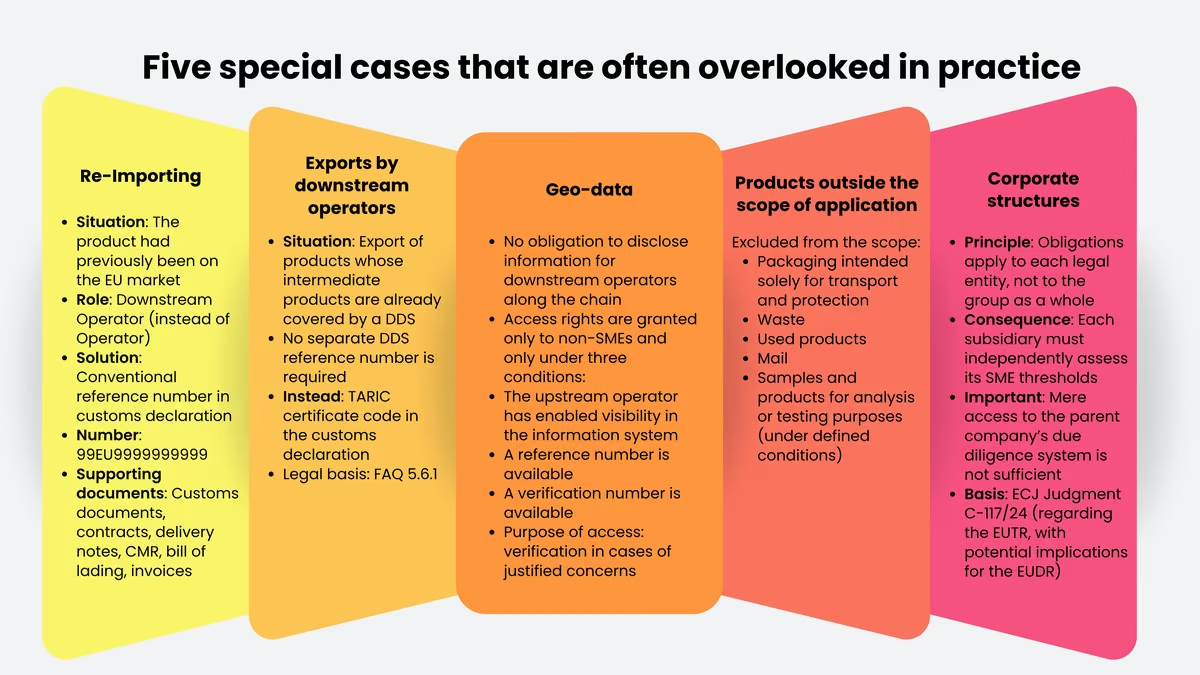
Anyone who re-imports products that were previously demonstrably already on the EU market is considered a downstream operator. In the customs declaration, the conventional reference number 99EU999999999999 can be used instead of a separate DDS. Customs documents, contracts, delivery bills, CMR, Bill of Lading, Air-Way-Bill or invoices serve as proof. If the proof is missing, the full operator obligation applies.
As a rule, no separate DDS reference number needs to be specified when exporting; instead, a dedicated TARIC certificate code is sufficient (FAQ 5.6.1).
Downstream operators are not obliged to pass on geocoordinates along the chain. Non-SMEs can access this data, provided the upstream operator releases it in the information system and they have a reference and verification number, in order to verify it in the event of justified concerns.
The scope includes pure transport and protective packaging, waste and used products, correspondence shipments as well as samples and products for analysis/testing purposes under defined conditions.
Obligations apply per legal entity, not per group. This means that each subsidiary checks its SME thresholds independently. According to ECJ ruling C-117/24 (on the EUTR, with transfer potential to the EUDR), mere access to the parent company's due diligence system is not sufficient.
Risk of sanctions: what happens in the event of violations
The sanctions logic of the EUDR is strict because it uses market access as leverage. Downstream operators and traders are also at risk if they breach their obligations. Art. 25 EUDR provides the member states with a minimum framework:
- Fines for legal entities: statutory maximum of at least 4% of the EU-wide annual turnover of the previous year.
- Confiscation of the products and/or the proceeds generated.
- Temporary exclusion from public contracts and EU funding for up to 12 months.
- In the event of serious infringements: temporary ban on placing on the market.
- Publication of final judgments against legal persons on a Commission list ("naming and shaming").
Added to this is the reputational risk vis-à-vis customers, investors and NGOs - which in practice often outweighs the fine itself.
Set up a concrete inbound process: What to do now
FAQ 3.4 describes the what, not the how. Five steps have proven to be a sensible sequence:
- Clarify my role. Am I an operator, first downstream, second downstream or trader? Do I have dual roles for different product flows? This results in the specific scope of duties.
- Determine SME status. Check thresholds in accordance with the Accounting Directive 2013/34/EU, taking into account the two-year rule and individual group view. Registration and verification obligations depend on this.
- Expand supplier master data. Add mandatory fields in the ERP or supplier system: full address, e-mail, web, and - as a technical field - DDS reference number/explanation ID with link to the incoming product flow (batch, goods receipt document, order number).
- Define the escalation process. Who reacts when a substantiated concern is received? Who informs the competent authority and within what timeframe? Who decides (for non-SMEs) on the temporary halt to distribution during verification?
- Define responsibilities. EUDR inbound affects purchasing, incoming goods, compliance and IT at the same time. Without a clear assignment, the duty remains between the functions.
A practical tip: Purchasing contracts with relevant suppliers should contain EUDR clauses that expressly regulate the disclosure of the DDS reference number. This creates clarity and reduces disputes if an upstream operator does not fulfill its obligation to disclose the DDS reference number under Art. 4(7) EUDR.
Conclusion
The inbound process for downstream operators and retailers is much leaner than an operator's full duty of care - but it is not trivial. Three points are crucial for smooth compliance:
- Clarity about your own role: first downstream, second downstream or trader? SME or non-SME? Almost everything depends on this.
- Clean inbound assignment: Incoming reference numbers must be linked to the associated product stream and be traceable for five years.
- Preparedness for emergencies: In the event of justified concerns, every hour counts - the reporting channels and (for non-SMEs) the verification steps should be defined in advance.
The EU Commission has deliberately minimized the effort for downstream stakeholders with the latest FAQ and guidance clarifications. Anyone who understands the logic of the passive obligation and the first downstream position can set up the process with a manageable use of resources - and at the same time is prepared for a request from the authorities or a substantiated notification.
Frequently asked questions
No. Downstream operators and traders do not submit their own DDS or SD. Their obligation is limited to the collection and storage of business partner data and - as first downstream - the associated reference numbers.
The obligation to pass on the number lies with the upstream operator. If you act in good faith and do not receive a number, you may assume that your supplier is not an upstream operator. If, on the other hand, you know positively that he is one and he does not provide the number, you may not place the product on the market or make it available.
They are not responsible for their collection. Non-SMEs can - with the consent of the upstream operator and the reference/verification number provided - access it in the information system, for example for verification in the event of justified concerns.
At least five years from the date of placing on the market, making available or export (Art. 5(4) EUDR).
Yes, the EUDR is product-related and not origin-related. Anyone who purchases a relevant product from an EU supplier and places it on the market or exports it is a downstream operator or trader and is subject to the information requirements.
No. The collection is a passive obligation. You record the number as soon as you receive it - you do not have to request it.
The first downstream is supplied directly by the upstream operator and must assign its reference number to the incoming delivery. The second downstream is supplied by another downstream operator or trader and has no corresponding reference number obligation - only supplier and customer data.

Matthias Klein
LinkedInESG compliance expert - lawcode GmbH
Matthias Klein advises companies on the implementation of supply chain laws such as the CSDDD and supports the implementation of digital solutions for legally compliant supply chains. His specialist articles on the lawcode blog combine regulatory depth with practical recommendations for action.