
 DE
DE

Important facts
- Are paper products such as disposable aprons subject to EUDR?
- Yes, if they are made of wood and fulfill the relevant CN headings.
- Which CN headings are relevant for paper products?
- Chapters 47 (pulp), 48 (paper and paperboard) and 4818 (hygiene articles). Please note that printed paper and books (HS Chapter 49) were removed from the scope of the EUDR in December 2025 and are therefore no longer subject to reporting.
- Does a product remain EUDR-relevant if it is further processed?
- Yes, as long as the end product is assigned to a listed CN heading, regardless of the processing steps.
- What does this mean for hybrid products made of paper and plastic?
- Hybrid products can be subject to EUDR as long as the tariff classification is as a paper-based product and the paper-based components are made from a relevant raw material such as wood (but not bamboo or rattan)
- Does the reporting obligation no longer apply due to technical processing?
- No. The obligation to declare remains in force as long as the CN heading is recorded.
Executive Summary
The EUDR not onl affects traditional commodity traders, but increasingly also companies in the paper and healthcare industry that place paper products and disposable items such as disposable aprons on the market. The key question is to what extent these products will remain subject to notification under the EUDR.
The EUDR lists seven primary raw materials (including wood) and products made from them as relevant for the reporting obligation. The decisive factor here is the tariff classification according to the Combined Nomenclature (CN). For paper products, the CN headings of chapters 47 (pulp), 48 (paper and paperboard) and 4818 (sanitary articles) are particularly relevant.
The decisive factor is whether the respective intermediate or end product is classified as an Annex I product. Processing steps, such as the production of pulp, paper and further processing into disposable aprons, do not automatically lead to the elimination of the obligation to declare. The customs CN heading of the end product is decisive.
Recommendations for action at a glance
→ Relevance check: Systematically check for each product whether it falls under an EUDR-relevant CN heading.
→ Internal cooperation: Technical, legal and logistics departments must cooperate closely.
→ Documentation: Comprehensive reporting obligation including proof of origin and composition.
→ Customs tariff information: Obtain binding customs tariff information in the event of uncertainties.
Never miss an update on the EUDR again.
New specialist articles, regulatory updates and practical tips, straight to your inbox. Once a week, no spam.
EUDR and raw materials: What counts as a relevant raw material?
Overview of the raw materials listed in the Deforestation Ordinance
The EU Deforestation Regulation (EUDR or Regulation (EU) 2023/1115) links its obligations to certain raw materials and products made from them. Seven relevant raw materials are covered:
- Beef
- Cocoa
- Coffee
- Palm oil
- Soy
- Rubber
- Wood
However, products are not EUDR-relevant simply because they have some connection to these raw materials. The decisive factor is whether they are included in Annex I of the Regulation on specific CN/HS headings and are placed on the EU market, made available on the market or exported from the EU.
Wood in particular is central to paper-based supply chains. Wood is used to produce pulp, paper, cardboard, packaging, hygiene products and numerous disposable medical products. The EUDR is therefore particularly relevant for companies in the paper and healthcare industry.
Would you like to find out more about the EUDR obligations for companies? Click here for our article.
Wood as the basis for paper products
The industrial manufacture of modern paper products is often based on pulp obtained from wood. This is used to make paper, cardboard, paperboard, tissue products, hygiene articles, disposable medical materials and packaging solutions. According to a report by DIE PAPIERINDUSTRIE e.V., around 23 million tons of paper, cardboard and paperboard were produced in Germany in 2021.
The decisive factor for the EUDR test is whether the pulp or cellulose used actually comes from wood. Not every plant-based or wood-like material is automatically "wood" in the sense of the EUDR. Bamboo, rattan or other wood-like materials must therefore be tested separately.
For companies, this means that the material composition must be reliably documented. Supplier declarations, technical data sheets, recipes, material lists and customs documents should be compared with each other. A purely technical product description is often not enough.
Disposable medical devices: precise material and code inspection required
Medical disposables can also be EUDR-relevant. However, it is not their medical use that is decisive, but the combination of raw material, material composition and tariff classification.
Latex gloves may be affected, for example, if they are made of natural rubber and fall under a relevant Annex I heading, such as in the context of ex 4015 for clothing and accessories made of vulcanized rubber. Purely synthetic rubber, on the other hand, is not covered as a relevant raw material within the meaning of the EUDR.
Absorbent pads, surgical drapes or similar disposable materials may be relevant if they are paper- or cellulose-based and fall under a relevant heading of Chapter 48, such as 4818 for certain hygiene and paper products.
The decisive test standard is therefore:
Disposable medical devices are not subject to EUDR across the board. They are only EUDR-relevant if they consist of a relevant raw material, fall under an Annex I heading and no relevant exception applies.
CN heading, "ex" prefix and raw material origin: the central scope check
The tariff classification according to the Combined Nomenclature is the starting point for every EUDR check. The CN heading shows whether a product can in principle fall under the scope of Annex I.
However, it is not always the only decisive factor. Many entries in Annex I have the prefix "ex" in front of the HS/KN code. This prefix means that not all goods within this heading are included, but only the section described in each case.
In practice, this results in a two-stage audit:
- Does the product fall under a relevant HS/KN heading in Annex I?
- Does the product actually consist of the relevant raw material?
In the case of paper products, it is therefore necessary to check whether the pulp or cellulose comes from wood. In the case of rubber products, it must be checked whether natural rubber, in particular from Hevea brasiliensis, is included. In the case of oil palm-based products, it is important to check whether raw materials from Elaeis spp. have been used.
This check is particularly important for hybrid products, coated materials and multilayer medical disposables. A paper-plastic apron may be EUDR-relevant depending on the classification and material composition. A predominantly plastic-based apron, on the other hand, may fall outside the scope.
Exceptions: When products are not EUDR-relevant despite raw material sourcing
Not every product that at first glance consists of a relevant raw material or comes close to a relevant CN heading automatically triggers EUDR obligations. Several exceptions and delimitations are important in practice.
Samples and test products: Samples of low value and small quantity may be excluded if they are only used to initiate orders. Products that are intended solely for examination, analysis or testing and are completely consumed or destroyed in the process are also excluded.
Waste: Waste within the meaning of the Waste Directive 2008/98/EC is generally not covered if the product consists entirely of material that would have completed its life cycle and would otherwise have been disposed of as waste. However, companies should carefully document this classification.
Used and second-hand products: Used and second-hand products must also be considered separately. The decisive factor is whether the product has already gone through a previous life cycle and is not placed on the market as a new relevant product.
Packaging material: A particularly important exception concerns packaging. Disposable packaging and packaging containers that are used exclusively to support, protect or carry another product and are presented together with this product must always be separated.
For reusable packaging materials, this applies from the moment they are actually used for this purpose. However, if packaging is sold or imported as an independent product, the EUDR relevance may be assessed differently.
Marketing and information materials: Correspondence articles and marketing and information materials that accompany another product or are provided free of charge for marketing or information purposes should also be checked separately.
For companies, this means that the CN classification remains the starting point, but must always be supplemented by the specific intended use, the status of the goods and the role of the product in the flow of goods.
Processing steps: When does the EUDR relevance change?
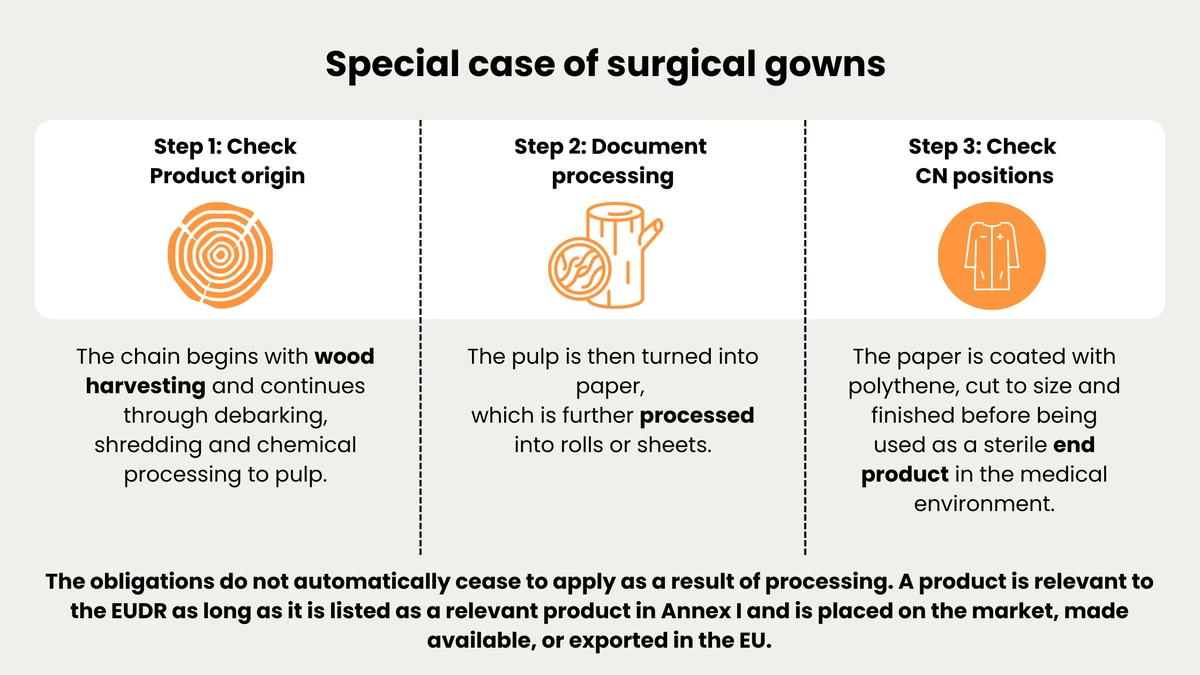
The processing of a relevant raw material does not automatically end EUDR relevance. The decisive factor is whether the resulting intermediate or end product continues to fall under an Annex I item.
A typical example is the processing chain from wood to disposable aprons:
- Timber harvesting
- Debarking and shredding
- Production of pulp
- Processing into paper
- Coating, for example with polyethylene
- Cutting and assembly
- Distribution as a disposable apron or disposable medical product
Each of these steps changes the material technically. Nevertheless, the end product can remain EUDR-relevant if it is classified as an Annex I product for customs purposes and consists of a relevant raw material.
Conversely, if further processing results in a product that is not listed in Annex I, this new product may fall outside the scope, even if it originally contained a relevant raw material.
Example: Paper-based disposable apron
A coated disposable apron can be EUDR-relevant if it is predominantly paper or cellulose-based, the cellulose comes from wood and the apron falls under a relevant CN/HS heading.
The distinction is particularly important for hybrid products made of paper and plastic. The decisive factor is not only which materials are included, but also which material gives the product its character in terms of customs tariffs.
This raises the following questions for companies:
- What materials is the apron made of?
- Does the paper-based portion come from wood?
- Which CN/HS heading was used for import or distribution?
- Is there an "ex" prefix in the relevant Annex I entry?
- Is the product sold as a stand-alone product or only used as packaging or accompanying material?
- What role does the company play in the supply chain?
In case of uncertainty, binding tariff information should be obtained.
Duties according to roles: Who has to do what?
The EUDR distinguishes between different roles in the supply chain. For companies, it is therefore not only product relevance that is decisive, but also the question of whether they are acting as an operator, downstream operator or trader.
First-time importers and exporters
The first operator to place or export a relevant product on the EU market bears the central responsibility for the initial due diligence. This includes, in particular, checking the absence of deforestation, legality, traceability and risk assessment.
Downstream operators and dealers
Under the current simplifications, downstream actors do not have to submit their own due diligence declaration for products that have already been tested upstream. Their obligations focus more on information, storage, registration and verification obligations.
The following are particularly important:
- Collect information about direct suppliers and commercial customers
- Retain relevant information for at least five years
- DDS reference numbers or declaration identifiers document, where relevant
- Inform the competent authorities in the event of justified concerns
- As a non-SME, if there are justified concerns, also check whether the upstream due diligence has been carried out properly
- as a non-SME downstream operator or non-SME trader, observe registration obligations in the information system
It is therefore crucial for companies to determine their role in each supply chain separately. A company may be the first distributor of one product and merely a downstream distributor of another product.
Application dates: When do the EUDR obligations apply?
Companies should include the current application dates in their project planning at an early stage:
- December 30, 2026: large and medium-sized enterprises
- December 30, 2026: Micro and small enterprises, provided their products are already covered by the EU Timber Regulation
- June 30, 2027: Micro and small enterprises for other EUDR products
The EUTR nuance is particularly relevant for paper and wood-based products. Companies should therefore not only check their company size, but also whether their products were already covered by the previous EU Timber Regulation.
Recommendations for action
Companies should check their entire product portfolio for EUDR relevance. It is not enough to just look at obvious raw material products. Processed products such as paper goods, hygiene articles, disposable aprons, surgical drapes, absorbent pads or latex gloves may also be affected.
It should be checked for each product whether it falls under an Annex I item. For entries with an "ex" prefix, it must also be documented whether the product actually consists of the relevant raw material.
Technical data sheets, supplier declarations, formulations, material lists and customs documents should be compared with each other. It is particularly important to differentiate between wood and non-registered wood-like materials and between natural rubber and synthetic rubber.
Samples, test products, waste, used products, second-hand products, accompanying materials and packaging should be assessed in a separate test step. In the case of packaging, the decisive factor is whether it is placed on the market as an independent product or exclusively supports, protects or carries another product.
Companies should determine for each product and each transaction whether they are acting as a first distributor, importer, exporter, downstream operator or distributor. This results in different obligations.
Downstream actors should set up processes to capture and retain relevant supplier data, customer information, DDS reference numbers and declaration identifiers.
In the case of unclear classification, hybrid products or multi-layered materials, binding tariff information can help to create legal certainty.
EUDR compliance is not just a legal issue. Purchasing, product development, quality assurance, customs, logistics, sales and compliance must work closely together. New products should be checked for EUDR relevance before they are launched on the market.
Conclusion
Paper products, disposable aprons and medical disposables can fall under EUDR if they are made from a relevant raw material and are classified under an Annex I heading. Processing steps such as pulp production, paper production, coating or packaging do not automatically result in EUDR relevance ceasing to apply.
The central test logic is: The decisive factor is not the technical degree of processing, but whether the product is to be classified as an Annex I product made from a relevant raw material and no relevant exception applies.
For companies, this means that anyone who manufactures, imports or distributes paper-based products, hybrid materials or disposable medical products should now set up a robust classification, documentation and supplier data management system. Correct CN/HS classification, verification of the "ex" prefix, proof of raw material origin and a clear definition of one's own role in the supply chain are particularly important.
Frequently asked questions
Almost all paper products classified under Chapter 48 of the CN headings fall under the EUDR reporting obligation across all sectors. This includes, for example, copying and printing paper, cardboard, tissue paper, paper bags, labels and napkins. According to the current version of Annex I, products in HS Chapter 49, such as printed paper and books, are no longer covered. Disposable medical products such as aprons and gloves are still relevant as long as they are predominantly made of paper and fall under the corresponding CN headings (e.g. 4818). The exact EUDR relevance ultimately always depends on the applicable CN heading of the product.
Yes, as long as the disposable apron is made of paper material and is therefore classified under a CN heading listed in EUDR Annex I, the EUDR declaration obligation applies. Even after further processing, such as coating with plastic film, the proof of origin of the wood and the full duty of care and documentation remain in place. However, this only applies as long as the customs description does not change to a product group exempt from EUDR.
The EUDR declaration obligation does not apply if the end product can no longer be classified under any of the CN headings listed in Annex I. This may be the case, for example, if it has been completely processed into a plastic product or if it is classified in a chapter that is not covered. However, technical processing steps alone are no guarantee that the obligation no longer applies. In case of doubt, the valid CN classification is decisive, not the technical condition of the material.
Companies that do not fulfill their EUDR obligations risk severe sanctions. These range from administrative offense proceedings to high fines and criminal prosecution. There is also the threat of import bans, product recalls and considerable reputational damage. Compliance with EUDR paper products and adherence to CN positions should therefore be a top priority.
In the event of uncertainties regarding CN classification, it is advisable to obtain binding tariff information from the national customs authorities. This provides a legally secure basis for compliance and reduces the risk of misclassification. Consultations with specialized customs lawyers can also help to correctly carry out complex product classifications and establish suitable due diligence processes.

Alexander Hilmar
LinkedInESG compliance expert - lawcode GmbH
Alexander Hilmar advises companies on the implementation of ESG compliance, sustainable reporting and supports the implementation of digital solutions for legally compliant supply chains. His specialist articles on the lawcode blog combine regulatory depth with practical recommendations for action.