 DE
DE

Important facts
- Does bamboo fall under the EUDR?
- No, bamboo is a woody grass and not a tree. It is therefore not covered by the EUDR timber regulations.
- Which special case occurs in relation to bamboo?
- Material mixtures of bamboo and wood are covered by the regulation.
- Are cardboard and paper packaging covered by the EUDR?
- Paper packaging is exempt from the EUDR if it only serves as packaging or is made from 100% recycled materials.
- Can paper packaging still be affected?
- If they are traded as independent products, they may be affected.
- What recommendations are there for companies?
- Companies should check the exact tariff classification of their materials. Complete documentation of the checks is essential.
- Why should companies check their materials at an early stage?
- Precise classification of materials can reduce compliance costs and minimize liability risks.
Executive Summary
Bamboo and cardboard are among the materials for which the EUDR causes uncertainty in practice. The FAQ version 5 (April 2026) and the draft delegated act (May 2026) now provide explicit clarifications.
Botanically, bamboo is not wood, but a woody grass, and is considered a "non-wood forest product" according to the FAO definition. Pure bamboo products are not subject to the EUDR. In the case of wood-bamboo composite products, only the wood components are subject to due diligence.
Cardboard packaging is exempt if it is used exclusively for support, protection or carrier functions. The delegated act extends this exemption to all packaging materials regardless of the material and to reusable packaging. However, if packaging is placed on the market as an independent commercial product, the EUDR obligations apply. The decisive factor in both cases is the correct customs classification in combination with the actual use function.
→ As a woody grass, bamboo is not subject to the EUDR. In the case of composite products with wood, only the wood components are subject to due diligence.
→ Cardboard packaging is exempt as pure packaging, including non-wooden and reusable packaging. The EUDR obligations apply as an independent commercial product.
→ As lignified grass, bamboo is not subject to the EUDR wood regulations, unless it is a mixed material with wood components that require more detailed material testing.
→ Cardboard packaging is generally exempt as pure packaging or made from recycled material. However, if they are placed on the market as stand-alone commercial goods, EUDR obligations may apply.
Never miss an update on the EUDR again.
New specialist articles, regulatory updates and practical tips, straight to your inbox. Once a week, no spam.
EUDR and the list of raw materials concerned
The central raw materials of the EUDR
The European Deforestation Regulation aims to reduce the risk that products made available in the EU may be associated with global deforestation or forest degradation. The scope of the regulation is defined on the basis of a list of raw materials and their derivatives, which are explicitly listed in Annex I of the EUDR. The main raw materials include soy, beef, palm oil, coffee, cocoa, rubber and, above all, wood. Wood and its derivatives are of particular importance, as they play a fundamental role in numerous products and production processes.
The EUDR lists a large number of specific HS codes (Harmonized System, or CN headings for the customs tariff), which companies can use to check whether their goods are subject to declaration or documentation. For example, in addition to raw timber and construction timber, wood pulp, paper and paper products are also explicitly named with specific customs codes. The clear naming of these codes provides security. But what about products that cannot be clearly subsumed under these categories in practice?
How to deal with materials not explicitly mentioned?
Actual uncertainties arise for companies time and again when the materials used have wood-like properties or are similar in function to other raw materials, but are not explicitly mentioned in the Annex to the EUDR or when their botanical or chemical origin is not clear. This is particularly relevant for substitute materials such as bamboo or composite materials, but also for classic secondary products such as cardboard. The question of whether such materials fall under the EUDR determines whether due diligence obligations, including verification, due diligence declarations and supply chain audits, must be fulfilled. Against this background, this article specifically analyzes the cases of bamboo packaging and cardboard and paper packaging. These are two groups of materials that, for different reasons, regularly trigger the need for audits in business practice.
Ready for the EUDR launch?
With our EUDR module, you can capture geodata, analyze risks, and create due diligence statements digitally and efficiently—instead of wading through spreadsheets.
Case study 1: Bamboo
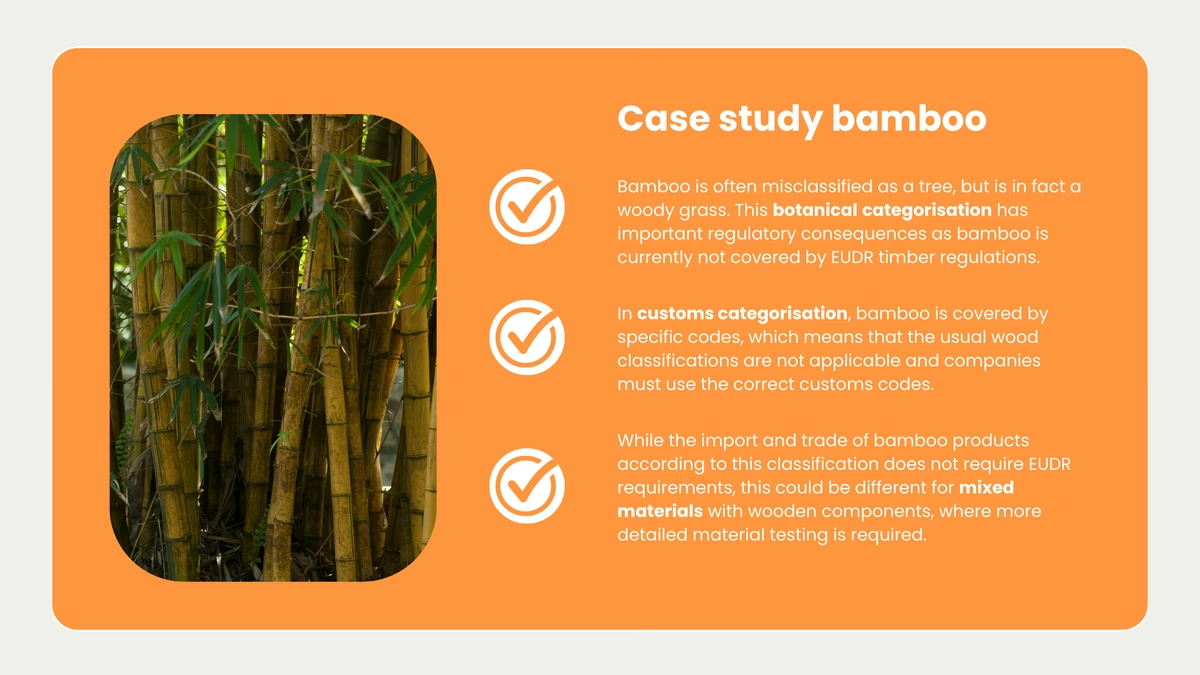
Botanical classification: Bamboo is not a tree
In order to enable the EUDR legal assessment of bamboo, a botanical clarification is first necessary. Botanically speaking, bamboo belongs to the sweet grass family (Poaceae). It is not a tree, but a woody grass that often reaches impressive sizes in tropical and subtropical regions and is of growing importance as a raw material in many branches of industry. Its ecological characteristic of growing quickly and taking up comparatively little space makes bamboo particularly attractive from a sustainability perspective and in bioeconomic cycles. Accordingly, bamboo is particularly in demand as a substitute for wood in areas such as furniture making, construction, packaging and consumer goods.
From a customs tariff perspective: Is bamboo treated like wood?
For the customs assessment, it is necessary to check under which HS heading bamboo and products made from it are classified. In fact, the EU customs tariff differentiates between "wood" (Chapter 44) and other woody plants. Bamboo is usually not part of the wood chapter, but runs under separate codes, for example "bamboo" under HS heading 1401 10. However, depending on the processing and product type, bamboo products can also appear in paper chapters or as finished goods under specific headings.
Although bamboo is sometimes referred to as "wood" due to its similarity to wood, customs law recognizes the botanical differentiation. Accordingly, bamboo is not a classic wood product in the strictest sense of the customs tariff. This tariff differentiation is particularly relevant with regard to the EUDR, as most obligations are explicitly linked to categories of wood defined under customs law.
Consequences for the EUDR
In FAQ version 5 (April 2026, point 2.12), the EU Commission expressly clarified that products made exclusively from bamboo do not fall within the scope of the EUDR. This is based on Article 1(1) EUDR, which only applies to products that contain or are made with Annex I raw materials, and the FAO classification of bamboo as a "non-wood forest product". Bamboo therefore does not fall under the raw material wood in the sense of the EUDR. This applies both to raw bamboo material and to products made from bamboo (e.g. chopping boards, furniture, bamboo parquet or disposable bamboo tableware). According to the current interpretation, companies that import, process or distribute bamboo products are not obliged to comply with the EUDR due diligence obligations for wood products (such as verification of deforestation-free status).
The clarification for composite products is important: According to FAQ 2.12, if a product contains both wood and bamboo components, only the wood components are subject to due diligence. The bamboo components are expressly excluded, even if the end product falls under a wood-related HS code. The decisive factor is therefore not a blanket "resurrection logic", but the specific differentiation according to material proportions. In the case of composite products, companies must document which components originate from wood and fulfill the EUDR due diligence obligations for these, not for the bamboo substrate.
The draft delegated act (as of May 2026) confirms and further expands the clarification on bamboo: in addition to bamboo, rattan, reeds, rushes, willow rod (osier), raffia, cleaned/bleached/dyed cereal straw and lime bark are expressly excluded from the wood scope. The Commission has thus created legal certainty for a whole range of substitute and natural materials that had previously caused uncertainty.
Note on the status: The delegated act is in public consultation until May 2026 (until June 1, 2026) and will only become binding upon publication in the Official Journal of the EU. According to the Commission, there is broad political consensus; companies should prepare their HS code mappings and supplier communications accordingly, but mark the clarifications as "expected" until formal adoption.
Case study 2: Cardboard packaging
HS code 48191000 - what does this mean?
Cardboard boxes and paper packaging are categorized differently in the customs system. Boxes and cartons made of corrugated paper or cardboard, which are primarily used as packaging material for a wide variety of products, are listed under the HS code 48191000. The heading is relevant for importers and producers who use paper packaging of any kind for the packaging, storage and transportation of their goods. With regard to the EUDR in particular, the question arises as to whether paper packaging based on wood is subject to notification or whether it is an exception and remains excluded from the scope of the EUDR.
EUDR logic: paper products and wood raw materials
The EUDR not only covers pure wood or wood-based materials, but also explicitly a range of paper products. This applies in particular to products in Chapter 48 of the customs tariff (paper and cardboard and goods made from them). They are recorded on the basis of clearly named HS codes. For example, certain pulps (CN headings 4701-4706), paper and cardboard products (e.g. CN 4802, 4804, 4806) as well as printed products or semi-finished products made of wood (derivatives) are subject to documentation.
Demarcation under wood, HS code 4415
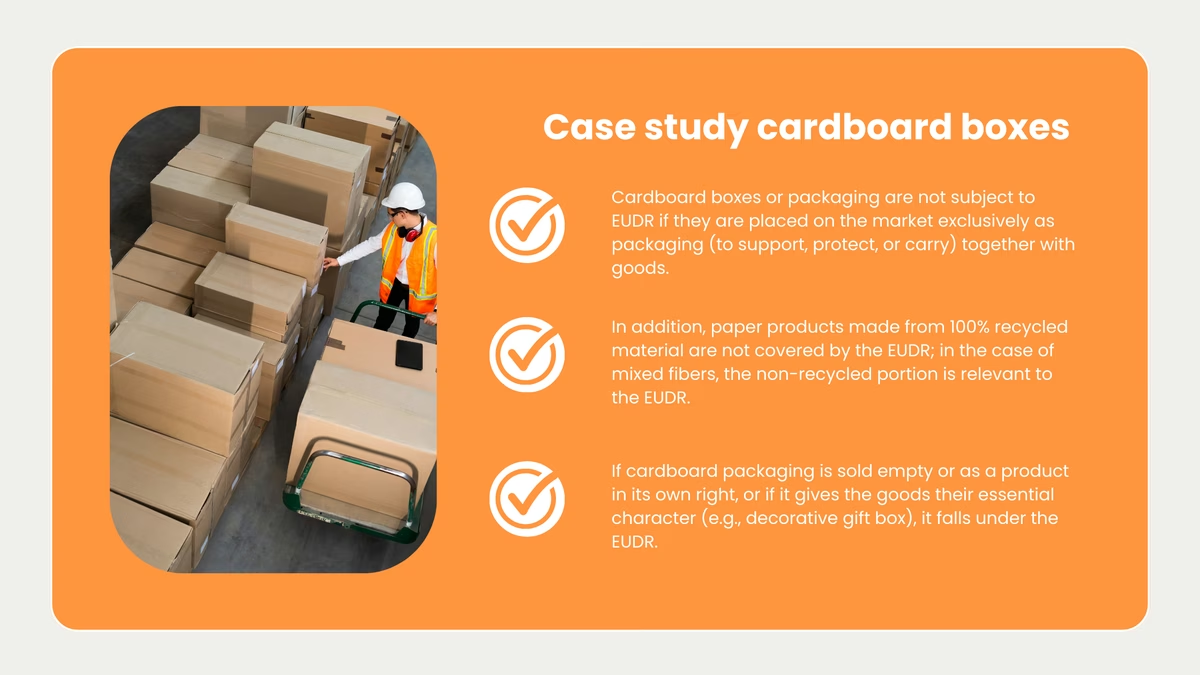
Packaging material that is used exclusively as packaging material to support, protect or carry another product placed on the market is not affected. This exemption originally applied to HS 4415 (wooden packaging). The draft delegated act (May 2026) explicitly extends it to all packaging materials and containers regardless of the material, including cardboard packaging under HS 4819, paper goods and other packaging HS codes. Reusable packaging such as reusable containers or pallet pools also fall out of scope as soon as they are used to protect or carry another product.
The actual function as packaging is decisive. FAQ version 5 (point 2.5) clarifies that it does not matter whether the packaging is shown separately on the invoice. Rather, the decisive factor is whether it would be classified together with the goods in accordance with General Rule 5b of the CN interpretation. Packaging that is typically classified together with the product is considered to be merely a carrier material and therefore EUDR-free.
This exemption is based on the aim of the regulation to primarily protect against deforestation-relevant raw material flows, while packaging material in supply chains is not the focus. However, unpackaged paper goods or paper products as such are regularly covered by the EUDR, provided they belong to the product groups listed in Annex I.
The recycling exemption should also be noted: the Regulation does not apply to goods produced exclusively from material whose life cycle has ended and which would otherwise have been disposed of as waste within the meaning of Article 3(1) of Directive 2008/98/EC.
The clarification in FAQ version 5 (point 2.8) is of practical relevance: Most recycled paper and cardboard contain a small proportion of virgin pulp for fiber reinforcement. In this case, it is not the entire product that is subject to due diligence, but only the non-recycled portion. For this virgin fiber content, geolocation must be carried out back to the area of origin; the person who places the virgin material or the components made from it on the market for the first time is responsible. In practice, this means that pure 100 percent recycled paper products are rare; most cardboard packaging with recycled content is at least partially subject to the EUDR.
Exceptional cases: When packaging can be relevant
However, companies should by no means assume that all cardboard packaging and EUDR paper packaging will remain exempt. In practice, there are several exceptions: If paper packaging is not traded or resold as a mere transport medium, but as a product itself, it may still be subject to the obligation to provide evidence. For example, the import of empty folding boxes under HS code 48191000 as an independent product, regardless of the non-wood-containing goods inside, may require an EUDR inspection.
The decisive factor is the function: packaging that exclusively supports, protects or carries another product is outside the EUDR scope, regardless of the CN/HS code. However, if packaging is provided as an independent product (e.g. empty folding boxes or gift boxes), it is subject to EUDR.
In some cases, it also depends on the type of paper raw materials: If the packaging does not exclusively contain end-of-life/waste material (e.g. mixtures of recyclate and primary fiber), it cannot fall under the recycling or waste exemption, in which case the EUDR obligations apply to the product placed on the market as a good in scope. Another special case exists for products where the packaging represents added value as part of the overall product, such as high-quality gift packaging or designer boxes that are themselves sold as goods. The EUDR can also be relevant here.
A special case of practical relevance is the change of function of packaging. FAQ version 5 (section 2.6) clarifies: If packaging is originally placed on the market as an independent product, such as a new pallet that a manufacturer sells to a production company, it is subject to the full EUDR obligations when it is first placed on the market. However, as soon as the same pallet is only used to carry or protect another product in its subsequent life cycle, it falls outside the scope of the EUDR. The decisive factor for reusable packaging is therefore its current function.
Another special case is repair: if a used pallet is repaired with new wooden components and then sold, the EUDR obligations only apply to the newly added wooden components, not to the original pallet.
Overall, this means an increased compliance effort for companies that come into contact with EUDR cardboard or EUDR paper packaging: for each customs item, they must check separately whether the product is really only used as packaging within the meaning of the EUDR or whether it has the character of goods itself.
Recommendations for companies
Check tariff classification - do not rely on material names
One of the most common sources of error in practice is the hasty classification of raw materials or products based on their common name. For example, bamboo products, in particular bamboo packaging, are often treated as wood products across the board, although they must be considered separately in terms of customs tariff and botanical classification. Companies should therefore always check the exact customs classification of their goods. The CN heading is always decisive, not the colloquial description. Particularly in the case of material mixtures, composite materials or special solutions such as impregnated cardboard packaging, a qualified check is recommended - ideally in close consultation with experienced customs or trade law experts and with the aid of the official nomenclature or binding tariff information. For small and medium-sized enterprises (SMEs) in particular, which do not have their own customs department, advice from external service providers or industry associations can be crucial in order to avoid costly mistakes.
Documentation of the test for later verification
The requirements of the EUDR go beyond mere knowledge of the classification of goods. In the event of liability, the company must be able to prove that it has carried out the correct classification and inspection with sufficient care. Complete, written documentation of every material-specific inspection is therefore essential. Whether it is a specific inventory of the HS codes used, a statement from a tax consultant or official customs information: only clean, documented evidence will protect companies against inspection authorities in the event of a conflict. Particularly in the case of critical materials such as bamboo (due to its proximity to traditional wood) or paper packaging (due to the exemption), every inspection should be recorded in a comprehensible manner.
Communication with suppliers and customs department
The success of effective EUDR compliance management stands and falls with transparent coordination along the supply chain. Companies should ask their suppliers specifically about the origin and composition of materials and, especially in the case of trading companies, obtain the exact customs tariff position and control documents. Internal coordination with the customs department or external service providers also minimizes the risk of incorrect entries in the import declaration. Especially in the case of complex materials or spontaneous market innovations, an interdisciplinary comparison must be ensured.
A practical case illustrates the importance of cooperation: a company was planning to introduce reusable food boxes made of bamboo. However, the customs department did not identify the HS item as wood, but as a product made of woody grass, which meant that there were no EUDR obligations. Without this reconciliation, additional evidence would have been wrongly requested, with additional bureaucratic work and outdated compliance processes.
Tips for implementation
- Check the exact CN heading for each product, ideally with the support of customs or trade law experts, especially in the case of mixed materials or special solutions.
- Keep a written record of every material-specific test, including HS codes, expert opinions or official customs information, so that you can provide complete evidence in the event of a conflict.
- Ask suppliers specifically about the origin and composition of the materials and ensure close internal coordination with the customs department, especially in the case of complex or new materials.
Conclusion
Bamboo and bamboo packaging do not currently fall under the EUDR wood obligations. Cardboard boxes are generally exempt as packaging. However, if they are sold as a separate commodity, EUDR obligations may apply. Treating wood-like materials across the board as subject to EUDR is neither correct nor sensible.
The decisive factor is the CN heading. Companies should check the customs tariff classification of their products at an early stage, ideally during product development or purchasing planning. This avoids unnecessary expense, liability risks and gaps in supplier communication.
Frequently asked questions
According to the current status, bamboo - botanically a woody grass and not a woody plant - and bamboo packaging are generally not subject to the EUDR wood obligations. Bamboo only becomes relevant if a product falls under a CN heading subject to EUDR as a mixture of materials or if an amendment to the regulation regulates this differently in the future.
Paper packaging and cardboard boxes that are used exclusively as packaging for non-wood goods are exempt under the EUDR. However, if cardboard boxes themselves are imported or sold as merchandise (e.g. empty folding boxes under HS code 48191000), the EUDR obligation may apply. A precise examination of the individual case is necessary.
The decisive factor is the customs classification: the CN heading under which the respective product is imported or placed on the market is decisive. Only if this is listed in Annex I of the EUDR and no exception applies is there an obligation to provide proof.
New interpretations or adjustments to the implementing regulation as well as individual clarifications by customs authorities or court rulings are possible. Companies should therefore continuously monitor legislative developments and regularly adapt their processes.
Complete documentation on customs tariff classification, correspondence with suppliers, any information from customs offices and documented risk assessments and due diligence declarations are recommended. In the event of uncertainties or special traps such as bamboo or paper packaging, every inspection should be recorded in order to be optimally prepared for inspections.

Alexander Hilmar
LinkedInESG compliance expert - lawcode GmbH
Alexander Hilmar advises companies on the implementation of ESG compliance, sustainable reporting and supports the implementation of digital solutions for legally compliant supply chains. His specialist articles on the lawcode blog combine regulatory depth with practical recommendations for action.