
 DE
DE

Important facts
- What is the HS code?
- The six-digit HS code is a globally used system for classifying goods in international trade.
- How does the TARIC code differ?
- The TARIC code is based on the eight-digit CN code and adds two more digits. This results in a ten-digit code number. These additional digits indicate EU-specific regulations, such as customs duties, import restrictions, or special obligations like the EUDR when importing into the EU.
- Which HS codes fall under the EUDR?
- The EUDR uses HS and TARIC codes to identify the goods concerned and to ensure due diligence.
- Where can companies find the relevant HS and TARIC codes?
- The EZT-Online and TARIC platforms are central points of contact.
- What is the function of the Y-codes?
- Y-codes provide specific information on exceptions.
- Why is the correct classification of goods important for companies?
- The precise classification of goods using HS and TARIC codes is crucial to ensure smooth import and export.
Executive Summary
The HS code is a six-digit system used worldwide for classifying goods. The EUDR uses it to identify affected goods and their due diligence obligations. The TARIC code extends the HS/CN code to ten digits and reflects additional EU measures applicable to imports—such as customs duties, import restrictions, and regulatory requirements.
It is important to clearly distinguish between these roles: Annex I of the regulation, which lists CN codes, specifies which goods fall under the EUDR. The TARIC, on the other hand, is used in the customs declaration to demonstrate—using C and Y codes—how the EUDR requirement is met in each specific case.
Both codes work together: This is the only way to correctly classify and verify goods and certify them as deforestation-free.
Companies can find HS codes via EZT-Online and TARIC codes in the Commission’s EU Customs Tariff Database; in addition, the EUDR Regulation itself provides information on the relevant codes.
Recommendations for action
→ Regularly check the classification of goods: Systematically check that HS and TARIC numbers are up to date.
→ Establish due diligence processes: Clear internal processes for risk assessment and documentation ensure traceability along the supply chain.
→ Actively involve suppliers: Inform suppliers about EUDR requirements at an early stage and oblige them to provide proof of origin.
→ Use technical expertise: Customs and compliance experts or specialized software solutions help to avoid classification errors.
Never miss an update on the EUDR again.
New specialist articles, regulatory updates and practical tips, straight to your inbox. Once a week, no spam.
Difference between HS codes and TARIC codes
The HS code (Harmonized System) is the internationally recognized classification system of the World Customs Organization (WCO). With six digits, it forms the global basis and ensures that goods can be classified uniformly worldwide. Countries and economic areas build on this and add further digits for their regulatory purposes.
In the EU, the code structure works in three successive steps:
→ Digits 1-6 (HS code): worldwide goods nomenclature of the WCO.
→ Digits 7-8 (CN code, Combined Nomenclature): EU-specific subdivision. It is the basis for all import and export declarations and for intra-Community trade statistics. Annex I of the EUDR also works at this level.
→ Positions 9–10 (TARIC): EU measures such as customs duties, anti-dumping duties, import restrictions, and regulatory requirements such as the EUDR. Combined with the CN code, this results in the 10-digit TARIC code, which is used in the import declaration.
→ Digit 11: national code number for Member State-specific regulations (e.g. national bans or statistical purposes).
Practical consequence: When exporting, the eight-digit commodity code (CN code) is usually sufficient. For imports, the ten-digit code number (CN + TARIC) is given, supplemented in Germany by the eleventh national digit.
Note: Annex I of the EUDR defines at CN level which products are covered. TARIC supplements this information in the customs declaration with specific document codes (C codes) and exception codes (Y codes).
TARIC numbers: A comprehensive overview
The legal basis for the EUDR TARIC codes is Regulation (EEC) No. 2658/87 of July 23, 1987, which governs the EU's customs nomenclature and the Common Customs Tariff.
TARIC harmonizes EU-specific requirements in trade and comprises two main categories of measures:
- Tariff measures determine the level of customs duties, such as those imposed on third countries, tariff quotas, or temporary suspensions of customs duties. In the agricultural sector, there are additional special rules, for example regarding additional duties and price-setting.
- Non-tariff measures are trade policy instruments that are not directly related to tariffs. These include, for example, anti-dumping and countervailing duties, as well as import and export bans on certain countries or goods. The control of sensitive goods is also included—such as CITES goods (protected species), dual-use goods (goods with both civilian and military uses), and luxury goods. Veterinary and phytosanitary controls also ensure that safety standards are met.
Overall, TARIC ensures that all import and export processes comply with EU directives and that integrity and sustainability in international trade are guaranteed.
The structure of HS and TARIC codes using the example of hangers
An example involving wooden hangers illustrates the practical use of these codes. The HS code provides general information about the product category. The TARIC code goes a step further: It specifies exactly which customs duties and trade requirements apply when importing into the EU. Together, these two codes form a system that makes international trade more efficient and regulates it.
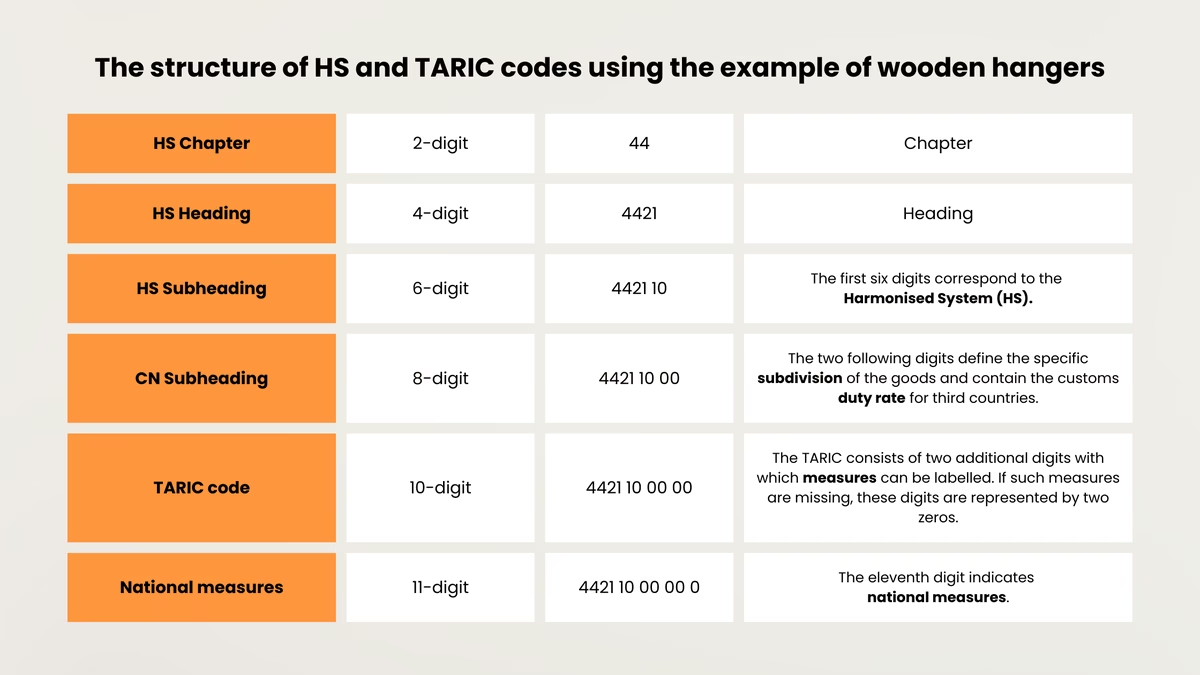
For an import declaration, the ten-digit code number (CN + TARIC) is given; in Germany, an eleventh digit is added for national code numbers. The eight-digit commodity code (CN code) is sufficient for export declarations.
Determination of HS and TARIC codes in the EUDR
The Harmonized System Codes (HS codes) and the TARIC (Integrated Tariff of the European Communities) play a decisive role in the implementation of the EU Regulation on the prevention of deforestation (EUDR). Everything you need to know about the EU Deforestation Regulation can be found here. These codes serve as a basis for the clear identification of product groups that could be affected by the regulation.
HS code change for processing: When do I become a downstream operator?
One issue that is often overlooked in practice concerns companies that further process products with relevant EUDR HS codes. In its updated FAQs (Version 5, FAQ 3.1.1), the European Commission has clarified that a change in the commodity code (HS, CN, or TARIC) results in classification as a downstream operator only if the change affects the items listed in Annex I.
An example from the Commission illustrates the principle: Company A in the EU imports unroasted, undecaffeinated coffee (HS 0901 11) and places it on the market. Company B buys it, roasts it and sells it on (HS 0901 21). A is the operator, B remains the trader, because both codes begin with the same four digits (0901) and only these four digits are listed in Annex I. For chapters HS 47 (wood pulp, paper) and HS 48 (paper, paperboard), only the first two digits match.
In practice, this means that companies should verify with each processing operation whether the new code still belongs to the same Annex I-relevant entries or whether it has been reassigned to a different Annex I entry. Only in the latter case is the company considered a downstream operator. And only then do the corresponding information and record-keeping obligations apply.
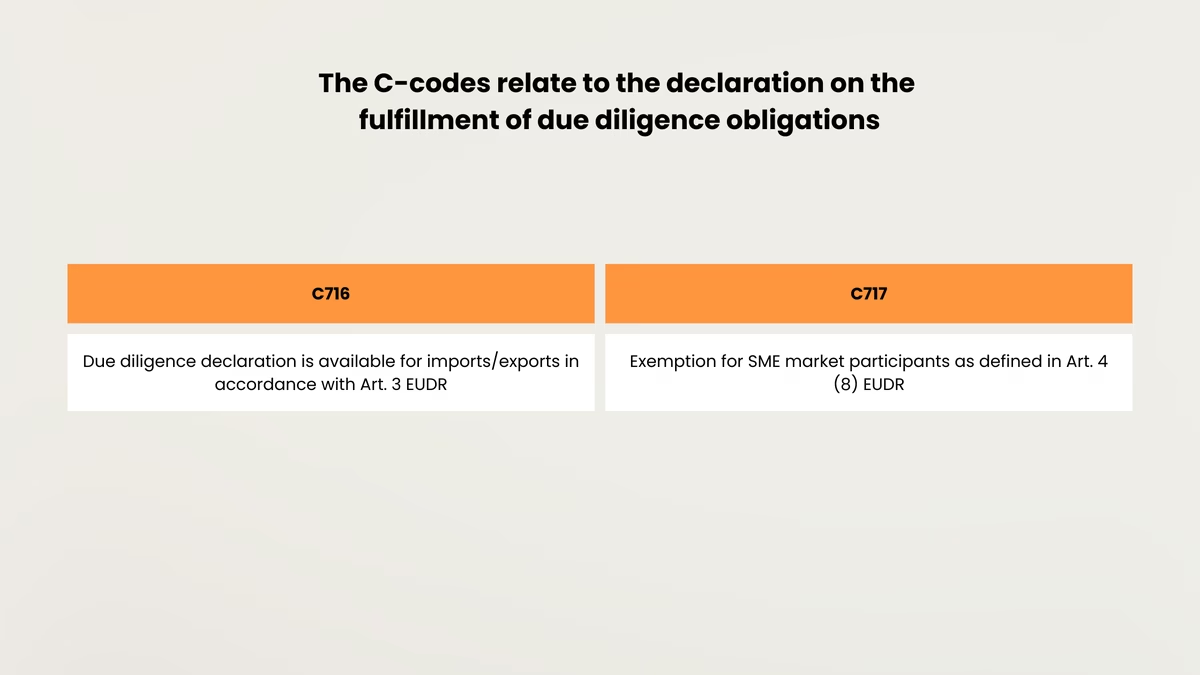
The C-codes relate to the declaration on the fulfillment of due diligence obligations
However, there is a problem: When importing or exporting EUDR-relevant products, the existing TARIC code alone does not indicate whether a due diligence statement is in place. For this reason, the European Commission has introduced new, EUDR-specific TARIC codes. These enable customs authorities to quickly verify whether a product meets the EUDR requirements or not.
TARIC code C716
The TARIC document code C716 is particularly important. It indicates that a due diligence statement is on file and that the product may be placed on the market. In practice, this means that if a due diligence statement is available for a product, both the complete customs tariff number and code C716 must be specified on the customs declaration starting from the date the regulation takes effect. There are specific fields provided in the customs declaration for all this information, including additional details such as the description of the goods.
TARIC code C717
Furthermore, a new TARIC code C717 is introduced, which is relevant for SME market participants that are exempt from due diligence in accordance with Article 4(8) EUDR. In other words, affected SMEs do not have to assume due diligence obligations for already declared relevant products that already comply with the due diligence obligation and for which a due diligence declaration is available. This code must be provided to customs if companies are not required to carry out due diligence on products that are already subject to declaration and for which a due diligence declaration is available. C717 serves as a reference number for the previously submitted due diligence declaration.
The logic following the simplifications at the end of 2025 (once-only approach) is important here. Responsibility for the formal DDS lies in principle with the first operator. According to Art. 4(7) EUDR, the operator is obliged to actively pass on the DDS reference number to the first downstream operator or trader. Downstream operators, on the other hand, do not have to actively inquire about their own role: if they do not receive a reference number from their supplier, they may assume in good faith that the supplier is not an upstream operator (FAQ 3.4 and 3.5). In practice, the collection and storage of reference numbers is primarily the responsibility of the first downstream operator. Further verification obligations only apply if there are substantiated concerns and only for non-SMEs. The DDS verification number does not have to be passed on along the chain by law - it can only be requested on a voluntary basis or in the event of substantiated concerns (FAQ 3.6.1).
The timing of the scope changes is important:
The EUDR Regulation itself was revised at the end of 2025, for example regarding the application deadlines and the “once-only” principle. This was published in the Official Journal on December 23, 2025. Changes to the product scope, however, are being implemented through a separate delegated act. One example is the removal of certain printed matter from Chapter 49 (CN). The current draft (as of May 2026) is not yet final. It is undergoing a public consultation until June 1, 2026, and will only become legally binding upon publication in the Official Journal. For companies, this means: Start preparing the HS code mappings now, but clearly mark the changes as “provisional” until formal adoption.
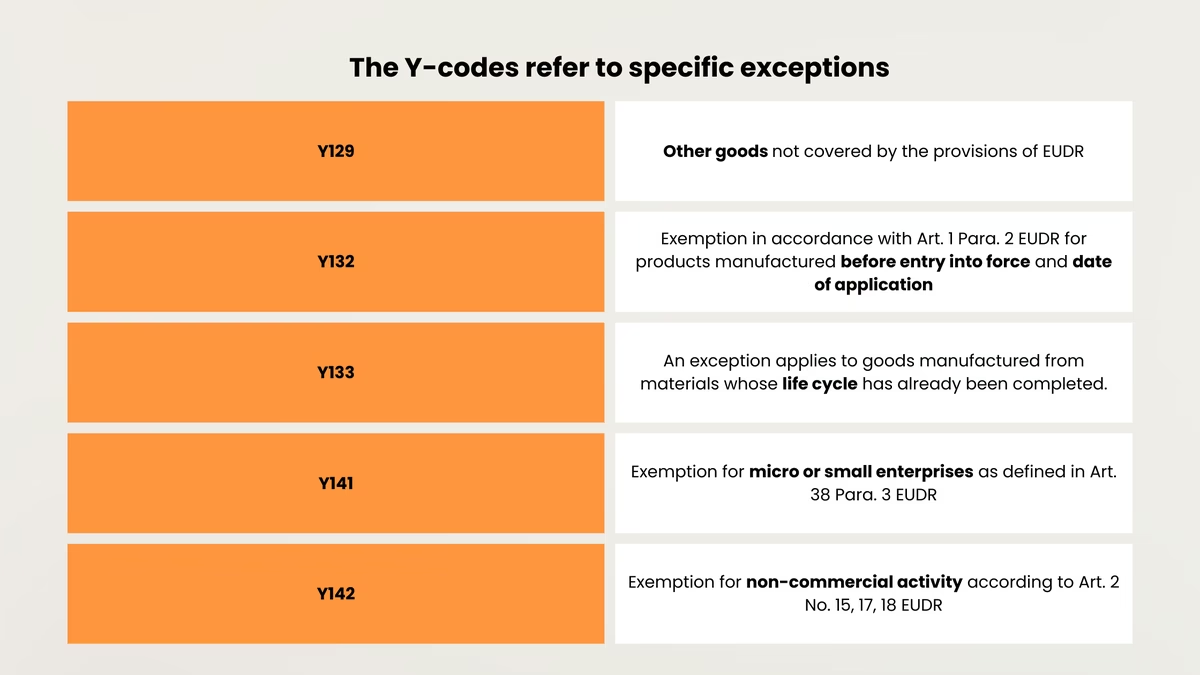
The Y-codes refer to specific exceptions
Y-codes identify exceptions, particularly those that are important for small and medium-sized enterprises (SMEs). They also apply to goods made from materials that have already reached the end of their life cycle, such as recycled materials.
A new TARIC code Y129 has been introduced for the "ex" codes in Annex I of the EUDR. The code refers to the declaration of goods that do not fall within the scope of the Regulation, so-called "ex" products. Here it is necessary for the declarant to be able to indicate that the Regulation does not apply to the import, even if the declared product is assigned to a nomenclature code covered by the EUDR.
To clarify:
The "ex" before the commodity code means that only some of the products with that code are included, not all of them. For example, commodity code 9401 covers seating furniture made of various materials. However, the EUDR applies only to the wooden seating furniture among them.
The TARIC code Y132 refers specifically to Art. 1 para. 2 EUDR. It states that the provisions of the EUDR do not apply to the relevant products listed in Annex I if they were manufactured before the date specified in Art. 38 (1) EUDR, i.e. before the period of validity of the EUDR.
TARIC code Y133 defines an exemption in accordance with the second paragraph of Annex I of the EUDR, according to which the Regulation does not apply to goods made entirely of materials whose life cycle has been completed. These products are considered recycled.
The TARIC code Y141 identifies the transitional arrangement under Article 38 of the EUDR in the customs declaration. Following the adjustment at the end of 2025, two effective dates apply: Large and medium-sized enterprises must comply with the EUDR requirements starting December 30, 2026. Micro and small enterprises (cut-off date for size classification: December 31, 2024, in accordance with Accounting Directive 2013/34/EU) have more time; the key obligations do not apply to them until June 30, 2027. Accordingly, EUDR documentation will be required from them at a later stage in the customs process. An important exception: This exemption does not apply to products that were already covered by the old EU Timber Regulation (EUTR, Regulation 995/2010). In these cases, the EUDR obligations apply uniformly to all companies starting December 30, 2026. Conclusion: Y141 should always be assessed on a case-by-case basis, depending on the product, the company’s specific role, and the current TARIC classification.
The TARIC code Y142 is used in customs declarations when the transaction is not part of a commercial activity—for example, in the case of purely private imports by individuals (consumer-to-consumer transactions). The European Commission clarifies in FAQ 3.16 that products intended exclusively for private use or consumption within the customs territory of the Union do not fall within the scope of the EUDR. Examples include a souvenir brought back from a trip in a quantity typical for household use or a package sent between private individuals from a third country.
The Combined Nomenclature (CN) and TARIC are firmly integrated into the EUDR. This allows for the clear classification of products that may contribute to deforestation. This not only simplifies administration. For companies engaged in international trade, the codes are also indispensable: they enable these companies to determine precisely whether their goods fall under the regulation and what steps are necessary to ensure compliance.
The codes listed are central to risk analysis and the preparation of due diligence statements. Precise categorization helps companies identify risks in their supply chains early on and implement appropriate risk mitigation measures. Knowing and applying the correct codes is therefore an essential component of strategic EUDR compliance.
Note: The correct identification and application of the CN and TARIC codes is a prerequisite for a valid risk analysis and legally compliant due diligence declaration in accordance with EUDR.
Obligation to declare raw materials and end products - What applies when?
The obligation to notify raw materials and end products is a crucial aspect of the EUDR. Above all, the question arises: if a raw material is affected by regulation, does this automatically apply to the resulting end product? The answer is complex and depends on various factors. The obligation to collect and hold reference numbers practically only affects the first downstream operator, as the transfer along the entire chain was explicitly defused at the end of 2025.
An end product becomes EUDR-relevant if it fulfills certain criteria. These include the CN heading, the level of processing and the ex designation of the product. The CN heading, also known as the Combined Nomenclature, is an important factor as it regulates the classification of goods in international trade and helps to determine the regulatory requirements. The level of processing and the ex designation also provide information on the extent to which a product is affected by regulation.
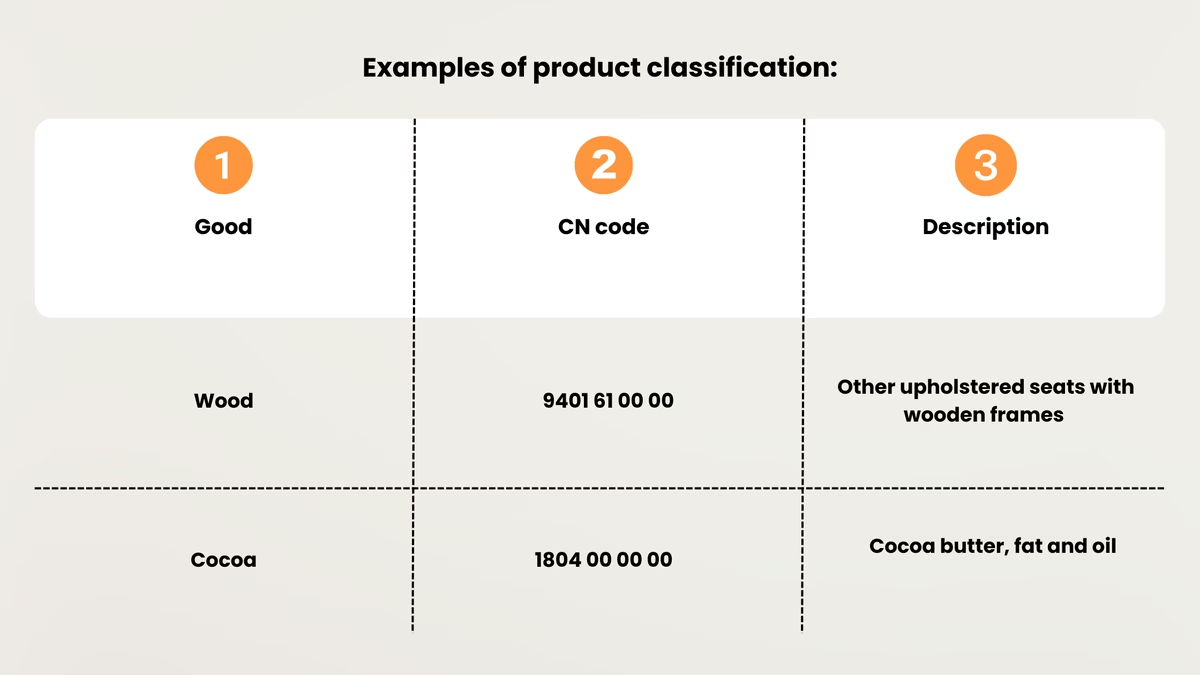
Examples of product classifications are helpful to illustrate this.
Step 1: View Annex I of the EUDR
✔️ The table in Annex I lists the goods according to their classification in the Combined Nomenclature.
Step 2: Determine the CN heading
✔️ Determine the CN codes for the goods concerned in TARIC. For example, Chapter 44 concerns wood and wood products.
Step 3: Check Annex I for ex code in the corresponding category
✔️ Check Annex I for relevant raw material and relevant products. The ex codes must be observed. Example: Tariff code ex9401 includes seating furniture made of different materials, whereby only the wood products are subject to the specific requirements of the EUDR.
Planned changes to the product scope: Delegated act 2026
Under Article 34(1) of the EUDR, the European Commission is authorized to amend Annex I by means of delegated acts.
Update: The legislation was adopted on July 13, 2026. It will now be reviewed by Parliament and the Council for two months and is scheduled to take effect in December 2026. Among other things, it excludes printed matter as well as bovine hides and leather from its scope and adds new products such as instant coffee and certain palm oil derivatives.
Since the regulation takes effect immediately—without a transition period—on the day following its publication, companies should begin preparing their HS code mappings, DDS templates, and supplier communications now.
Substantial scope changes at a glance:
- Inclusion: frozen bovine tongues (ex 0206 21 00), soluble coffee (2101 11 00) and additional palm oil derivatives from oleochemistry (including various alcohols, fatty acids, soap bars and flakes).
- Deletion: Hides, skins and leather of bovine animals (ex 4101, ex 4104, ex 4107) - Reason: low economic leverage of EU actors on upstream suppliers, separate value chains compared to meat.
- Cattle adjustment: ex 0102 replaces 0102 21 / 0102 29 - one collective code, editorial, no scope change.
- Adjustment rubber: ex 4012 90 30 instead of ex 4012 - EUDR obligations for retreaded tires will in future be limited to the new rubber tread, the carcass casing will be removed from the scope.
- Clarification of the "ex" codes for oil palm and rubber: Only products that were actually manufactured from the relevant raw material are included.
There are also technical clarifications, including on waste, used and second-hand products and their components, sample and test products, non-wooden and reusable packaging, marketing and information material and correspondence within the meaning of Regulation (EU) 2015/2446.
Recommendation: Mark the planned codes internally as "expected" and monitor the Commission's FAQ updates and guidance documents. Anyone who is already affected by soluble coffee, frozen beef tongues, palm oil oleochemicals or retreaded tires - or who needs to check whether leather products fall outside their own scope - should actively use the consultation phase to prepare.
Still unsure how to implement the EUDR?
In a no-obligation live demo, we’ll show you step by step how our EUDR module handles geodata collection, risk analysis, and documentation for you—without any Excel chaos.
Mandatory information in the customs declaration: How the codes come together
In practice, compliance is often decided directly at customs. Certain information must be included in the customs declaration for the import or export of EUDR-relevant goods - otherwise the goods will not be released. The prerequisite is that the DDS (or, if applicable, the SD) has been submitted in the EU information system before the customs declaration is submitted and the reference number has been received.
This mandatory information must be included in the application:
- Customs tariff number (incl. TARIC): The ten-digit EU customs tariff number on HS/CN basis, supplemented by TARIC.
- Quantity: in kilograms net weight (without packaging), plus additional unit if applicable.
- Document coding (TARIC document code): indicates to customs that the EUDR requirement has been met (e.g. C716 for "Due diligence declaration available", C717 for SME exemption in accordance with Art. 4(8) EUDR).
- Document number = DDS reference number: The reference number from the EU information system is specified as the document number. Several DDS reference numbers can be combined in one customs declaration.
- Y-codes, if applicable: for exemptions and simplifications (SME constellations, transitional periods, "ex" HS codes from Annex I or products made from recycled material).
What HS code depth must be specified in the DDS?
When creating the DDS or SD, the HS code must be specified to at least the digit level listed in Annex I (FAQ 7.24). It can be extended by up to six digits on a voluntary basis. Example: HS 1201 (soybeans) can be selected; subheadings 1201 10 (seeds) or 1201 90 (other) can be added voluntarily. If Annex I already lists six positions, the declarant cannot switch to a shorter depth.
Special cases:
- Re-import: The conventional reference number 99EU999999999999 can be used instead of a separate DDS for products that were demonstrably previously placed on the EU market and exported. Customs documents, contracts, delivery bills, CMR, Bill of Lading, Air-Way-Bill or invoices can be used as proof.
- Export by a downstream operator: The DDS reference number is omitted here; a dedicated TARIC certificate code is used instead.
Important: The goods will only be released if the coding is complete, including the reference number. If any information is missing, the import or export cannot be processed.
Practical implementation for companies
Companies involved in international trade face a challenge: they must always use correct and up-to-date HS and TARIC codes. Accurate classification of goods is essential for complying with customs regulations and avoiding legal risks. Therefore, companies should regularly review and update these codes.
Cooperation between the customs department, purchasing, and product management plays a key role in this process. Only when these departments communicate regularly can everyone stay up to date and work together to ensure accurate commodity classification. This prevents delays in operations while also ensuring compliance with legal regulations.
To successfully navigate the complexities of tariff classification, companies should ensure that their goods are classified correctly. Practical guidelines and digital tools such as the EU Customs Tariff Database (TARIC) and EZT-Online can help with this. These tools allow goods to be classified precisely and efficiently, making it easier for companies to meet their compliance goals. The Binding Tariff Ruling (vZTA) offers additional legal certainty: Companies can apply to the customs authorities for a binding classification of their goods, which is valid throughout the EU for three years and provides legal certainty in the event of a dispute.
Tips for implementation:
- Check HS and TARIC codes regularly to ensure they are up to date and correct
- Ensure cross-departmental cooperation between customs, purchasing and product management
- Actively use digital tools such as the EU customs tariff database (TARIC) and EZT-Online
- Document and standardize internal processes for classifying goods
Conclusion
Product codes form the basis for EUDR-compliant, transparent supply chains. Errors in classification are risky; they can lead to delayed customs clearance or even import and export bans.
In 2026, companies should keep three things in mind. First, the Delegated Act: It adds products such as instant coffee, frozen beef tongues, and palm oil derivatives, removes others such as hides, skins, and leather, and clarifies some “ex” codes. Second, the correct application of TARIC document codes and Y-codes in the customs declaration, including for re-imports with the reference number 99EU9999999999. Third, the question of whether a company’s own processing steps alter the commodity code at a point relevant to Annex I. Only then does the trader become a downstream operator.
Those who regularly review and update HS, CN, and TARIC codes and document all changes lay the groundwork for audits, transparent reporting, and legally compliant due diligence statements.
Frequently Asked Questions
The relevant HS codes for the Deforestation Regulation (EUDR) are listed in Annex I of the Regulation. They cover seven commodity groups—beef, cocoa, coffee, oil palm, rubber, soy, and timber—as well as products derived from them, such as chocolate, furniture, tires, and paper. Using this list, companies can clearly determine whether a product falls within the scope of the EUDR.
The HS Code (Harmonized System) is an international classification method with six digits that is used worldwide for the systematic classification of goods. Within the EU, two digits are added to the Combined Nomenclature (eight digits). The TARIC code adds two further digits to reflect EU-specific trade protection measures such as customs duties or restrictions. An eleventh digit can include national special features or regulations.
The HS and TARIC codes are crucial for the implementation of the EU regulation to prevent deforestation (EUDR), as they identify the product groups covered by the regulation. The mandatory HS code list of all raw materials and products subject to EUDR can be found in Annex I of the regulation - from cocoa beans and chocolate to furniture, tires and paper. Companies can use this HS code list to clearly check whether a product falls within the scope of the EUDR. New TARIC codes such as C716 and C717 also help to monitor compliance with due diligence obligations and ensure that affected products meet the EUDR requirements.
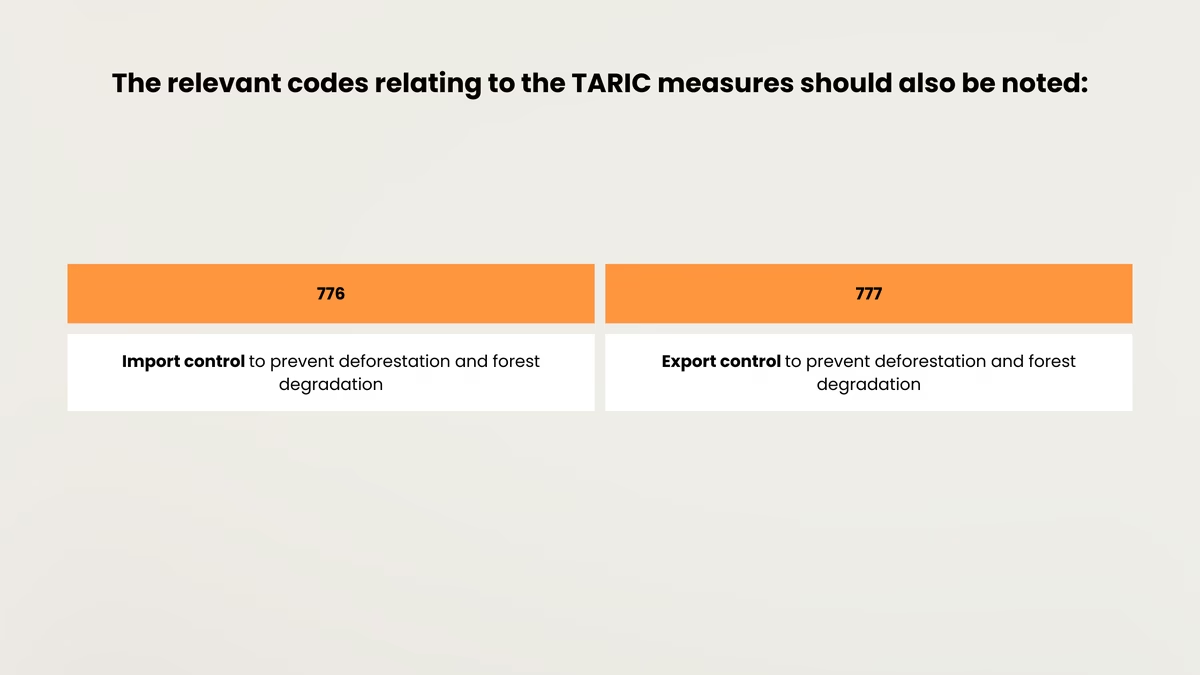
The TARIC code is crucial for import control, as it indicates specific measures such as customs duties and import restrictions. Codes 776 and 777 in the TARIC system are relevant, for example, for import and export controls to prevent deforestation and forest degradation.
C-codes in the TARIC system indicate a product’s declaration of due diligence. Y-codes indicate exceptions. An example: recycled goods. Another example: special rules for small and medium-sized enterprises (SMEs). Both codes help businesses and customs authorities. They demonstrate that EU rules are being followed.
The reporting requirement depends on the classification under the Combined Nomenclature (CN). Raw materials and finished products fall under the EUDR if they meet certain criteria. These include the CN heading, the degree of processing, and the “ex” designation. Companies should carefully review their product specifications. This is the only way to ensure compliance with the EUDR.
Companies should regularly review and update their commodity codes. This ensures compliance with customs regulations and reduces legal risks. Close collaboration between the customs department, procurement, and product management is essential. Online tools help ensure correct classification. Two examples are the EU Customs Tariff Database (TARIC) and EZT-Online. They also facilitate compliance with the EUDR.
The correct use of product codes is essential for EUDR compliance. Companies should establish formal processes for this purpose. These processes regularly review and update classifications. A good documentation system is also helpful. It ensures transparency and traceability, both of which are important for meeting regulatory requirements. Companies should regularly review their internal systems to ensure they are in line with new regulations.

Karim Boukaouche
LinkedInESG compliance expert - lawcode GmbH
Karim Boukaouche advises companies on the implementation of the EU Deforestation Regulation (EUDR) and supports the implementation of digital solutions for legally compliant supply chains. His specialist articles on the lawcode blog combine regulatory depth with practical recommendations for action.