
 DE
DE


Important facts
- Why do composite products pose a particular challenge for EUDR?
- They combine raw materials with different EUDR references; even micro-fractions may be subject to reporting.
- How can companies determine whether a composite product is covered by the EUDR?
- The decisive factor is whether the product falls under a CN heading listed in Annex I and contains a relevant raw material, regardless of its visibility in the end product.
- What is the significance of the Combined Nomenclature (CN) in the EUDR context?
- The CN determines whether a product is fundamentally affected and should be checked regularly against the current CN/TARIC due to annual updates.
- What needs to be considered when testing products with a low raw material content?
- Even the smallest quantities, such as palm oil in a layer of packaging, can be subject to reporting as long as the raw material is identifiable.
- When is the EUDR obligation waived despite the presence of raw materials?
- If the end product does not fall under a relevant CN heading or an exception applies, e.g. production before June 29, 2023.
- What organizational measures help companies with EUDR implementation?
- An interdisciplinary inspection process with clear responsibilities in purchasing, customs and compliance as well as regular product range inspections.
Executive Summary
The EU Deforestation Regulation (EUDR) poses considerable challenges for companies, particularly when it comes to composite products. Such products consist of several materials and often combine different EUDR-relevant raw materials such as wood, cocoa or palm oil, which results in complex supply chains and differentiated testing requirements. The decisive factor for compliance is not just the raw material content, but whether the end product falls under a CN heading listed in Annex I (incl. 'ex' classification) and is therefore considered a relevant product. The Combined Nomenclature (CN) serves as the central classification system here, while 'ex' headings only cover a sub-area of a CN heading and therefore require delimitation via a goods description and, if applicable, TARIC.
To ensure legally compliant classification, companies must establish systematic review processes, starting with the identification of all relevant raw material components, through correct tariff classification to the final assessment of EUDR relevance. Operationally, the processes should also be set up in such a way that the required due diligence declarations (DDS) can be created consistently in the EU information system and referenced internally. Close cooperation between purchasing, product management, customs and compliance is essential here.
Common mistakes such as general assumptions, inaccurate material descriptions or overlooking hidden raw material components can be avoided through structured processes, precise documentation and regular portfolio analyses.
Recommendations for action
→ Check whether the product falls under a CN heading listed in Annex I, including "ex" classifications via goods description and TARIC.
→ Systematically identify all relevant raw material components in the end product, including the smallest quantities of hidden components.
→ Establish a review process with clear responsibilities in purchasing, product management, customs and compliance.
→ Ensure that due diligence declarations are created in the EU information system and referenced internally.
→ Avoid blanket assumptions through precise material descriptions and regular portfolio analyses.
Challenge: Composite products in the context of the EUDR
More and more everyday and capital goods consist of numerous individual components sourced from different raw materials. However, the EU Deforestation Regulation targets specific groups of raw materials, above all wood, cocoa, coffee, soy, palm oil, cattle and rubber, as well as individual products made from these. Composite products break through this categorization as they combine several of these raw materials, sometimes as the main ingredient, sometimes in traceable small quantities or as a component of intermediate products. This leads to special testing requirements for which a suitable solution must be found in order to efficiently meet regulatory requirements.
A great deal of uncertainty arises primarily due to material mixtures and complex international supply chains. Many companies are faced with the task of carrying out a reliable and legally secure assessment for products with a proportion of EUDR-relevant raw materials (such as furniture with wooden frames, packaging with a palm oil coating, chocolate bars with cocoa powder), including the requirement to provide geolocalized proof of the parcels of origin of all relevant raw materials contained in relevant composite products.
In addition, due diligence declarations (DDS), risk analysis and, if applicable, supporting evidence (e.g. audit reports, standards, certificates as information modules) must be available for the above-mentioned processed raw materials in order to guarantee freedom from deforestation. The audit intensity can also vary depending on the country risk classification. At the same time, unclear responsibilities and a lack of transparency in partial supply chains pose additional risks for compliance and EUDR conformity.
The more raw materials a product combines, the more complex the EUDR testing obligations and the more important it is to have systematic, complete traceability back to the parcel of origin.
Basics: Composite products
What are composite products?
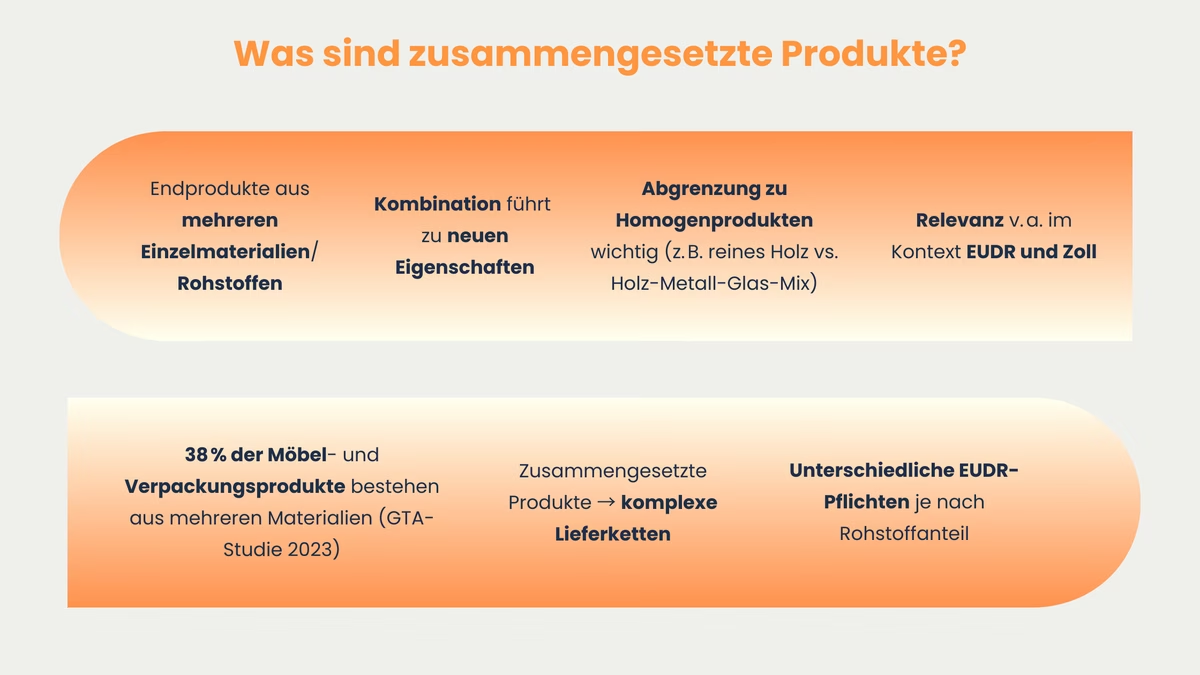
The term "composite products" refers to end products that combine several individual materials. The term 'composite products' is a practical term; the EUDR refers to relevant products that contain or are manufactured with relevant raw materials or products. These composite articles consist of different raw materials that are processed in varying proportions to form a new product. Typically, this combination results in a product with different properties than the sum of its individual parts.
A precise demarcation is essential in the EUDR and customs context: simple homogeneous products such as pure wooden boards or cocoa powder can be clearly demarcated. However, if a cabinet consists of wood, metal and glass, or if packaging contains a laminated layer of palm oil, it is referred to as a composite product.
Typical examples from practice
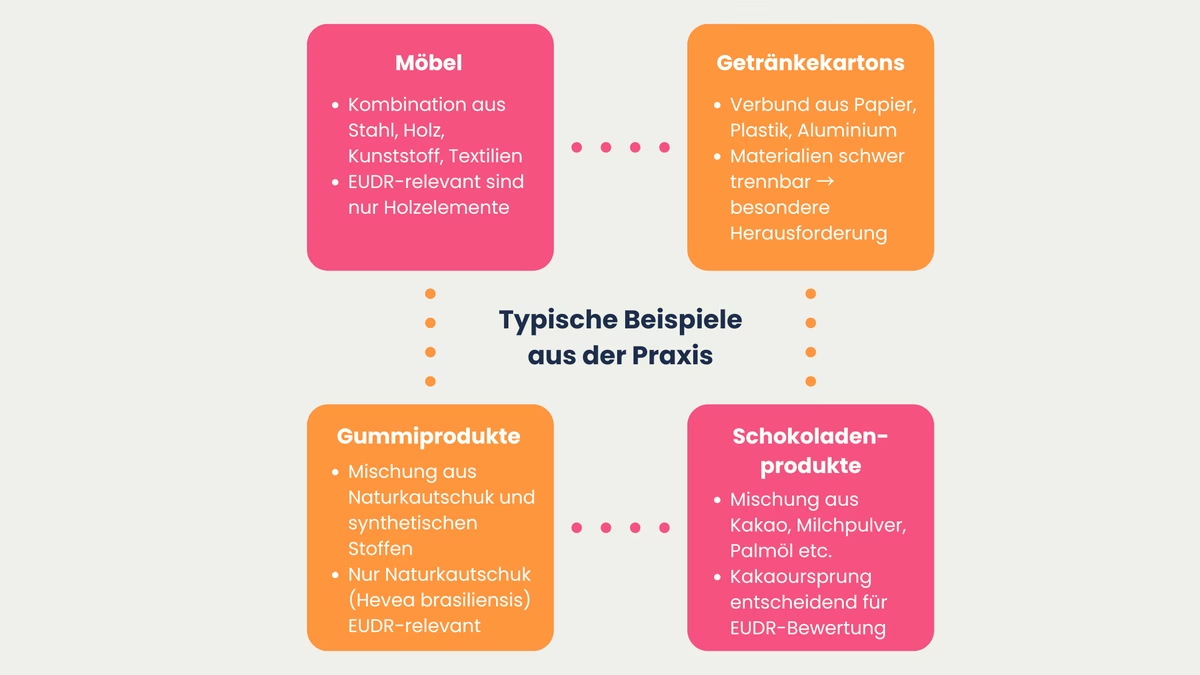
The example of furniture illustrates the complexity particularly well. A piece of seating furniture often consists of a steel structure, wooden panels, plastic upholstery and textile covering. Whether the piece of furniture itself is an EUDR-relevant product is determined by the CN classification according to Annex I (including 'ex' classifications). If the piece of furniture is relevant, the relevant raw materials that it contains or with which it was manufactured must be fully covered, including geolocation of all parcels of origin.
The issue is even clearer in practice with beverage cartons: here, paper (made from wood), plastic (usually from crude oil) and aluminum are processed into a composite that can hardly be separated from one another in terms of quantity. Rubber products with a proportion of natural rubber and synthetic components also give rise to a differentiated examination, as only natural rubber (Hevea brasiliensis; usually CN/HS 4001 or, in the case of derived products, partly 'ex') is covered by EUDR. Important: Packaging is only EUDR-relevant if it is placed on the market as an independent product. Pure transport or protective packaging of another product is generally no longer covered.
In the food industry, the challenge can be seen in chocolate products, for example, in which cocoa powder, cocoa butter, milk powder and various fractions of palm oil are processed together. Although the cocoa content of a chocolate bar usually only accounts for a fraction of the total mass, the raw material origin of the cocoa it contains plays a key role for the EUDR. These so-called composite products often have complex supply chains. Depending on which raw materials are included, different obligations may apply under the EUDR. The prerequisite is that the end product falls under a relevant CN heading (Annex I). In this case, the origin or geolocation of the relevant raw materials used must be documented, even for highly processed formulations.
Whether furniture, beverage cartons or chocolate bars, it is not the raw material content that is decisive, but whether the end product falls under a relevant CN heading: In this case, the origin of each EUDR raw material contained must be proven down to the parcel of origin.
Commodity logic of the EUDR: When does relevance begin?
The EUDR is linked to selected raw materials and the products listed in Annex I. The decisive factor here is not "materiality" or a certain minimum proportion, but the legal classification via the customs tariff number (CN) and the goods description in Annex I. If an end product (including composite products) falls under a listed CN heading, the EUDR obligations apply. The relevant raw materials or products that the product contains or with which it was manufactured must then be mapped for the quantities concerned in the DDS, risk analysis and evidence (deforestation-free and legal).
When is a product EUDR-relevant?
EUDR scope of application: Annex I and CN headings
Whether a product is subject to EUDR compliance is primarily determined by looking at Annex I of the regulation. This Annex lists all the raw materials and associated products concerned on the basis of the Combined Nomenclature (CN headings). Please note: Only products that fall under a listed CN heading are affected at all and are required to provide information. This limits the obligation to check and prevents all complex goods from having to be checked across the board. In the case of items marked "ex", it is also necessary to check which part of the CN heading is actually covered, often via TARIC or subdivisions.
Only products that fall under a CN heading listed in Annex I are subject to EUDR; in the case of "ex" markings, TARIC must also be used to check which specific sub-sector is covered.
Relevance criteria for composite products
For companies that trade in or import composite articles, there are three key criteria for assessing relevance in practice.
- Firstly, the decisive factor is whether an EUDR raw material is explicitly mentioned in the tariff description of the product - for example in the case of "wooden furniture", "cocoa products" or "rubber articles".
- Secondly, the so-called "ex" suffix in Annex I is particularly important. This abbreviation means that only a section of the product group is covered by the regulation, but not the complete CN heading.
- Thirdly, it must be checked whether a chemical transformation has taken place. The EUDR does not recognize a general exemption based solely on chemical transformation. The CN listing in Annex I (incl. 'ex' delimitation) and the use of relevant raw materials/products remain decisive. The EUDR also applies to processed products, regardless of whether the original raw material is still directly recognizable, provided the CN code is listed and the raw material has been used. There is no minimum quantity as a general trigger: the trigger is the listing of the end product in Annex I (CN, where applicable 'ex'/TARIC). The quantity or volumes are then subsequent details in the DDS and verification process.
Examples of typical classification cases
A classic example of practical classification is the export or import of finished furniture with a visible or invisible wood component, such as a veneered shelf. As furniture with wood content is shown in detail in the CN, the reference to the EUDR can often be clearly established, provided that the piece of furniture falls under a commodity code listed in Annex I. In the case of composite wood elements, all parcels of origin of the relevant wood components must be geolocalized.
In the confectionery sector, the decisive factor is whether the end product falls under a CN heading listed in Annex I. There is no general minimum quantity. The abbreviation "ex" indicates that only a part of the respective CN heading is covered.
A distinction must be made for packaging: If the packaging is placed on the market as an independent product, it may - depending on the CN/Annex I listing - be EUDR-relevant. If it is used exclusively to support, protect or carry another product, it is generally not covered by EUDR. In practice, such classification and delimitation issues are often clarified with customs, specialist departments and, where applicable, the competent authorities.
Understanding and correctly using the combined nomenclature (CN)
What is the combined nomenclature?
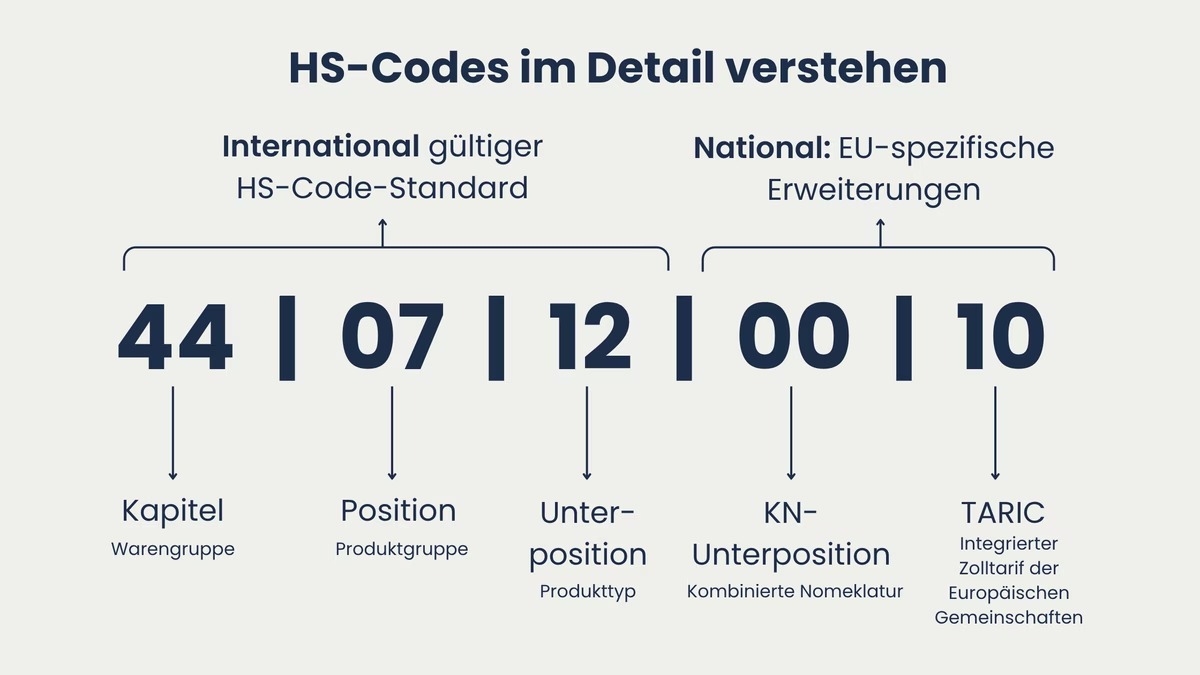
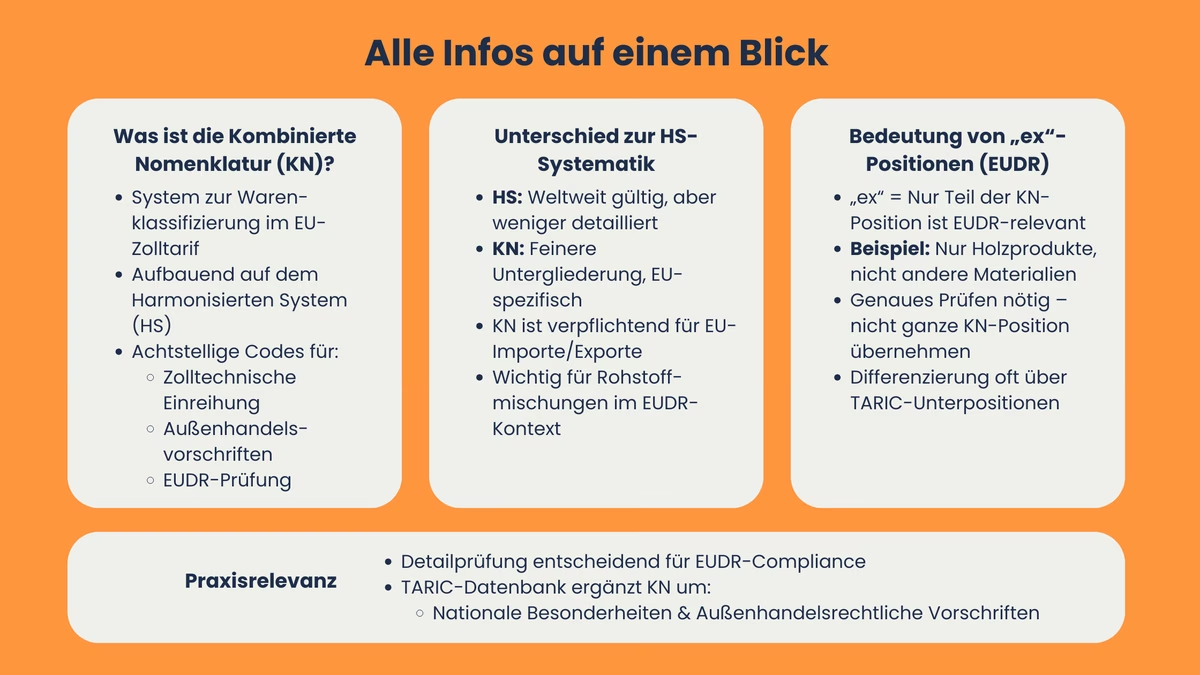
The Combined Nomenclature (CN) is the central system for classifying goods in the EU customs tariff. Based on the globally valid "Harmonized System" (HS), the CN offers a finer subdivision tailored to EU requirements and codes goods according to eight-digit codes. The CN is updated annually (e.g. valid version from January 1, 2026), so CN classifications should be checked regularly against the current version. These are used both for customs classification and as a reference for numerous foreign trade regulations and are at the heart of the EUDR relevance check. For operational delimitation (e.g. for 'ex' items), TARIC is often also used, which supplements the CN with further EU subdivisions.
The Combined Nomenclature (CN) is the central classification system for EUDR testing. As it is updated annually, CN classifications should be checked regularly against the current version.
Difference to the HS code system
Although the HS classification forms the first basis for tariff classification, it is international and therefore often offers a less granular distinction than the EU CN. The latter goes deeper with additional numerical levels and is decisive for tariff classification in the EU customs tariff. This additional level of detail is particularly important in the context of the EUDR: many products consisting of mixtures of raw materials can only be clearly assigned to the regulation based on their CN number.
Meaning of "ex" positions in the EUDR
The term "ex" in Annex I of the EUDR indicates that only part of a CN heading is affected - for example, only products made of wood, but not those made of other materials. This can mean that not the entire CN heading is covered, but only the subheading described in the Annex. Depending on the case, the distinction is made via the goods description and, if necessary, via TARIC subdivisions. At this point, companies must not classify the entire CN heading as EUDR-relevant, but must check exactly which subcategories are affected and how these are mapped in their own product range.
In practice, it is therefore essential to look at the details. The EU's TARIC database expands the Combined Nomenclature to include national characteristics and specific foreign trade regulations - these can also be relevant for EUDR compliance.
Use in practice
The TARIC database is the EU's integrated customs tariff and links the CN with EU-wide measures from customs, trade and agricultural law in order to enable uniform application in all member states. In practice, the applicable CN heading is determined via TARIC - supplemented by tariff explanations/annotations and, if necessary, binding tariff information (BTI) in the event of uncertainty. As the CN is updated annually, CN mappings should be checked regularly against the current version.
It is crucial that the product description is stored clearly and technically correctly in the company's own systems. This forms the basis for legally compliant tariff classification and subsequent documentation. As part of EUDR compliance, it must also be ensured that all relevant product groups are continuously reviewed, especially if supplier structures, material compositions or product portfolios change. The technical documentation should therefore not only accurately reflect the final product, but also the raw material fractions it contains.
Practical test steps and implementation for companies
Systematic review of the EUDR impact
The necessary check as to whether a composite product is subject to the EUDR is carried out in several steps. The first step is to identify the product and all relevant raw material components along the supply chain. The second step is the tariff classification based on the CN and TARIC data. This is followed by a comparison with the listed items in Annex I of the EUDR. Once the end product has been recorded, the EUDR obligations (including geolocalization/legality/risk analysis) apply and a due diligence declaration (DDS) must be filed in the EU information system before the product is placed on the market or exported. However, this serves as preparation, as the obligation to perform further due diligence, in particular documentation, reporting and traceability obligations, only arises once all these verification steps have been completed.
Practical tools and checklists can efficiently support this process. Companies that regularly work with material mixtures should create a database for the standardized classification of their product ranges and integrate automated reconciliation processes with CN and TARIC codes. In addition, companies should align their processes with the EU information system (DDS register) (roles/workflows, reference numbers, interfaces). The amendments of December 2024 and December 2025 also introduced simplifications that can reduce the administrative burden for certain downstream actors in particular - the data and cooperation obligations in the supply chain nevertheless remain central.
Organize collaboration within the company
Especially in the case of composite products, an isolated approach by individual departments is rarely expedient. Instead, interdisciplinary cooperation should be established. Purchasing provides information on the primary product and suppliers, while product management knows the composition and can document changes. The customs department is an expert in correct tariff classification and can identify risks within the framework of the EUDR. Finally, the legal or compliance department checks compliance with due diligence obligations and provides information on appropriate documentation and communication with authorities. It is best to set up an internal review process in which responsibilities and review deadlines are clearly defined - for example, through an internal compliance board or a regular coordination meeting for new products or changes to the product range.
Avoid typical mistakes
A common mistake in practice is the basic assumption that every raw material component in a product makes the entire end product EUDR-relevant. In reality, however, the CN heading and Annex I comparison must always be considered together before a notification obligation is assumed. Blanket assessments, for example on the basis of parts lists or rough material descriptions, should therefore be avoided. The relevance of "hidden" raw material components is also often underestimated: In many cases, EUDR raw materials are only indirectly present, for example as an adhesive component, coating or in auxiliary materials.
Special care is required here: The trigger is the Annex I/KN relevance of the end product, not the 'visibility' of individual components. Once the product has been recorded, indirect raw material components, insofar as they fall under the EUDR logic, must also be mapped in the data and verification process.
Conclusion
The EUDR check for composite products stands and falls with the correct CN classification according to Annex I, including "ex" classifications via TARIC. As the CN is updated annually, regular mapping against the current version is essential.
Companies should carry out a structured portfolio analysis at an early stage, prioritize EUDR-relevant product groups and carry out a reassessment in the event of changes to the product range or suppliers. Due diligence declarations must be consistently stored in the EU information system and referenced internally in a traceable manner.
Complete documentation of all tariff classification decisions and risk assessments is not only mandatory, but also provides effective protection in the event of inspections by customs and market surveillance authorities.
Frequently asked questions
The EUDR obligation only applies if the product falls under one of the CN headings listed in Annex I, which relates to one of the seven relevant raw materials. For composite products, the CN classification according to Annex I (incl. 'ex' delimitation) is decisive. Whether the raw material is mentioned in the description text can be an indication, but is not mandatory.
The HS code provides the basic international classification of goods, while the CN codes are the EU-specific classification system based on this, with a greater level of detail. Classification according to CN/Annex I is decisive for the EUDR. In practice, TARIC is often also used for clarification (especially for 'ex' items).
Companies must check at least the position of the listed CN number and the specific product specification. In case of uncertainty, it is advisable to consult with the customs authority or obtain binding tariff information. It is important to document the classification decision and the underlying product description in such a way that it can be consistently verified later for DDS/authority audits.
Particularly in complex supply chains with multiple production steps, manufacturing stages and material mixtures, it is crucial to obtain comprehensive information from the entire chain. Anyone acting as an importer remains responsible for the complete documentation of all relevant raw material components. Any market participant placing a relevant product on the EU market for the first time or exporting it remains responsible for the full due diligence declaration and the underlying information, even if data originates from sub-suppliers.

Matthias Klein
LinkedInESG-Compliance Experte · lawcode GmbH
Matthias Klein berät Unternehmen bei der Umsetzung von Supply Chain Gesetzen wie der CSDDD und begleitet die Implementierung digitaler Lösungen für rechtssichere Lieferketten. Seine Fachbeiträge auf dem lawcode Blog verbinden regulatorische Tiefe mit praxisnahen Handlungsempfehlungen.