
 DE
DE


Important facts
- What constitutes "correspondence" within the meaning of the EUDR?
- Correspondence is individualized, written messages for personal or business communication. The decisive factors are individualization and purpose, not the paper itself.
- Which paper products are covered by the correspondence exemption?
- Individually addressed communication items are covered, whereby the classification is based on purpose and distribution and enclosed EUDR-relevant products may nevertheless be subject to notification.
- Do brochures, flyers or advertising material count as correspondence?
- No, as they are not individualized and are distributed en masse. In addition, their EUDR relevance has depended heavily on the customs tariff number since the end of 2025 (HS 49 mostly outside, HS 48 still covered).
- What is the main difference between correspondence and advertising material?
- Correspondence is individualized and is used for direct communication with a specific recipient. Advertising material is standardized, distributed en masse and serves marketing or sales purposes.
- How is the legal allocation made within the company?
- Check the purpose and distribution (individualized = correspondence, standardized = advertising material) and then clarify the customs tariff number.
Executive Summary
The EUDR obliges companies to classify paper products correctly. The correspondence exception is central to this: individualized communications such as letters or invoices are exempt from the obligation to provide evidence. However, mass-distributed advertising materials such as flyers or brochures are not, provided they fall under the relevant CN headings (in particular HS 47/48).
The differentiation is based on the main purpose (communication vs. advertising) and type of distribution (individualized vs. mass). Companies should classify their products according to these criteria, store them in the ERP system and closely interlink compliance, marketing and sales. Incorrect classifications can have significant regulatory consequences. Continuous monitoring and, if necessary, specialist advice are therefore recommended.
EUDR and the derogation: What does "correspondence" mean?
Legal basis and CN classification
With the EUDR (Regulation (EU) 2023/1115), the European Union has created a binding legal framework to keep products on the EU internal market free from deforestation and forest degradation. The products affected include wood and products made from it. The regulation imposes strict due diligence requirements for the import, marketing and use of these products.
Since the revision at the end of 2025, many printed products under Chapter/HS 49 have also been excluded from the EUDR scope of application. The correct CN classification therefore remains decisive (in particular delimitation 48 vs. 49).
Of particular importance here is the classification according to the customs tariff (CN code, Combined Nomenclature). Paper products are technically and legally differentiated according to their intended use and form. According to Annex I of the EUDR, pulp and paper of Chapters 47 and 48 of the Combined Nomenclature are affected, with the exception of bamboo-based and recovered products (waste and scrap).
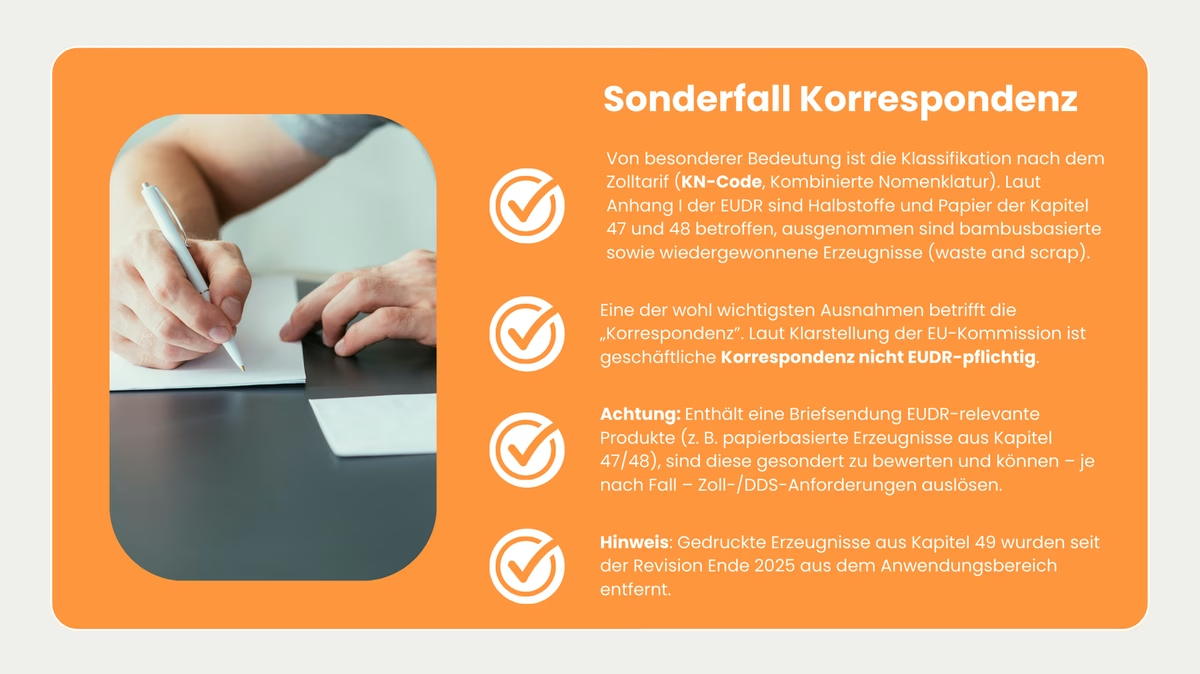
One of the most important exceptions probably relates to "correspondence". According to the EU Commission 's clarification, business correspondence is not subject to EUDR (2.13). Letters are used exclusively for communication within the EU. In accordance with Article 1(26) and Article 141(2) of Delegated Regulation (EU) 2015/2446 to the Union Customs Code, "letters" are not subject to the customs declaration obligation and therefore not subject to the obligation to submit a DDS reference number. Even within the EU, such letter consignments are not placed on the market or made available, but are used for communication purposes.
It should be noted that relevant products contained in letter consignments (e.g. in an envelope) cannot be considered as "letter consignments" and may therefore be subject to customs declaration and the presentation of a DDS reference number.
This means that enclosures to the letters are covered by the EUDR, provided they are relevant raw materials and products as defined in Annex I.
The legislator is thus drawing on the established customs tariff classification system, which defines the term "correspondence" narrowly but clearly. The pragmatic implementation for companies lies in correctly assigning the paper goods concerned to their customs tariff and documenting the respective intended use.
What is classic correspondence?
In the context of the EUDR, "traditional correspondence" refers to all documents whose main purpose is personal or business communication with a specific or individualized person or organization. Examples include business letters, invoices, offers, confidential communications, medical letters, official notifications or personal cards and invitations. As a rule, these are documents created exclusively for a specific recipient, which are sent in the form of letters or cards or handed over personally.
Last but not least, the criterion of individualization is essential. The correspondence contains references to the addressee, is not distributed identically en masse and has correspondingly personalized elements. Technically, there is often an address field, an individual salutation or relevant additional information. In addition to traditional paper letters, cover letters, administrative documents and official forms are also considered correspondence in most cases if they are personalized accordingly.
Background to the exception
The exemption for correspondence articles in the EUDR has its origins in the European legislator's desire to avoid unnecessarily burdening the functionality and efficiency of business and personal communication with additional regulatory obligations. Written communications that are directly related to the recipient and are mostly used in original work, business or legal transactions should remain exempt from deforestation regulation.
Nevertheless, a blanket inclusion in the scope of the EUDR would entail a large administrative burden. Authorities and companies would be forced to provide proof of the supply chain of the paper used for every document - even for the smallest items of mail such as invitations, invoices or personal letters. The exemption would therefore reduce the burden on communication and administration without jeopardizing the main objective of the EUDR - the reduction of deforestation.
Since the revision at the end of 2025, many printed products (Chapter/HS 49) have been excluded from the scope of application. The correspondence exemption nevertheless remains relevant, particularly for communication consignments and paper-based products, which continue to fall under Chapter 47/48.
Differentiation from advertising material: flyers, brochures and co.
Definition of advertising material in the context of the EUDR
While "correspondence" in the EUDR context refers to individualized messages with a communication purpose, "advertising material" describes standardized, identical and mass-distributed printed materials such as flyers, catalogs, brochures, product brochures, trade fair newspapers or advertising supplements. Such printed materials are regularly aimed at a broad target group and primarily pursue advertising, informative or promotional purposes. The correspondence exception does not generally apply here because the main purpose is not individual communication with a specific recipient.
However, since the revision at the end of 2025, the scope of application (Annex I/KN scope) must first be checked for legal classification: Many classic printed advertising materials are classified as "printed products" in Chapter/KN 49 for tariff purposes (e.g. CN 4901, CN 4911). These items have been removed from Annex I as a result of the amendment to the EUDR and are therefore no longer subject to EUDR. However, paper-based products that continue to fall under Chapter 47/48 (e.g. certain paper and cardboard goods such as labels or packaging components, depending on the specific CN classification) remain EUDR-relevant. The decisive factor is therefore not just the term "advertising material", but the correct CN classification and - if the product is still in scope - the main purpose (communication vs. advertising/public relations).
Advertising material ≠ Correspondence: the legal and substantive difference
The core difference between advertising material and correspondence lies on the one hand in the distribution (targeted at individuals versus the general public) and on the other hand in the purpose (individual communication versus promotional, marketing-related information). However, since the revision at the end of 2025, an additional first step is crucial for the legal assessment in the EUDR context: First of all, it must be checked whether the respective printed or paper product falls within the scope of application (Annex I) at all, which is mainly done via the CN classification. Many classic printed advertising materials (e.g. flyers, brochures, catalogs) are often classified as "printed products" in Chapter/KN 49 for tariff purposes and are no longer relevant to Annex I as a result of the amendment to the EUDR. However, EUDR obligations may still apply if advertising materials fall under Chapter/KN 47/48 as paper-based products (e.g. certain labels, labels or packaging components, depending on the specific classification).
If the Annex I scope applies, the following still applies: The correspondence exception generally does not apply to advertising material (marketing/publicity purpose, standardized content, mass distribution). Correspondence items that are individually addressed and primarily intended for personal or internal communication are not classified as advertising material; however, it should be noted that enclosed EUDR-relevant products in the envelope may have to be assessed separately.
Practical examples:
- A company sends invoices with individually listed services - this is correspondence and is typically not treated as a flow of goods.
- A company places EUDR-relevant paper-based advertising materials on the market for the first time (e.g. labels or printed packaging components under Chapter 48 - depending on the CN classification). If Annex I is applicable, the EUDR obligations apply here because the main purpose and distribution are advertising/marketing-related and not individual communication.
Typical practical examples in comparison
Specific practical examples help to clarify the distinction between correspondence and advertising material within the EUDR framework:
- A craft business sends individual offers, project descriptions and order confirmations to its customers. Each document explicitly refers to a specific recipient and their order by date, address and content. Such documents are typically considered correspondence and are not treated as a flow of goods.
- The situation is different in cases where paper-based advertising materials continue to fall under Chapter/KN 47/48 (e.g. certain labels, labels or printed packaging components, depending on the CN classification). If such products are placed on the market for the first time and are primarily used for marketing or sales purposes, the correspondence exception does not apply; if Annex I is relevant, EUDR obligations may be triggered.
- It becomes difficult in borderline cases, such as information letters of an explanatory nature. An energy supplier informs all customers about tariff changes in a standardized message. Although the content is largely identical and only the address data differs, this is often still classified as correspondence in practice; however, the assessment may depend on the practice of the authorities in individual cases. The following also applies: If a correspondence item contains EUDR-relevant products (e.g. enclosures), these must be assessed separately.
Recommendations for companies
Classification of paper products in the portfolio
For companies with a wide range of paper products, the precise classification of individual items with regard to the EUDR correspondence exemption is of central importance. First of all, it is advisable to take a comprehensive inventory of all paper products used in the portfolio: Which products are mainly used as correspondence, which are used for marketing or promotional purposes, and which fall into hybrid categories?
In the next step, each product should be analyzed according to its main purpose, mode of distribution and actual use. Products that are regularly sent to individuals, partners or authorities on an individualized basis should be clearly assigned to correspondence. For products with identical content and mass distribution (e.g. advertising brochures, trade fair flyers or mailing campaigns), classification as advertising material is generally EUDR-compliant.
Establishment of clear classifications in the ERP/merchandise management system
To minimize the risk of incorrect declarations, it is advisable to firmly anchor the defined product classification in the ERP or merchandise management system. A merchandise management system is a specialized system for managing the movement of goods. Whereas an ERP system (Enterprise Resource Planning) is a more comprehensive solution for planning and controlling all company resources. The integration of unique features for classification and tariff codes enables the automated assignment of individual products to the categories "correspondence" and "advertising material" as defined by the EUDR. This facilitates both internal compliance checks and subsequent documentation for customs or inspection authorities.
Practical example: A wholesaler implements a mandatory field in its merchandise management system to specify the primary intended use for each paper item. Only products with a clearly personalized shipping route can be booked as correspondence. For promotional products, the proof with the EUDR-relevant supply chain information is automatically triggered.
Regular training of the responsible department heads and an annual review of the classified product groups also offer additional security. In the case of complex product portfolios, a regular comparison with current customs or compliance law assessments should be carried out.
Cooperation between compliance, marketing and sales
The successful implementation of the EUDR exemption for correspondence products requires close cooperation between the compliance/legal department, marketing and sales. While compliance management ensures the legal classification, marketing is responsible for the correct description and labeling of products. Finally, the sales department knows the actual use cases in the market.
A smooth exchange in the form of internal coordination rounds, joint development of decision-making aids and a central list of questions helps to eliminate ambiguities. For new or hybrid paper products in particular, it is advisable to establish joint workshops in order to avoid uncertainties and keep the internal workflow lean.
The appointment of a central EUDR officer, who acts as a central point of contact for all questions relating to the classification and categorization of paper products, has also proven its worth here. Companies with international locations should ensure that local particularities are taken into account in the national implementation of the EUDR.
Conclusion
Traditional correspondence such as letters or invoices are generally exempt from EUDR verification requirements. For paper-based bulk products, the following applies since the revision at the end of 2025: CN classification and Annex I relevance are decisive, as many printed products (CN 49) have been removed from the scope. Paper-based products under CN 47/48 may still be covered.
The criteria of CN classification, intended use and type of distribution must be clearly documented, as incorrect classifications significantly increase the compliance risk. Companies should integrate classification processes into ERP systems, train interdisciplinary teams and consolidate internal checklists now and continuously compare them with regulatory developments.
Frequently asked questions
The EUDR defines correspondence as all individualized written messages that are exchanged between specific senders and recipients - such as letters, invoices, personal invitations or internal business documents. Advertising material, on the other hand, includes mass-distributed printed materials with the same content that primarily serve the purpose of advertising, information or public relations - including flyers, brochures or leaflets. Only the former is excluded.
The classification is based on the main purpose of the product and its actual use. If the product uses personalized content, is tailored to a specific addressee and is not distributed en masse, it counts as correspondence. Advertising material that is used in large quantities and with identical content generally falls under the EUDR obligation to provide evidence.
For advertising materials that are placed on the market in the EU for the first time, companies must provide complete proof of origin on the basis of the EUDR. This includes supply chain declarations, guarantees of origin for the wood or pulp used and, where applicable, certificates of sustainable forestry. The documents must be able to be presented to the authorities on request.
The decisive factor is individualization and intended use. Digitally printed mailings that are customized in terms of content and sent specifically to individual addressees are generally considered correspondence. Mass mailings that are only personalized with a name field but are otherwise identical are classified as advertising material.
In the case of products that cannot be clearly categorized (e.g. informative letters with a simultaneous advertising character), a careful case-by-case examination is required. Companies should document all bases for decision-making, consult (customs) legal advice in case of doubt and ensure transparency in the delimitation. This will help to avoid potential liability and verification difficulties under the EUDR.

Matthias Klein
LinkedInESG-Compliance Experte · lawcode GmbH
Matthias Klein berät Unternehmen bei der Umsetzung von Supply Chain Gesetzen wie der CSDDD und begleitet die Implementierung digitaler Lösungen für rechtssichere Lieferketten. Seine Fachbeiträge auf dem lawcode Blog verbinden regulatorische Tiefe mit praxisnahen Handlungsempfehlungen.