 DE
DE

Important facts
- What is the circular economy?
- The circular economy is an economic model that keeps materials and products in circulation for as long as possible through reuse, repair and recycling instead of disposing of them after a single use.
- What are the central goals?
- Minimize raw material consumption, avoid waste and maximize the service life of products.
- Why is it so important?
- Earth Overshoot Day 2025 already fell on July 24. Humanity is consuming the Earth's natural resources 80% faster than ecosystems can regenerate them.
- What economic advantages does it offer?
- Companies benefit from less dependence on raw materials, new business models and cost savings.
- What is the political framework?
- Binding standards have been set with the National Circular Economy Strategy (NKWS) and the EU Action Plan.
- What are the biggest challenges?
- Technological hurdles in recycling, high investment costs for companies and a profound cultural change in consumer and production habits are slowing down implementation.
Abstract
The circular economy replaces the linear "take - make - dispose" model with a system that keeps materials and products in circulation for as long as possible. Instead of consuming resources once, the focus is on reuse, repair and recycling. The aim is to structurally avoid waste before it is produced. The urgency of this change is measurable: Earth Overshoot Day in 2025 was already reached on July 24, and for Germany as early as May 3, 2025.
For companies, the circular economy offers far more than ecological responsibility. Reduced dependence on raw materials, new business models and greater customer loyalty are tangible economic benefits. The potential for value creation is predicted to be up to 12 billion euros per year and around 120,000 new jobs for Germany alone.
The political framework is in place: The National Circular Economy Strategy (NKWS) and the EU Action Plan, including the Ecodesign Regulation, digital product passport and right to repair, are creating binding standards that will accelerate the transition. However, the transition will only succeed if companies, politicians and consumers work together.
Definition, relevance and objectives
Definition and basic principles
The circular economy is much more than just a sustainability trend. It represents a fundamental rethink in the way we manufacture, use and treat products at the end of their life.
Brief definition: The circular economy is an economic model that aims to keep resources in circulation for as long as possible, for example by sharing, leasing, reusing, repairing, refurbishing and recycling.
Essentially, it is about preserving the value of materials and products in the long term instead of disposing of them after a single use. As long as resources circulate within the economic system, they continue to generate added value without consuming new raw materials.
What that means in concrete terms:
- Share & lease: Products are not sold, but offered as a service or shared
- Reuse: Products and components are reused in their original form
- Repair & refurbish: defective or obsolete products are repaired instead of replaced
- Recycle: Materials are fed back into the production cycle at the end of their life cycle
This approach is in direct contrast to the so-called throwaway economy, in which large quantities of resources are used for short-lived products and then end up as waste.
Remember: In the circular economy, there is no such thing as "waste" in the traditional sense. What is no longer needed becomes the raw material for something new.
The model is also becoming increasingly relevant from a business perspective. As part of the CSRD reporting obligations, the circular economy is a central element of the ESRS E5 standard (resource use and circular economy): Material use, waste rates, recycling practices and product design thus become relevant for measurement, control and reporting. Internationally, implementation is supportedby standards such as ISO 59004:2024, which provides companies with specific guidelines for implementing circular principles.
Differentiation from the linear economy
To really understand the circular economy, it is worth taking a look at the model that is supposed to replace it: the linear economy. The linear model follows a simple but problematic three-step process: take → make → dispose (take - make - dispose)
Raw materials are extracted, processed into products, used and then thrown away. The finite nature of the resources consumed in this process is largely ignored in this system. The result: growing quantities of waste, increasing dependence on raw materials and a growing burden on people and the environment.
A first step in the right direction: the 3R model
In response to this problem, the 3R model was introduced, which is an important but ultimately inadequate approach:
- Reduce: Reduce resource consumption through more efficient production and use
- Reuse: reusing products that still work instead of throwing them away
- Recycle: Processing materials and returning them to the production cycle
The 3R model improves the linear economy, but does not solve its fundamental problems. Recycling, for example, is often energy-intensive and leads to so-called "downcycling". Materials can only be used for inferior applications and gradually lose quality and value.
The key difference is that while the 3R model attempts to mitigate the damage of the linear economy retrospectively, the circular economy aims to eliminate waste and pollution from the outset through a fundamentally rethought system, not just reduce it.
In concrete terms, this means that products are designed from the outset in such a way that they can be completely dismantled after use and their materials reused. In this model, waste is not an unavoidable by-product, but a design flaw that needs to be avoided right from the planning stage.
Raw material consumption and planetary boundaries
We live on a planet with finite resources and operate as if the opposite were true. Global consumption of raw materials has multiplied in recent decades, driven by a growing world population, increasing prosperity and an economy based on continuous growth. In 2022 alone, every European consumed an average of 14.9 tons of raw materials per person, per year.
The consequences of this consumption are far-reaching:
→ Destruction of natural habitats through mining and extraction
→ Loss of biodiversity in resource-rich regions
→ Growing dependence on imports, often from just a few supplier countries
→ Price fluctuations and supply risks for critical raw materials
The problem is particularly evident with so-called critical raw materials. These are materials that are indispensable for the energy transition and modern technologies, but whose availability is severely limited. The forecasts for EU demand are alarming: while demand for rare earths will increase six-fold by 2030 and seven-fold by 2050, the figures for lithium are even more drastic. Here, a twelve-fold increase is expected by 2030 and even a twenty-one-fold increase by 2050.
Europe is currently heavily dependent on imports for many of these raw materials, often from just one third country. Crises such as the COVID-19 pandemic have shown how vulnerable these dependencies can make us.
This is where the circular economy comes in: By keeping raw materials in the cycle rather than consuming them, the need for newly mined primary raw materials can be significantly reduced, thereby reducing both the environmental impact and strategic dependence on third countries.
Earth Overshoot Day: When the earth goes into debt
Earth Overshoot Day marks the day in the calendar year on which humanity has consumed more natural resources than the Earth can regenerate in an entire year. Everything consumed after this date is literally at the expense of future generations. In 2025, this day was already reached on July 24. This means that humanity is living in ecological "overdraft" for more than five months.
The Country Overshoot Day, the country-specific value that shows how soon the annual budget would be exhausted if the entire world population were to follow the consumption habits of a particular country, is even more specific. For Germany, this day fell on May 3, 2025, i.e. after just four months. This year it is one day earlier, on May 2, 2026.
The good news is that this trend is not irreversible. The consistent implementation of circular economy principles, recycling, reuse and sustainable production methods can demonstrably postpone Earth Overshoot Day.
Plastic waste: the most visible symbol of the throwaway society
Plastic waste is one of the most visible and pressing environmental problems of our time. Millions of tons of plastic are produced worldwide every year. A significant proportion of this ends up in the environment, with particularly devastating consequences for marine ecosystems and the species that live in them.
However, the problem does not start with recycling, but with the product itself:
- Many plastic products are designed as disposable items from the outset
- Packaging, films and everyday objects have a useful life of minutes - but a residence time in the environment of hundreds of years
- Once in the environment, plastic breaks down into microplastics, which accumulate throughout the food chain
The circular economy is rethinking plastics: instead of relying on disposable products, it is promoting reusable alternatives, circular packaging design and closed-loop recycling systems. The aim is to keep plastics in the economic cycle for the long term and reduce their impact on the environment to zero.
Objectives of the circular economy
Circular Economy pursues concrete, measurable goals that combine ecological necessity with economic rationality. At its core, it is about creating an economic system that grows not despite, but through sustainability. Ecological responsibility and economic success are not mutually exclusive in the circular economy - they are mutually dependent.
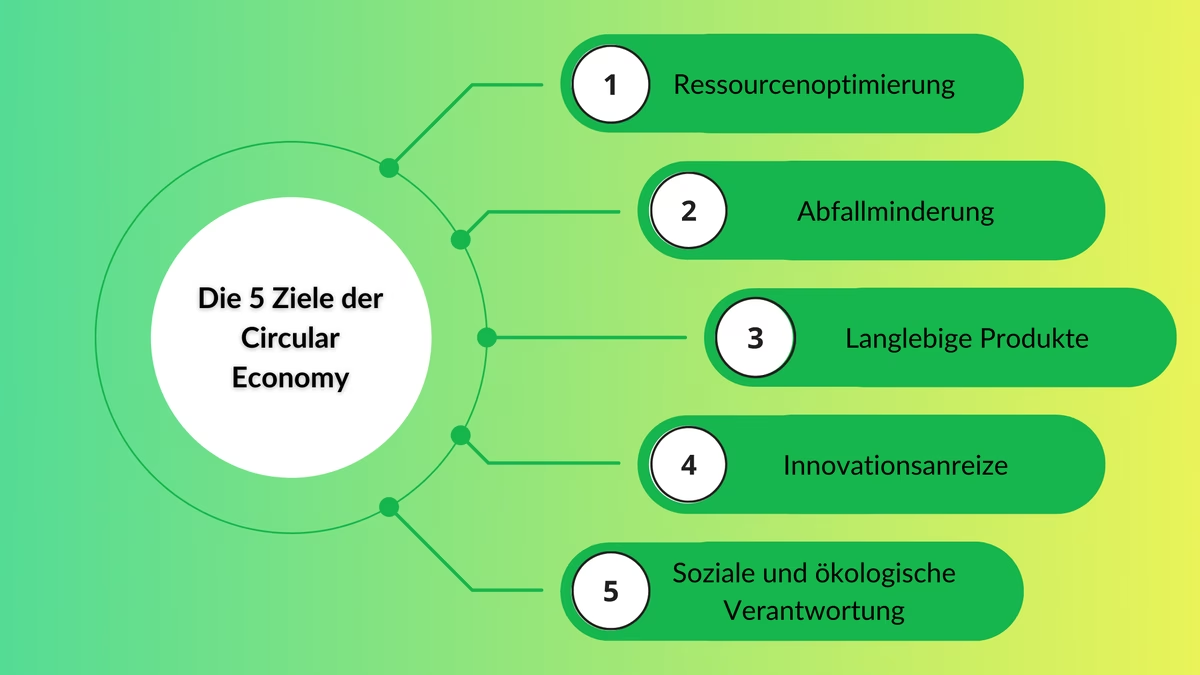
Goals at a glance
The overarching goal of the circular economy is to maximize efficiency in the use of resources. Materials should be kept in the system for as long as possible, for example through recycling, upcycling and reuse. This not only reduces the environmental impact, but also reduces dependence on imported raw materials and makes companies more resilient to price fluctuations and supply bottlenecks.
In the circular economy, waste is not an unavoidable by-product, but a design flaw. Innovative product design - repairable, dismantlable, recyclable - prevents waste at source. At the same time, this opens up economic opportunities: new business models for repair, processing and recycling are emerging where previously only disposal costs were incurred.
Another key objective is to extend the service life of products. More robust, modular and easily repairable products remain in use for longer and thus actively counteract the widespread practice of planned obsolescence. For companies, this means that those who focus on longevity gain customer confidence and build a lasting reputation for quality.
The circular economy is a powerful driver of innovation. It challenges companies to develop technologies and processes that are both ecologically and economically beneficial. This creates new markets, new professional fields and strengthens international competitiveness in a global economy that increasingly relies on sustainable practices.
The economic potential is considerable: for Germany alone, estimates predict an annual increase in gross value added of up to 12 billion euros and the creation of around 120,000 new jobs as a result of the transition to a circular economy.
The fifth goal goes beyond pure efficiency gains: the circular economy promotes a fundamental rethink among companies and consumers alike. Decisions are no longer made solely on the basis of short-term profitability, but also in terms of their impact on the environment and society. The result is an economic system that is not only more efficient, but also fairer and more sustainable.
How does the circular economy work?
The 10 R strategies at a glance
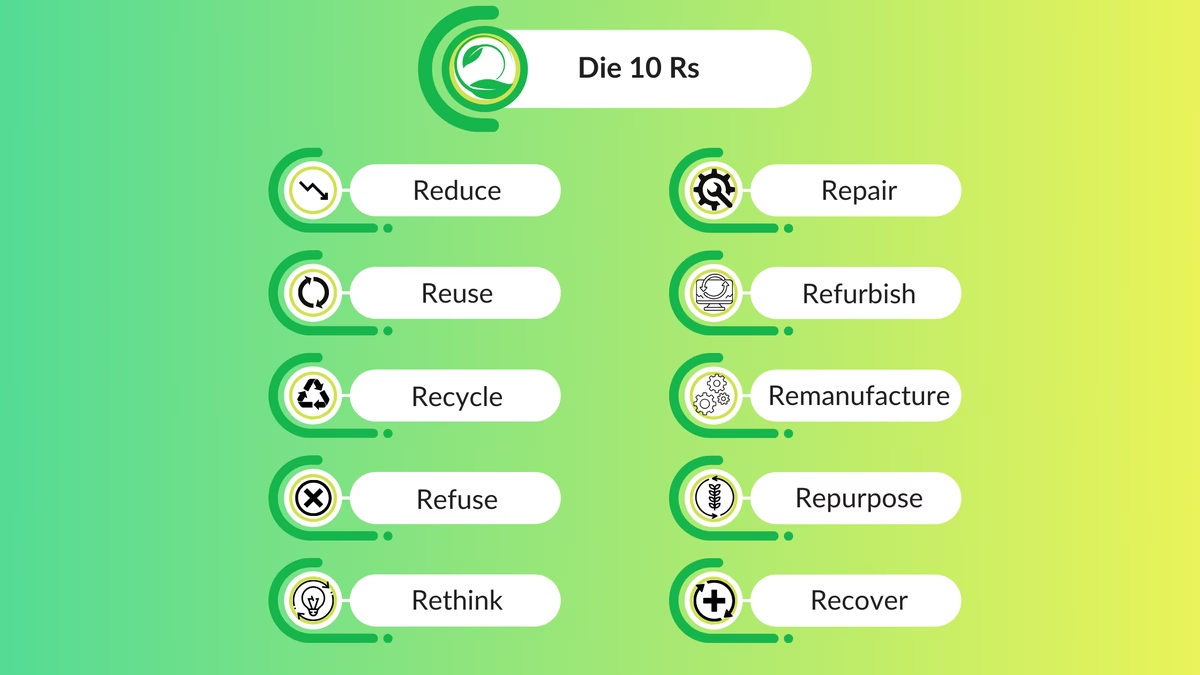
The circular economy is not a single concept, but a toolbox of ten strategies, the so-called 10 Rs. They form the core of the circular economy and show specifically how materials and products can be kept in the economic cycle for as long as possible.
Basic principle: The earlier a strategy starts, i.e. the higher up the list, the more value is retained and the lower the environmental impact.
The 10 Rs can be divided into three superordinate groups:
- Refuse: Actively avoid overconsumption, for example through product innovations or more conscious purchasing decisions
- Rethink: Fundamentally questioning and redesigning usage habits and production processes
- Reduce: Reduce the use of materials to a minimum through more efficient production and use
- Reuse: reusing products in perfect condition without modifying them
- Repair: Repair and maintain defective or damaged products instead of replacing them
- Refurbish: refurbish discarded products and make them fit for further use
- Remanufacture: reusing individual product parts in new products with the same function
- Repurpose: Use products or components for a completely new purpose
- Recycle: Processing materials and returning them to the production cycle as secondary raw materials
- Recover: Generating energy from non-recyclable materials through incineration as a last resort
Important: Recover is the last option, not the goal. The circular economy strives to ensure that as little material as possible reaches this point.
Together, these ten strategies form a system that not only reduces waste, but makes it structurally superfluous. For companies, this means that those who consistently apply the 10 Rs not only conserve resources, but also open up new business models and competitive advantages.
Reuse, repair and recycling
We regularly encounter the three terms reuse, repair and recycling in everyday life. In the context of the circular economy, they take on a whole new dimension. They are not just individual measures, but interlocking strategies that together ensure that materials and products remain in the economic cycle in the long term.
Reuse: Preserving value before it is lost
Reuse means continuing to use a product in its original form without modifying it or reprocessing it at great expense. It sounds simple, but it has an enormous leverage effect: every product that is reused saves the energy, resources and emissions that would be required to manufacture a new product.
Sharing models that organize access to products through shared use instead of individual ownership are particularly effective:
- Car sharing and bicycle rental systems in the mobility sector
- Shared office space and coworking spaces
- Platforms for exchanging and lending everyday objects, tools or clothing
The paradigm shift: In the circular economy, the model is shifting from ownership to use - companies are no longer selling products, but access to their function.
Modern technology plays a crucial role here: digital platforms and apps organize sharing models, while networked systems can track the condition and whereabouts of products in real time, ensuring longer, more efficient use.
Repair: the underestimated potential
Repairing is actually a matter of course and yet we have almost forgotten how to do it. Yet repair is one of the most effective strategies in the circular economy: a repaired product does not need new raw materials, a new production process or new packaging. It simply works again.
This sounds obvious, but it is no longer the case: many products today are deliberately designed in such a way that repairs are made more difficult or even impossible. This phenomenon is known as planned obsolescence, the deliberate shortening of a product's lifespan in order to force the purchase of a successor.
The circular economy actively counteracts this: products should be designed from the outset so that they are easy to open, maintain and repair. An approach that is now also enshrined in law thanks to the EU-wide right to repair that came into force in July 2024.
Recycling and upcycling: when waste becomes a raw material
Recycling is the best-known strategy of the circular economy and at the same time the one that is most often misunderstood. Recycling does not automatically mean that the value of a material is retained. In classic recycling, material is recovered from a product and used to manufacture new goods, but often with a loss of quality.
This is where upcycling comes in: Instead of simply recovering materials, they are transformed into something more valuable. Textile waste is turned into high-quality designer products, industrial waste into building materials, disused components into new design objects.
The difference at a glance:
- Recycling → Material is recovered, often with a loss of quality
- Upcycling → Material is upgraded and has a higher value than before
Upcycling is therefore not only ecologically sound, but also a real driver of innovation. New products, new markets and new business models are emerging that would not exist without the creative use of existing materials.
Closed loop systems
Reuse, repair and recycling are effective individual measures, but they only develop their full power when they work together in a closed-loop system. This systems thinking is at the heart of the circular economy.
A closed-loop system has a clear objective: materials should be returned to the economic cycle completely and without loss of value after use, again and again, without the need to add new raw materials or generate waste.
The guiding principle behind this is the so-called cradle-to-cradle principle: every product is designed in such a way that at the end of its life it serves entirely as a raw material for a new product, without waste and without loss.
Prerequisite: cooperation along the entire supply chain
Closed-loop systems do not work on their own. They require close cooperation between all players in the value chain:
- Manufacturers design products for dismantlability and recyclability from the outset
- Suppliers provide materials that can be processed in a circular manner
- Retailers and service providers organize take-back and reconditioning processes
- Consumers specifically return products to the cycle after use
Only when all these players act in coordination with each other can a truly closed cycle be created. One in which materials circulate continuously instead of ending up as waste at some point in the chain.
The role of digitalization
Closed-loop systems are hardly conceivable without digital infrastructure. Data analysis, real-time monitoring and modern tracking technologies are the prerequisites for making material flows transparent, traceable and controllable:
- Digital product passports document the entire life cycle of a product, from raw material extraction to disposal
- Blockchain technology ensures the integrity of this data and makes transactions along the supply chain tamper-proof and traceable
- Predictive analytics help companies to forecast material requirements and deploy resources in a targeted manner
Digital product passports are no longer an optional extra: the EU has decided to make their introduction mandatory as part of the extended Ecodesign Regulation in April 2024. In future, they will contain all relevant information about the life cycle of a product and will be accessible to all players in the value chain.
Systems thinking as a key competence: Perhaps the most important aspect of closed-loop systems is a cultural one: it requires a fundamental rethink, away from an isolated view of individual processes and towards a holistic understanding of systems. Companies that make this change recognize that waste is not destiny: Waste is not destiny, but the result of a poorly designed system. And well-designed systems not only create ecological benefits, they are also economically superior.
Guide to the GHG protocol and Scopes 1-3
What relevance do the various emissions scopes have for your sustainability strategy?
Opportunities and challenges
Ecological advantages
The hunger for raw materials is growing and the earth cannot satisfy it forever. More people, more consumption, more production: the demand for primary raw materials is constantly increasing, while the available deposits are finite.
The circular economy reverses this logic. What has already been extracted, processed and used should remain in the cycle instead of ending up as waste and being replaced by newly mined material. This is particularly important for critical raw materials such as lithium, cobalt and rare earths, which are essential for batteries and electric motors and which Europe currently has to import to a large extent.
Less mining has a pleasant side effect: fewer mines, less interference with natural habitats, less species extinction. The circular economy therefore not only protects resources, it also protects the nature from which they originate.
A central ecological goal of the circular economy is the consistent avoidance of waste. Products are designed in such a way that they can be reused, repaired and recycled, which means that less material ends up as waste and the impact on soil, water and air is reduced. This effect is particularly evident in the area of plastics: circular packaging design and closed-loop take-back systems reduce the amount of plastic entering the environment directly at source.
The good news: Earth Overshoot Day is not an inevitable fate. Recycling, reuse, more sustainable production methods - all of these make a measurable contribution to reducing resource consumption and gradually postponing Overshoot Day. Every tonne of material that remains in the cycle is a tonne that does not have to be mined again. That sounds small, but it adds up.
The bigger picture: the environmental benefits of the circular economy are not abstract promises. They are measurable, direct consequences of a system that conserves resources, avoids waste and respects nature as the basis of economic activity.
Economic opportunities
The circular economy not only makes ecological sense, it is also a tangible economic factor. Companies that consistently align their business models with circular principles open up new markets, reduce costs and strengthen their competitiveness.
Less dependency, more stability: who doesn't remember the supply chain crises of recent years? Raw materials that suddenly became scarce, prices that exploded, production that came to a standstill. This is precisely where one of the most tangible economic opportunities of the circular economy lies: those who keep materials in circulation and see recycling as a strategic tool become less dependent - on imports, on price fluctuations and on the vulnerability of global supply chains.
New business models and market opportunities: The transition to a circular economy is not a renunciation. Rather, it is an invitation to innovation. Where previously only disposal costs were incurred, new business areas are now emerging.
New business areas could be, for example:
→ Repair and maintenance services as independent, recurring sources of income
→ Product-as-a-service models in which the function of the product is sold rather than the product itself
→ Refurbishment and refurbishment services that bring discarded products back onto the market
→ Sharing platforms that utilize resources more efficiently and tap into new user groups
The product-as-a-service model in particular is gaining in importance across all sectors: manufacturers retain ownership of their products, take over maintenance and repair and at the same time benefit from stable, long-term customer relationships.
Cost savings through resource efficiency: using less material simply means spending less money. Closing material cycles and relying on secondary raw materials also makes you less dependent on the global raw materials markets - with their sometimes severe price fluctuations and supply risks. Especially in economically uncertain times, this is not a nice extra, but a real competitive advantage.
Customer loyalty through quality and sustainability: Products that are designed for durability, repairability and quality strengthen customer trust. Companies that follow this path build a sustainable reputation and benefit from customer loyalty that goes beyond pure price competition. The economic potential is enormous: for Germany alone, estimates predict an annual increase in gross value added of up to 12 billion euros and the creation of around 120,000 new jobs as a result of the transition to a circular economy.
An economy that relies heavily on primary raw materials cannot be sustainable in the long term. The circular economy offers a way out, not as a limitation, but as a growth model for the future.
As convincing as the advantages of the circular economy are, its implementation is not a sure-fire success.
Technological hurdles
Not all materials can be recycled equally well. Many products consist of material combinations, composites or alloys that make clean separation and recycling considerably more difficult. The result is often downcycling, the loss of value of materials with each recycling run, or in the worst case, complete unusability.
This is particularly evident in the electronics industry: a modern smartphone contains dozens of different materials, glued, soldered and miniaturized in a very small space. Theoretically valuable, practically almost impossible to recover. With the technologies available today, economically viable recovery of many of these materials is simply not possible. The raw material is there, you just can't get at it.
A large part of the technological challenge does not begin with disposal, but with design. Products that are not designed from the outset to be dismantled, repaired and recycled can hardly be integrated into a cycle retrospectively. The conversion of existing production processes and product architectures requires considerable investment in research, development and new manufacturing technologies.
Even where circular technologies already exist, there is often a lack of the necessary infrastructure to implement them on a large scale. Collection systems, sorting facilities and processing capacities must not only be available, but also coordinated across company and national borders.
One example that illustrates the problem well: digital product passports could greatly improve the traceability of materials and make recycling processes much more efficient. Sounds good, but only works if everyone plays along. From raw material suppliers to recycling companies, everyone in the supply chain must have the necessary digital infrastructure in place. Feasible for large corporations, but often a real hurdle for smaller companies.
There is also the issue of data quality: closed-loop systems are only as good as the information on which they are based. Incomplete or inconsistent data on material compositions, product states and material flows make efficient closed-loop management considerably more difficult.
Economic and cultural barriers
In addition to technological hurdles, it is often economic and cultural factors that slow down the transition to a circular economy. These barriers are more difficult to tackle than technical problems and are therefore often the most persistent.
Economic barriers: When sustainability does not pay off in the short term
The linear economic model has decades of roots and they run deep. Machines, processes, supply chains: many things are geared towards "produce and sell", not cycles. Conversion costs money, and that is no small matter. There is also a structural problem: linear business models are often cheaper in the short term because the true costs of resource consumption - environmental damage, disposal costs, scarcity of raw materials - are not reflected in the product price but are borne by society. As long as this remains the case, the linear model is simply the more rational choice for many companies. This hits small and medium-sized companies particularly hard: As the backbone of the German economy, they play a key role in change, but often have neither the financial means nor the capacity to initiate it.
Regulatory challenges
The legal situation does not always make things easy for companies either. If you want to operate in a circular economy, you quickly come up against a patchwork of different standards, inconsistent recycling regulations and a lack of international coordination. What is considered recyclable in one country may not be permitted in the next. This costs time, money and slows down change.
The EU is actively working to close these gaps, for example through the Circular Economy Action Plan, the Ecodesign Regulation and the Right to Repair. However, until these regulations take effect across the board, regulatory uncertainty remains a real obstacle for many companies.
Cultural barriers: The most difficult obstacle
For decades, growth was synonymous with more production, more consumption, more turnover. This way of thinking runs deep - in companies as well as among consumers. On the corporate side, the circular economy requires a rethink at all levels. New business models such as product-as-a-service or sharing platforms not only require new processes, but also a different attitude: longevity and resource conservation as a strength, not a sacrifice.
Consumers are aware of the problem: People want to live more sustainably and still buy the cheaper disposable product. This is not a question of morality, but of the framework conditions. As long as throwing away is more convenient and cheaper than keeping, little will change.
Political framework conditions
National Circular Economy Strategy (NKWS)
Germany can look back on a comparatively long history of enshrining circular economy principles in law. The Closed Substance Cycle and Waste Management Act (KrW-/AbfG) was passed back in September 1994. This was a milestone that formulated the principles of the circular economy in law for the first time. Further developments followed until the modernized Closed Substance Cycle and Waste Management Act(KrWG) finally came into force in 2012, which still forms the legal basis for systematic waste management in Germany today.
The KrWG in three principles: Waste should primarily be avoided, its quantity and harmfulness reduced and then recycled or used to generate energy, with the overriding aim of conserving natural resources and protecting people and the environment.
Building on this legal foundation, the Federal Cabinet adopted a comprehensive National Circular Economy Strategy (NKWS) on December 4. It is a strategic framework designed to lead Germany towards a resource-efficient future. The strategy pursues three central goals:
- Goal 1: Drastically reduce the consumption of primary raw materials: The per capita consumption of primary raw materials is to be reduced to 6 to 8 tons by 2045. It currently stands at just under 15 tons per person per year. At the same time, the proportion of secondary raw materials is to be doubled by 2030. This means: more recycled materials, fewer newly mined raw materials.
- Goal 2: Strengthen independence from raw material imports: In accordance with the European Critical Raw Materials Act(CRMA), the EU should be able to cover 10 percent of its demand for strategic raw materials and 40 percent of its demand for processed raw material products from its own production by 2030. In addition, the EU's recycling capacity should make it possible to recycle 25 percent of strategic raw materials by 2030. Another protective wall against dependency: no single raw material may be sourced more than 65% from a single third country.
- Goal 3: Consistently reduce the volume of waste: Per capita waste generation should fall by 10 percent by 2030 and by 20 percent by 2045, an ambitious but necessary target given current waste volumes.
The ten fields of action of the NKWS
In order to achieve these goals, the NKWS defines ten specific fields of action that cover the entire spectrum of economic activity:
- Digitalization and circular economy
- Clothing and textiles
- Renewable energy plants
- Vehicles, batteries and mobility
- Construction and buildings
- ICT and electrical appliances
- Metals
- Plastics
- Public procurement
- Circular and resource-efficient production
The economic potential of the strategy is considerable: according to forecasts, the consistent implementation of the NKWS could increase annual gross value added by up to 12 billion euros and create around 120,000 new jobs.
Of course, there is still a lot to do. Existing infrastructures must be restructured, smaller companies must not be overburdened financially and international approaches must be better coordinated. These are no small tasks. But the NKWS creates something that has been missing until now: a binding framework that clearly sets Germany's course and shows that sustainable business is no longer a question of goodwill, but a political priority.
EU strategies and directives
While Germany has created a national framework with the NKWS, the circular economy is also being actively promoted at European level through a variety of strategies and directives. The EU is pursuing a clear overarching goal: climate neutrality by 2050 and the circular economy is a central building block on this path.
The Waste Framework Directive: The foundation
The foundation stone was laid back in 1975: With the Waste Framework Directive (WFD)(Directive 75/442/EEC), the EU formulated for the first time a binding requirement that waste should be reduced and materials should be used for as long as possible through reuse and recycling. Principles that sound obvious today were groundbreaking at the time.
Since then, the directive has been revised and tightened several times. The current version, last consolidated in February 2024, goes much further than its origin: it actively obliges member states to promote sustainable production and consumption models and not just to manage waste once it has already been generated.
In concrete terms, this means that the member states are required to actively support more sustainable consumption and production patterns, and not just on paper. This includes ensuring that electrical appliances last longer and can be repaired more easily, that food waste is systematically combated and that consumers are better informed so that they can make more conscious decisions.
The EU action plan for the circular economy
In March 2022, the European Commission presented a comprehensive action plan for the circular economy, the most ambitious set of European regulations in this area to date.
It includes, among other things:
- Extended regulations for the ecodesign of products
- A strategy for sustainable textiles
- Strengthening consumer rights and combating greenwashing
- A new regulatory package for packaging
- A Europe-wide certification system for CO₂ removals
The action plan is not a static document. It is continuously supplemented and fleshed out with new measures, as the developments in the years 2022 to 2024 show.
Three regulations stand out in particular:
The extended Ecodesign Regulation goes far beyond its original focus on energy-related products. Adopted in April 2024, it aims to fundamentally strengthen the market for sustainable and resource-efficient products in Europe.
Digital product passports are a key instrument in this regard: in future, they will contain all relevant information about the entire life cycle of a product, from raw material extraction to production and disposal. This will enable transparency and sustainable decisions along the entire value chain for all stakeholders.
What this means for companies: the digital product passport is not an optional extra, it is becoming mandatory. Companies that set up the necessary data infrastructure at an early stage will gain a clear competitive advantage.
With the Right to Repair Directive(Directive 2024/1799), which was published in the Official Journal of the European Union on July 10, 2024, the EU has taken a significant step towards a circular economy.
The directive pursues two closely related objectives:
- Facilitating access to repairs for consumers
- Make repairs more cost-efficient in order to establish them as a genuine alternative to new purchases
The logic behind this is simple: if you can repair your product, you don't have to buy a new one. Less new production means less resource consumption, less waste and longer value creation from materials already in use.
The directive has tangible consequences for companies: products must be built in such a way that repairs are not only theoretically possible, but also practically feasible and affordable. Companies that artificially make spare parts scarce, withhold repair instructions or use software to protect devices against third-party workshops are increasingly treading on thin legal ice.
In January 2024, the EU introduced new consumer rules that target misleading environmental claims, also known as the "Empowering Consumer Directive"(Directive 2024/825). It is aimed directly at the widespread practice of greenwashing and pursues a clear objective: consumers should be able to make sound, informed purchasing decisions without being misled by vague or false sustainability claims.
In concrete terms, this means that environmental claims must be verifiable, verifiable and clearly communicated in future. Statements such as "environmentally friendly", "sustainable" or "climate-neutral" without substantial evidence behind them will therefore increasingly become a legal risk.
With these regulations, the EU is gradually creating a binding framework that holds companies and consumers equally accountable and gives the circular economy the regulatory tailwind it needs for broad implementation.
Circular economy in practice
The principles of the circular economy sound convincing in theory. But what do they look like in practice? The answer is: as diverse as the economy itself. The European Commission's EU Action Plan identifies seven key areas in which the transformation to a circular economy is particularly urgent and at the same time particularly effective.
Best practices by sector
Plastic is the material that most clearly sums up the problems of our throwaway society. It is cheap, practical and ends up in the environment en masse. The circular economy tackles this in three places at once.
- Firstly, avoidance: disposable products should be reduced from the outset through circular packaging design.
- Secondly, when it comes to recovery: closed collection and recycling systems ensure that plastics remain in the cycle instead of ending up as waste.
- And thirdly, in development: new materials that are biodegradable or fully recyclable should tackle the root of the problem in the long term.
The fashion industry is one of the most resource-intensive sectors in the world. Here, the circular economy means longer product lifecycles thanks to higher-quality materials, repair and refurbishment services, clothing sharing models and the recovery of fibers from used clothing for new textiles.
This is precisely where the EU strategy for sustainable textiles comes in and requires manufacturers to fundamentally rethink their product design. The topic of fast fashion in particular is coming into focus: clothing that is disposed of after a few weeks is the opposite of a circular economy and is increasingly being targeted by European regulation.
Smartphones, laptops, tablets - we are replacing them at ever shorter intervals, even though they often still work. Electronic waste is now one of the fastest growing waste streams in the world. And the paradox is that this waste contains valuable raw materials such as gold, copper and rare earths, which would have to be mined at great expense if they were not simply recovered.
Circular design starts earlier: Appliances that are easy to open and repair, standardized connections that keep an appliance usable for years, and take-back systems that ensure that valuable materials do not end up in landfill. With the right to repair and the Ecodesign Regulation, the EU has now set clear legal guidelines - the industry must deliver.
In the food sector, the circular economy aims to consistently reduce food waste at all stages of the value chain, from production to retail to the consumer. Nutrients from organic waste are fed back into the cycle as a valuable resource, for example as compost or through biogas production. Water is also being re-evaluated as a scarce resource: closed water cycles in production are becoming increasingly important.
Packaging is perhaps the most visible symbol of the throwaway society and at the same time one of the areas where changes can be made most quickly. The new EU regulatory package makes clear statements: less overpackaging, greater recyclability, more recycled material in new packaging and a consistent expansion of reusable systems.
For companies, this means a real rethink. The question is no longer "What is the cheapest packaging solution?", but "What happens to this packaging once the product has reached the customer?" Those who approach this strategically now are better prepared than those who wait until the legislator comes knocking more forcefully.
The energy transition has a blind spot: electric cars are considered clean, but what actually happens to the batteries when they have had their day? They contain valuable and scarce raw materials such as lithium, cobalt and nickel, which have to be imported at great expense and whose extraction is often associated with considerable environmental and social costs. Since 2006, the EU Batteries Directive(Directive 2006/66/EC) has regulated the handling of batteries and waste batteries, but the changing market requires a modernization of the legal framework.
The circular economy is thinking ahead here. Batteries that are no longer suitable for electric vehicles can be given a second life as stationary energy storage units, for example for the temporary storage of solar or wind energy. And what remains afterwards can be processed using modern recycling processes so that the valuable raw materials can be recovered and used again. Today's battery is tomorrow's raw material.
The construction sector is one of the most resource-intensive sectors of the economy. It consumes enormous quantities of raw materials and at the same time generates large amounts of waste, from demolition rubble to building materials that are disposed of after only a short period of use. Circular construction relies on modular construction methods, the recovery and reuse of building materials and the planning of buildings as material depots for the future.
An update to the Energy Performance of Buildings Directive ( Directive 2024/1275) was adopted by Parliament in March 2024 and came into force on May 28, 2024 in order to achieve a climate-neutral building sector by 2050.
The common denominator: as different as the sectors are, the basic principle is the same everywhere. Materials are seen as a value that needs to be preserved. Products are designed in such a way that they do not become a problem at the end of their useful life, but a raw material for the next one.
Tips for companies and consumers
The circular economy is not an abstract idea. It starts with concrete decisions. Both companies and consumers can actively contribute to the transformation. Here are the most important starting points:
Tips for companies
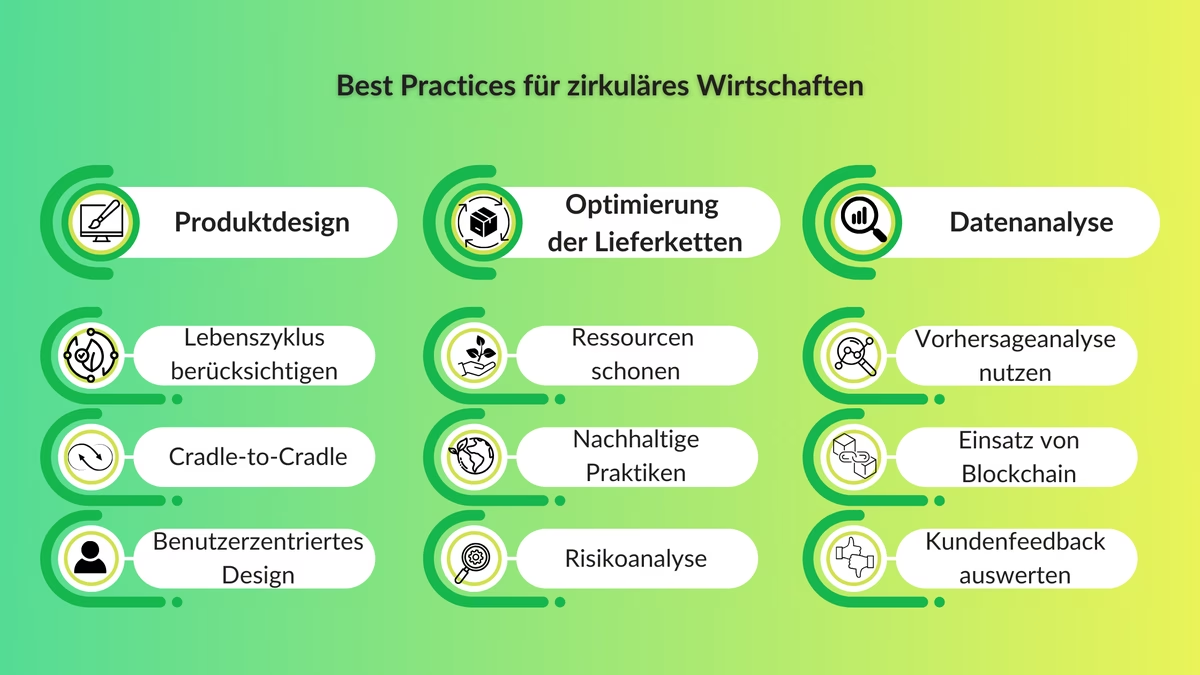
Circular product design right from the start: The most effective lever for companies lies in the design. Products should be designed from the outset in such a way that they are easy to repair, dismantle and recycle. Concrete approaches for this are:
- Conduct life cycle assessments to understand and minimize environmental impacts at every stage of production
- Apply the cradle-to-cradle principle - design products in such a way that their materials can be used entirely as raw materials for new products at the end of their useful life
- Promote user-centered design that supports intuitive operability and energy-efficient use
Optimizing the supply chain: A circular supply chain is more than an environmental statement, it is an economic advantage:
- Focus on efficient use of resources, for example through just-in-time deliveries and optimized warehousing
- Introduce sustainable procurement practices and select suppliers according to environmental and social standards
- Strengthen risk management through real-time monitoring and early warning systems, especially with regard to supply bottlenecks for critical raw materials
Using data as a basis: The circular economy needs a solid database:
- Use predictive analytics to plan resources with foresight and react more agilely to market changes
- Using blockchain technology to document transactions and material flows along the supply chain in a transparent and tamper-proof manner
- Establish customer feedback systems to continuously improve products and better align them with actual user needs
The most important advice for companies: Circular economy is not a project with an end date, it is a permanent transformation. Companies that start early will gain a decisive competitive advantage over those that wait for regulatory pressure.
A few targeted measures in everyday life can make a real contribution:
Tips for consumers
The most effective measure is the simplest: buy less, but better. Before every purchase, it is worth asking whether the product is really necessary and whether there is a longer-lasting, more sustainable alternative. Quality rather than quantity extends the lifespan of products and reduces the pressure on resources.
Use products for as long as possible and repair defective items instead of replacing them immediately. Many cities now offer repair cafés or workshops where people can get help with repairs. Upcycling, the creative upcycling of used items, is also an easy way to conserve resources.
Why should everyone own a drill that is used for an average of 13 minutes a year? This is exactly where the sharing economy comes in: Tools, vehicles, household appliances - many things can simply be shared or swapped via platforms or neighborhood initiatives instead of buying new. This saves money, conserves resources and promotes social interaction.
Pay attention to recyclability when buying and return materials to the cycle after use. Separate waste conscientiously and use local collection points for hazardous waste such as electronic waste, batteries or textiles.
Purchasing decisions are also votes for or against certain economic models. Give preference to companies and products that support circular principles. Certificates such as the Blue Angel or the EU Ecolabel, which indicate sustainable manufacturing processes, help here.
Whether companies or consumers, every stakeholder has leverage. The circular economy does not work top-down through regulation alone, nor bottom-up through individual decisions alone. It needs both: an economic environment that rewards circular behavior and a society that actively supports this change.
Conclusion
The circular economy is not a vision for the distant future. It is an economic necessity of the present. In view of finite resources, growing volumes of waste and increasing dependence on imports, it offers the only viable way out of the limitations of the linear economic model.
The good news is that change is in full swing. Political framework conditions at national and European level are creating binding standards, technologies such as digital product passports are making circular systems scalable and companies that act early are gaining a clear competitive advantage.
Ultimately, the circular economy is not a compromise between ecology and economy. It shows that both belong together and that sustainable economic activity does not come at the expense of growth, but rather makes it possible in the long term.
Frequently asked questions
Recycling is just one of many strategies within the circular economy. While recycling recovers materials at the end of their life, often with a loss of quality, the circular economy aims to preserve the value of products and materials by reusing, repairing and refurbishing them for as long as possible before they even need to be recycled.
Do you know the feeling that a device gives up the ghost shortly after the warranty expires or that a software update suddenly makes the old model noticeably slower? This is no coincidence. Planned obsolescence describes the deliberate decision by manufacturers to build products in such a way that they fail or become obsolete sooner than necessary, with the clear aim of driving the next purchase. The circular economy is exactly the opposite. Products should be designed so that they can be repaired, upgraded and reused, not thrown away. Since July 2024, this has even been enshrined in law in the EU: the right to repair obliges manufacturers to make repairs technically possible and economically reasonable. A long overdue step.
Cradle-to-cradle means that products are designed from the outset in such a way that their materials can be used entirely as raw materials for new products at the end of their useful life, with no waste and no loss of quality.
A digital product passport is something like the life cycle of a product. It documents where the raw materials come from, how it was manufactured and what should happen to it at the end. This means that everyone in the supply chain, from the manufacturer to the recycling company, has access to the information they need to make informed decisions. Sounds like a dream of the future? It no longer is. In April 2024, the EU made the introduction of the digital product passport mandatory as part of the Ecodesign Regulation. For companies, this means that those who set up the necessary infrastructure early on will have a clear advantage. Those who wait will be caught up by the law.
In recycling, materials are recovered and fed back into production, often with a loss of quality. Upcycling goes one step further: materials are not only reused, but transformed into something more valuable, for example when textile waste is processed into high-quality designer products.
Imagine a company produces cheaply, but the dirt it creates is paid for by the general public. This is exactly what external costs describe: environmental damage, disposal costs or follow-up costs that exist in reality but do not appear in the polluter's calculations. Instead, they end up with society as tax money, health costs or simply as a damaged environment. This is also the reason why the linear economic model continues to be attractive for many companies: those who do not bear the true costs of their actions themselves have little incentive to avoid them. As long as this remains the case, the circular economy will be fighting with unequal weapons.
Greenwashing refers to the practice of presenting products or companies as more sustainable than they actually are. The EU is tackling this problem with the "Empowering Consumer Directive" (Directive 2024/825), which requires environmental claims to be verifiable, verifiable and clearly communicated in future.
Consumers are a key player in the system: through conscious consumption, the use of repair cafés, participation in sharing platforms and support for sustainable products, they actively contribute to reducing resource consumption and strengthening circular business models.
Critical raw materials are materials that are indispensable for modern technologies and the energy transition. These include lithium, cobalt and rare earths. At the same time, they are scarce and heavily dependent on imports. The circular economy makes an important contribution here by reducing the need for newly mined materials through recycling and reuse.
As part of the CSRD reporting obligations, the circular economy is a central element of the ESRS E5 standard, which obliges companies to report on resource use, waste volumes, recycling rates and product design, thus making these topics measurable and controllable.

Alexander Hilmar
LinkedInESG-Compliance Experte · lawcode GmbH
Alexander Hilmar berät Unternehmen bei der Umsetzung von ESG-Compliance, nachhaltiger Berichterstattung und begleitet die Implementierung digitaler Lösungen für rechtssichere Lieferketten. Seine Fachbeiträge auf dem lawcode Blog verbinden regulatorische Tiefe mit praxisnahen Handlungsempfehlungen.