
 DE
DE
Important facts
- What does the EUDR require in relation to geodata?
- Exact geo-coordinates of the original area must be available for each unit of goods concerned.
- Why is geo-information so important?
- They serve as objective proof that there is no deforestation or illegal origin.
- Who is responsible for the geodata?
- Every market participant must ensure the completeness and accuracy of the geodata.
- What happens if geodata is missing?
- The product may not be placed on the EU market without geolocation data and EUDR reference number.
- How can companies implement geodata efficiently?
- Digital tools, clear processes and supplier contracts help with secure recording and transfer.
Executive Summary
The EUDR places the precise collection, documentation and transfer of geodata at the heart of compliance requirements. Companies that import raw materials such as soy, coffee, palm oil or wood into the EU must prove exactly where their products were produced. Together with an EUDR reference number, geo-coordinates provide objective proof of deforestation-free supply chains and form the basis for official inspections and automated risk analyses.
Downstream traders in particular face major challenges: They have to organize, contractually secure and check the plausibility of geo-information for collective deliveries of various origins, often without direct access to the areas of origin. If the data is missing or incomplete, there is a risk of import bans, product seizures and fines in the millions.
Geo-data is not a "nice-to-have", but the key to EUDR compliance. Companies should firmly integrate it into supplier contracts, quality management systems and internal processes, supported by digital platforms that automate data collection and management of EUDR reference numbers.
Never miss an update on the EUDR again.
New specialist articles, regulatory updates and practical tips, straight to your inbox. Once a week, no spam.
Geodata in the EUDR - what is required?
Obligation to provide coordinates
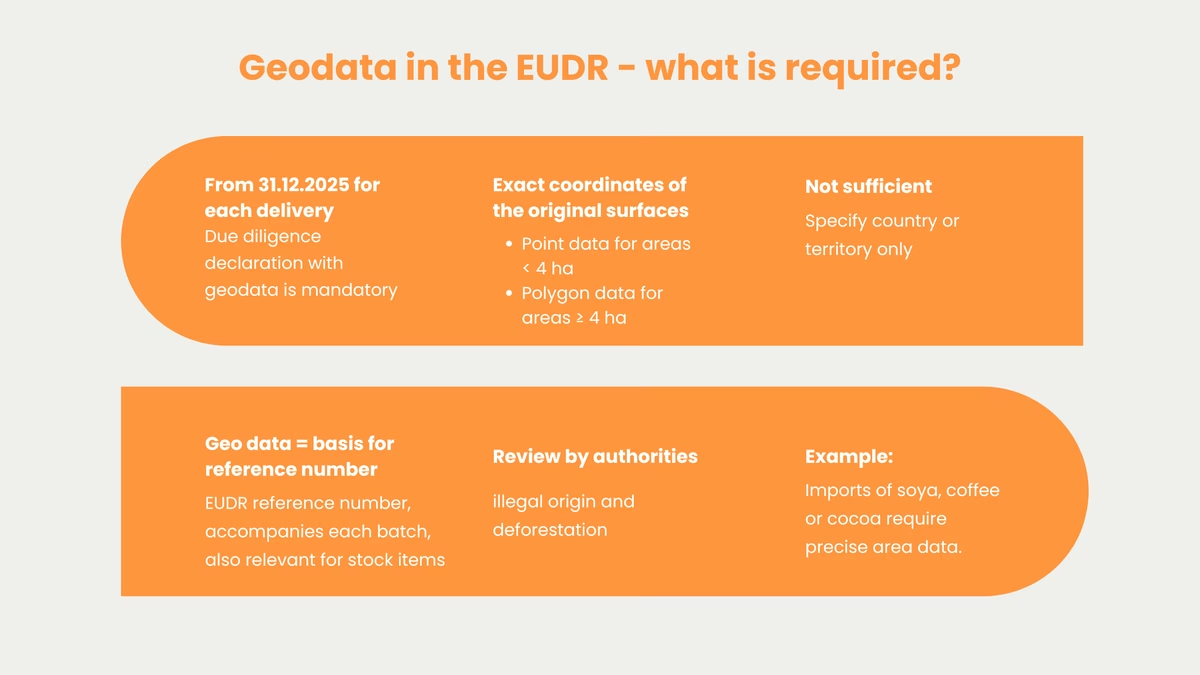
The EUDR(EU Regulation 2023/1115) stipulates that a due diligence declaration must be available for every relevant product sold on the Union market after December 30, 2026. This due diligence declaration must include the precise geo-coordinates of the agricultural or forestry land on which the raw material was produced. It is not sufficient to simply provide the country of origin or a vague description of the area.
How the coordinates are to be specified depends on the size of the area:
- Up to 4 hectares: either a single point or a polygon
- Over 4 hectares: Polygons with a sufficient number of corner points - one point is no longer sufficient
- Cattle (special rule): one point per holding, but for all holdings over the entire lifespan, i.e. including pasture areas and slaughterhouses
In addition, a technical minimum accuracy of six decimal places applies for longitude and latitude. Transmission takes place exclusively in GeoJSON format in the WGS-84 coordinate system (EPSG:4326). Other formats are not accepted by the EU information system.
This geolocation data is not only mandatory for every batch or consignment. They also serve as the basis for the unique assignment of EUDR reference numbers in digital systems. This allows authorities to check at any time whether raw materials or products made from them (relevant products) are associated with illegal deforestation and forest degradation. In practical terms, this means Anyone importing coffee from Brazil, cocoa from the Ivory Coast or soy from Argentina, for example, must prove exactly on which area and at what time the production took place.
Here you will learn all about the basics of EUDR.
Geodata needs a timestamp
Geo-coordinates alone are not enough. According to Article 9(1)(d) EUDR, the time or period of production must also be recorded, i.e. the harvest date or production period. Only the combination of place and time allows a comparison with the cut-off date of December 31, 2020 and thus proof of freedom from deforestation. For cattle, the entire lifespan is even relevant."
Why is the use of geodata so important?
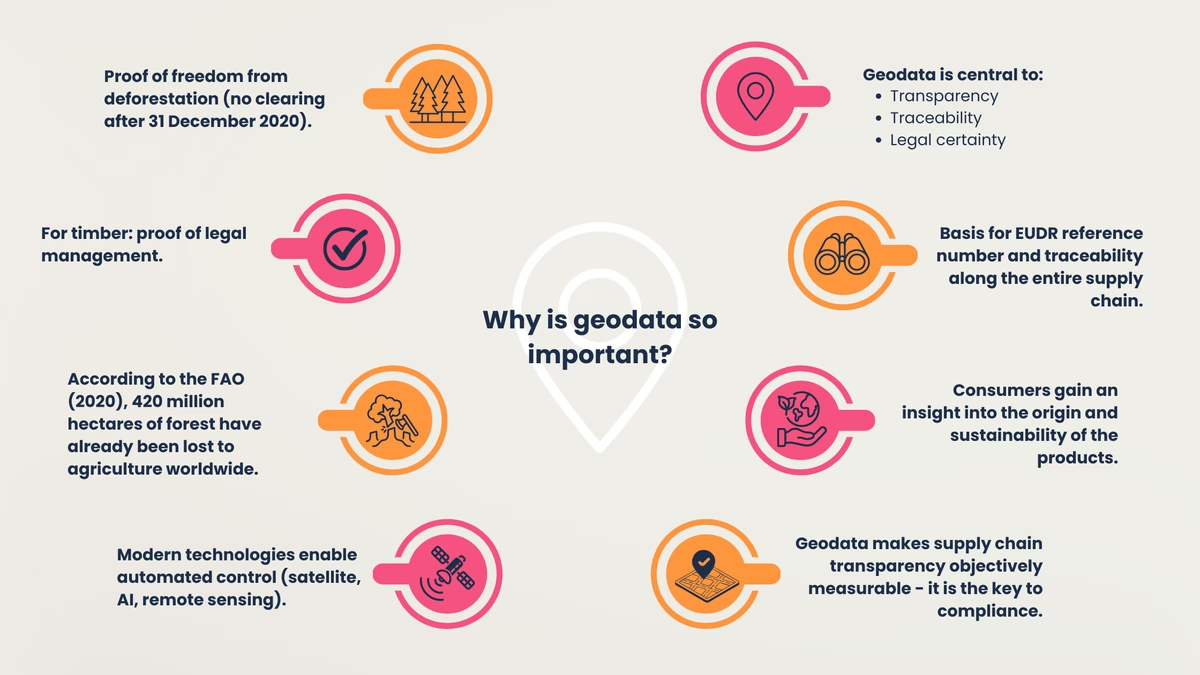
Geolocation data plays a central role in the implementation of the EU regulation on deforestation-free supply chains (EUDR) because it forms the basis for transparency, traceability and legal certainty. Only by providing precise geo-coordinates of the agricultural or forestry production areas can it be clearly proven whether a product originates from an area that was not cleared or deforested after the cut-off date of December 31, 2020. In the case of wood, the information also serves to verify whether the cultivation was legal.
The EUDR requirement is not purely theoretical:
According to a 2020 report by the Food and Agriculture Organization of the United Nations (FAO), around 420 million hectares of forest worldwide have been converted into agricultural land in the last three decades. This is almost equivalent to the area of the entire EU.
The EUDR addresses precisely this ecological problem and uses modern technologies for monitoring and tracking. Thanks to digital geographical data, satellite images, drone images and other remote sensing data can now be analyzed automatically, often with the help of artificial intelligence. This allows authorities to quickly, efficiently and objectively check whether a supply chain complies with legal requirements. This also gives civil society actors and independent organizations new opportunities for verification.
However, geodata is not only of central importance for authorities. They also form the basis for assigning the so-called EUDR reference numbers. They are a digital identification feature that clearly assigns each product placed on the market to its area of origin. These reference numbers accompany the goods through the entire supply chain all the way to the retailer and create a new level of traceability.
For consumers, this means that in future they will be able to better understand where the products they consume come from and whether their production complies with environmental and social standards. Geo-information thus enables a new era of supply chain transparency that goes far beyond mere documentation requirements. It is the backbone of a system that makes sustainability measurable and verifiable and therefore the key to EUDR compliance.
Challenge for downstream retailers
How retailers handle geographical data
For companies that work directly in the field or in the forest, such as agricultural producers or loggers, collecting the necessary geodata is generally easy to implement. They know their areas and can use GPS devices, satellite maps or geographic information systems (GIS) to record exactly where their raw materials were produced. This data and content can be documented relatively easily and made available as part of the EUDR.
However, it is much more difficult for downstream players. These include traders, middlemen, importers or processors who do not purchase their raw materials directly from the producer. They often purchase so-called collective deliveries, where the goods come from many different areas of origin, sometimes even from several countries. In these cases, it is almost impossible for the retailer to tell which product comes from which area.
What does the EUDR stipulate?
Since the revision at the end of 2025, the so-called once-only approach has applied: only the first distributor (operator) must submit a full due diligence declaration including geodata. Downstream actors, i.e. downstream operators and traders, no longer have to obtain or pass on their own geodata. Their obligation is reduced to recording the DDS reference number of the upstream operator, assigning it internally and retaining it for at least five years.
In practice, this relieves retailers considerably. Nevertheless, there are still residual obligations that are relevant in a geo-data logic:
- Inbound process: If you receive reference numbers as a first downstream operator, you must be able to assign them correctly to your own goods receipts
- Substantiated concerns: If there are concrete indications that the underlying geodata is incorrect or that the supply chain is not deforestation-free, non-SMEs must actively verify this and may not continue to place the goods on the market until this has been clarified
- Stop distribution: If there is no reference number, although there should be one, the goods may not be passed on
Important: The first downstream operator does not have to actively request his role. He can rely on the fact that he is not in this role as long as no reference number is received from the supplier. If the geo-data is not available, in the worst case scenario the product cannot be imported into the EU and sold here.
Less Effort, Greater Security in EUDR Implementation
Our platform automates key EUDR processes—geodata, risk analysis, and documentation—thereby significantly reducing the manual workload for your team.
Transparency vs. Privacy
A particularly sensitive tension arises between the legitimate interests in supply chain transparency, on the one hand, and data protection, on the other. Geodata often reveals information about ownership, internal organizational structures, or—in the case of smallholder farmers, for example—personal data. Within the framework of the EUDR, transparency requirements and the right to data protection must be observed. In practice, therefore, the full geocoordinates are submitted in the due diligence statement and on the digital EUDR platform.
In addition to the DDS reference number, there is a so-called verification number that serves as an extra layer of protection. It is generated when the DDS is submitted and generally remains with the operator. There is no legal obligation to pass on the verification number along the supply chain; however, it may be disclosed voluntarily or upon request by authorities in the event of justified concerns. This ensures that the internal flow of goods remains traceable via the reference number without sensitive background data circulating unnecessarily throughout the chain.
Important: Without underlying geo-information, the EUDR reference number is worthless.
What to do if the supplier does not provide geodata?
Consequence of missing information
If the required geodata for a product is missing, i.e. the exact coordinates of the area of origin and the corresponding EUDR reference number, the goods may not be traded further in Europe. This applies to all companies along the supply chain, in particular traders, importers and processors. They may only resell or import products for which complete and verified documentation is available.
Anyone who nevertheless puts products into circulation without complete geo-information risks serious legal consequences. The competent authorities of the EU member states are obliged to consistently prosecute infringements. They can not only confiscate products with incomplete information, but even permanently exclude them from the market. The competent authorities may also carry out on-site inspections in third countries in accordance with Article 18(2)(e) of the EUDR, provided they agree.
The potential financial consequences are also serious: According to the EU Commission, serious infringements could result in fines of up to 4% of the total annual turnover generated by a company in the EU. Depending on the size of the company, this can quickly amount to millions.
There is also the potential for reputational damage: Companies that violate the EUDR quickly come under the scrutiny of authorities, NGOs and the public. Especially in times of increasing transparency requirements, such a case can have a significant impact on the trust of customers, partners and investors.
Conclusion: Without reliable geo-data and an EUDR reference number, legally compliant trade in the EU is no longer possible. Companies should therefore ensure at an early stage that they have complete information and, if in doubt, prefer to forego a delivery rather than take a risk.
Responsibility of the market participant
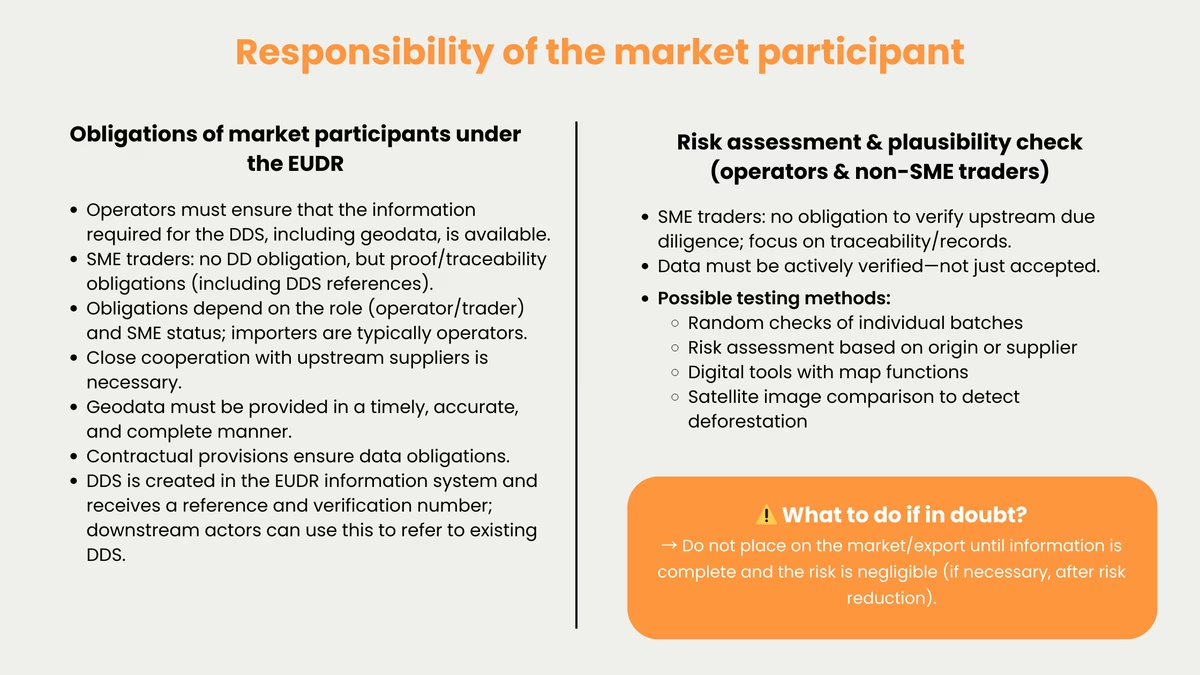
The EUDR makes it clear that every market participant, including retailers, importers and processors, is responsible for checking and correctly documenting the geolocation data of their products. It does not matter how far away they are from the actual place of production. The length or complexity of their supply chains are not decisive factors.
Particularly important: The responsibility for the accuracy of the geodata lies with the operator, even if the coordinates were supplied by the producer or an upstream supplier. Incorrect, manipulated or inaccurate geodata is considered a breach of the regulation, regardless of whether the operator collected the data themselves. This is precisely why contractual safeguards and plausibility checks are not an optional extra, but liability protection.
In practice, this means that companies must work closely with their suppliers. They should clarify at an early stage that their suppliers will provide all the necessary geodata completely, correctly and on time. The best way to do this is by contract in order to create clear rules and obligations for all parties involved. Only if the location data is passed on reliably can the EUDR reference number be correctly assigned and carried throughout the entire supply chain. This reference number is crucial for proof of origin and legality.
But simply passing it on is not enough:
Retailers and processors must also check the plausibility of the data received. For example:
→ Random samples of individual deliveries
→ Risk assessments by country of origin or supplier
→ The use of digital tools with map views or
→ Comparison with satellite images, e.g. to identify deforestation
If there are doubts about the accuracy of the data, for example because something does not match or remains unclear, companies should rather refrain from making the delivery in question. This is because incomplete or incorrect coordinates can lead to legal and financial problems later on.
SMEs and geodata - what applies here?
For many small and medium-sized enterprises (SMEs), implementing the EUDR requirements is particularly difficult. They often lack digital solutions for collecting geodata, sufficient staff to take care of this or expertise in using map and GIS systems and digital supply chain platforms. Nevertheless, the EUDR only makes a few exceptions. Even SMEs must provide precise coordinates of origin if they import or trade affected goods such as soy, coffee, wood or palm oil. The obligation to provide coordinates and use the EUDR reference number therefore applies to everyone.
Although there are somewhat reduced obligations for SMEs, this does not change the fact that the origin of the products must be clear and verifiable.
Special case MSPO - postal address instead of geocoordinates
With the revision at the end of 2025, a separate category was created: the Micro or Small Primary Operator (MSPO). The cumulative requirements are: natural person or micro/small enterprise, established in a low-risk country, marketing own products directly on the EU market. MSPOs submit a one-off simplified declaration (SD) instead of a full DDS and may, under certain conditions, provide their postal address instead of geo-coordinates. This makes MSPOs the only real exception to the geo-data obligation. For all other SMEs, the standard specifications (point/polygon, GeoJSON, six decimal places) remain in place.
If SMEs act as downstream market participants or traders, these products are already covered by a DDS. In this case, SME traders are not required to provide additional geolocation data or issue new DDSs. In particular, SME traders must document the DDS reference or verification numbers and buyer/seller information, keep them for five years and pass them on to buyers or authorities on request.
Depending on the size of the area, point or polygon data is required (from >4 ha usually polygon). The data is typically transmitted in standardized formats such as GeoJSON. However, you must keep the information collected and the due diligence declaration for at least five years. If, on the other hand, the SME places the products on the market itself, it must provide the DDS including the geodata itself.
So what can SMEs do?
- Joining forces, for example in cooperatives, associations or industry networks
- Use specialized service providers to help with the digital capture and verification of geodata
- take advantage of support programs, for example from chambers of industry and commerce, trade associations or EU initiatives. These often offer advice, training and technical support
In this way, smaller companies can also meet the requirements of the EUDR: more efficiently, together and with less effort.
Mixed processing and "declaration in excess" - when everything runs into a silo
Bulk goods such as soy, palm oil or cocoa pose a particular challenge. Raw materials from different producers are often brought together in the same silos, tanks or processing plants. It is no longer physically possible to clearly identify "this liter of palm oil comes from this plantation" once it has been mixed.
The EUDR solves this pragmatically, but strictly: all areas of all plots whose material could be contained in the respective delivery must be recorded, for example all suppliers who have fed into the tank since the last silo emptying. This so-called "declaration in excess" is expressly permitted, but only under clear conditions:
- Full due diligence must be carried out for each of the declared areas, including risk assessment in accordance with Article 10 EUDR
- A negligible risk must be demonstrated for each of these areas
- Blanket over-declarations at regional or national level are expressly inadmissible
If even just one of the declared plots is non-compliant, the entire shipment is considered non-compliant. This makes geodata in bulk supply chains a collective responsibility: a single problematic plot can block an entire shipment."
Practical implementation and recommendations for action
Creating contractual clarity
Companies are well advised to make clear, written agreements on the delivery and accuracy of the required geodata when selecting and managing their suppliers. Supplier contracts should specify exactly how, when and in what form the coordinates are to be handed over and that the data must correspond to reality. At the same time, a legal framework should be defined in the event that data is missing or is subsequently identified as incorrect. This includes liability regulations, warranty periods and the obligation to correct incorrect data immediately and ensure the flow of reference numbers. Example: A medium-sized coffee importer in Hamburg has concluded contractual clauses with its Brazilian suppliers according to which each shipment is only accepted with complete geo-coordinates of the respective plantation. The agreement also provides for a contractual penalty in the event that incorrect or manipulated EUDR geo-information is discovered during external inspections.
To Do: Specify in supplier contracts the binding form in which geodata is to be supplied, including liability regulations and contractual penalties for incorrect or missing information.
Use of digital tools and platforms
The technical implementation of EUDR requirements is most efficiently achieved with modern digital tools that are specifically tailored to supply chain management and supply chain tracking. Special supply chain or EUDR management platforms, such as our lawcode suite, make it possible to automatically record and validate geodata and assign it to the corresponding consignments. This enables all supply chain participants to digitally document sustainable standards and adopt the EUDR reference number as a unique digital identity.
Our solution also offers import and export interfaces to ERP systems and merchandise management software in order to efficiently integrate the data flow into existing process landscapes. It can also be used to carry out geographical risk analyses and provide objective evidence for due diligence, which can be convincingly communicated to authorities and stakeholders. In practice, it has been shown that digital platforms for recording geodata can significantly reduce administrative costs.
To Do: Rely on specialized EUDR management platforms that automatically capture, validate and link geodata with EUDR reference numbers, ideally with an ERP interface for seamless integration into existing processes.
Training and process anchoring
In order for companies to meet the requirements of the EUDR permanently and reliably, it is not enough to rely solely on technology or contracts. It is equally important that the handling of geodata is firmly anchored in internal processes. This includes, above all, providing employees with targeted training. Everyone who works with the products concerned should understand why geo-information is so important and how it is correctly recorded, checked and passed on. Training courses should therefore not only teach the technical basics of geodata and GIS systems, but also cover the legal principles of EUDR, data protection and the obligation to provide evidence.
In addition, collecting, checking and documenting the coordinates, including the EUDR reference numbers, should be an integral part of the internal processes. This process is best integrated into existing structures such as the quality management system. This ensures that there are no gaps if something changes in the company, for example due to a change of personnel, new suppliers or changes in the flow of goods. Audits in particular closely examine whether the handling of geodata in the company is organized in a permanent, comprehensible and systematic manner. Sustainable EUDR compliance can only be established with clear processes and responsibilities.
To Do: Train all relevant employees on geodata, EUDR requirements and data protection and anchor the collection and verification of data as an integral part of the quality management system.
Technical implementation of geodata
Technical integration is crucial for efficient implementation. The geodata should be transmitted in standard formats such as GeoJSON to ensure compatibility between different systems.
Automated validation of the incoming coordinates is crucial, ideally by comparing them with current satellite images to check conformity. However, the key to efficiency lies in connecting the EUDR software to existing ERP or merchandise management systems using programming interfaces (APIs). This enables the EUDR reference number to be automatically linked to the respective batch of goods and eliminates error-prone manual data entry.
To Do: Rely on standard formats such as GeoJSON and use APIs to integrate your EUDR solution directly into your ERP system to automate processes.
Conclusion
Geodata is no longer a voluntary sustainability measure, it is a binding requirement for market participation. Only those who can prove exactly where their products come from will meet the EUDR requirements and prevent environmentally harmful goods from entering the EU.
The EUDR reference number alone is not enough. Without verifiable geo-data, it loses its value as proof of authenticity. Companies must therefore establish systems that guarantee the permanent and reliable collection, transfer and updating of data, because only with high data quality can geo-information retain its regulatory and practical relevance.
Frequently asked questions
In the context of the EUDR, geodata refers in particular to the exact geographical coordinates (longitude and latitude) of the original area on which a raw material was cultivated, extracted or harvested. Depending on the size of the area, this must be either a single point or a precisely delimited polygon describing the cultivation or production area. Addresses, parcel numbers or mere area descriptions are explicitly not sufficient to meet the legal requirements.
As a retailer, you are responsible for ensuring that you have the required geo-data and the corresponding EUDR reference number for each unit of goods sold. Physical access to the production areas is not mandatory, but the obligation to have authentic and complete information from all upstream suppliers documented is. Missing evidence leads to compliance violations, regardless of your position in the supply chain.
For monitoring purposes, authorities access the geodata and EUDR reference numbers transmitted and compare them with satellite images, remote sensing data and cartographic information sources. In the event of deviations or suspicions of deforestation, physical inspections or in-depth queries can be carried out. Automated reconciliation systems with AI-supported monitoring solutions help inspectors to detect irregularities at an early stage.
Yes, in principle, the obligations of the EUDR and thus the requirement to provide professional geo-information including reference numbers also apply to small traders and SMEs, provided that the types of goods listed in Annex I of the Regulation are traded. However, SMEs do not have to provide additional geodata if a DDS is already available. This applies to SME market participants in the downstream supply chain, such as small traders. However, the goal of complete traceability remains.
Reliable quality assurance is achieved through a combination of digital plausibility checks, map comparisons, risk analyses and, if possible, on-site spot checks by third parties or independent auditors. Ideally, retailers should use digital tools that enable automatic checks based on up-to-date satellite data. It is also advisable to continuously raise awareness and train all suppliers on the importance of data quality and transparency.

Karim Boukaouche
LinkedInESG compliance expert - lawcode GmbH
Karim Boukaouche advises companies on the implementation of the EU Deforestation Regulation (EUDR) and supports the implementation of digital solutions for legally compliant supply chains. His specialist articles on the lawcode blog combine regulatory depth with practical recommendations for action.