 DE
DE

Important facts
- When is an area considered a forest under the EUDR?
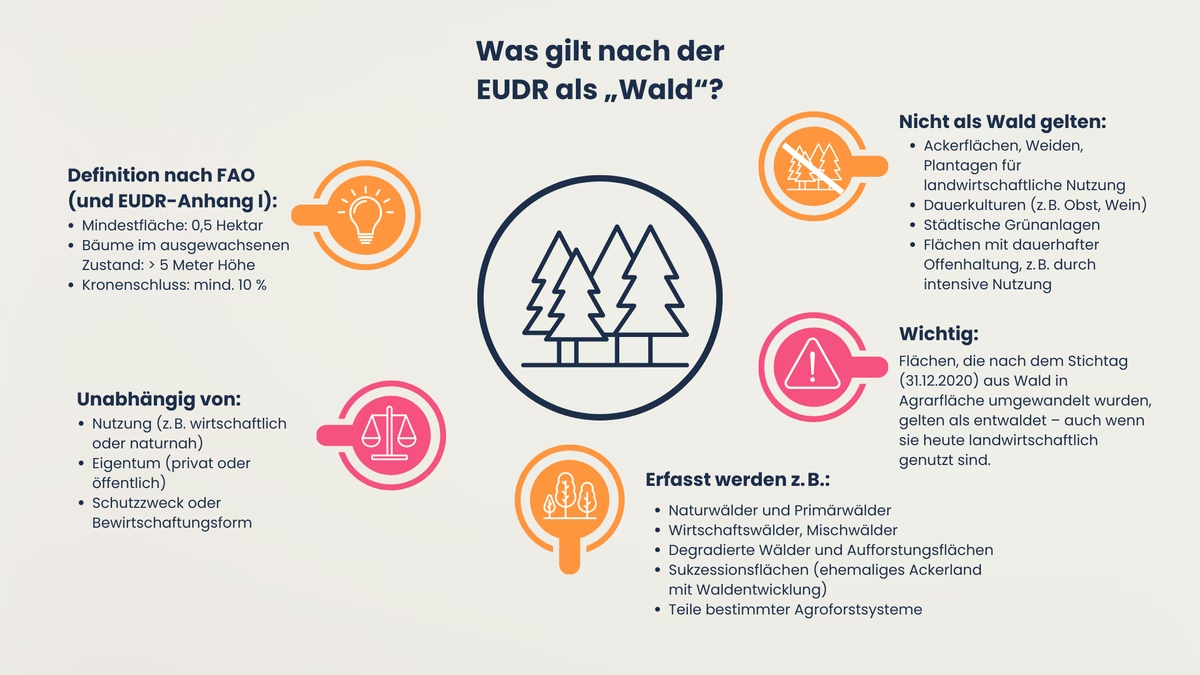
- If it is at least 0.5 ha in size, trees are over 5 m high and there is at least 10 % canopy closure, regardless of use or condition.
- When does an agricultural area become EUDR-relevant?
- If it emerged from formerly forested land after December 31, 2020.
- What is the difference between forest and non-forest according to EUDR?
- Non-forest areas are, for example, arable land, orchards or pastureland without a forest structure. The decisive factors are tree height, density and area.
- Which types of forest are affected by the EUDR?
- All: Natural, commercial, mixed and degraded forests as well as afforested areas, provided they meet the structural criteria.
- Does the EUDR also apply to forests in the EU?
- Yes, areas in the EU are also subject to the requirements if forest was cleared or damaged there after the cut-off date.
Executive Summary
The EU regulation against deforestation (EUDR) presents companies with new requirements regarding the origin of their raw materials. The aim is to ensure that products such as wood, soy, coffee, cocoa or palm oil that are placed on the EU market were not produced on land that was deforested or ecologically damaged after the deadline of December 31, 2020. The definition of "forest" plays a central role here: the decisive factors are not use or ownership, but purely structural characteristics such as a minimum size of 0.5 hectares, a tree height of over five meters and at least ten percent canopy cover, regardless of whether the land is natural, commercial or afforested.
Agricultural land also comes into focus if it has been converted from forest after the cut-off date. In such cases, the products produced there are considered to be non-deforestation-free and are subject to comprehensive verification requirements. The EUDR covers both imported goods and goods produced within the EU and requires complete traceability of the origin of the land using modern geodata, official documentation and digital monitoring tools. Companies must therefore systematically check their supply chains for risks, document historical use and, if necessary, seek legal or technical support to ensure compliance and avoid sanctions.
The EUDR and the term "forest"
The legal definition of "forest", as set out in the EUDR, is crucial for determining the absence of deforestation. The term remains inconsistent at European level and requires precise interpretation and knowledge of the practical pitfalls.
EUDR definition of forest
The EUDR does not have its own binding definition of a forest, but essentially refers to the internationally used definition of the FAO (Food and Agriculture Organization). According to this definition, an area is a forest if it is at least 0.5 hectares in size and the trees on it are taller than five meters when fully grown and have a canopy cover of at least 10 percent. These thresholds are already the subject of intense debate, as they cover numerous types of land that many entrepreneurs would not have previously considered to be "forest". It does not differentiate between commercially used and semi-natural forest, provided the areas are not "temporarily deforested" (for example after a slash-and-burn or timber harvest, but with subsequent reforestation). This means that even a reforested stand that meets the minimum parameters (size, height, canopy closure) falls under the EUDR forest definition.
→ An area is considered a forest from 0.5 hectares, with trees at least 5 meters high and 10 % canopy cover
→ The definition does not distinguish between commercially used and semi-natural forest
→ Afforested areas are also covered by the EUDR, provided they meet the minimum parameters
Which types of forest are affected by the EU regulation?
According to the EUDR forest definition, almost all forest types are relevant, regardless of the form of ownership, intensity of use or the purpose of protection. This includes natural forests, commercial forests, mixed forests, degraded forests and also certain afforested areas. It does not matter whether it is primary forest or secondary forest that has already been managed several times. The only decisive factor is the presence of the structural characteristics: Area size, tree height, crown closure.
By way of example, this applies to forest areas that are used for logging, the production of pulp, furniture wood or wood-based materials, as well as areas that are of natural origin and are not subject to intensive use at all. Even certain agroforestry systems or abandoned agricultural land that has undergone natural succession to become forest may be classified as "forest" within the meaning of the EUDR.
There are around 160 million hectares of forest in the EU, which corresponds to a global forest area of 4% and which would be classified as forest according to the EUDR. They cover 39% of the EU's surface area, and the six Member States with the largest forest areas (Sweden, Finland, Spain, France, Germany and Poland) account for two thirds of the EU's forest area. This means that the regulation de facto covers all of Europe's core forests and many adjacent forest types, with corresponding implications for companies along the upstream and downstream supply chain.
What does not count as forest?
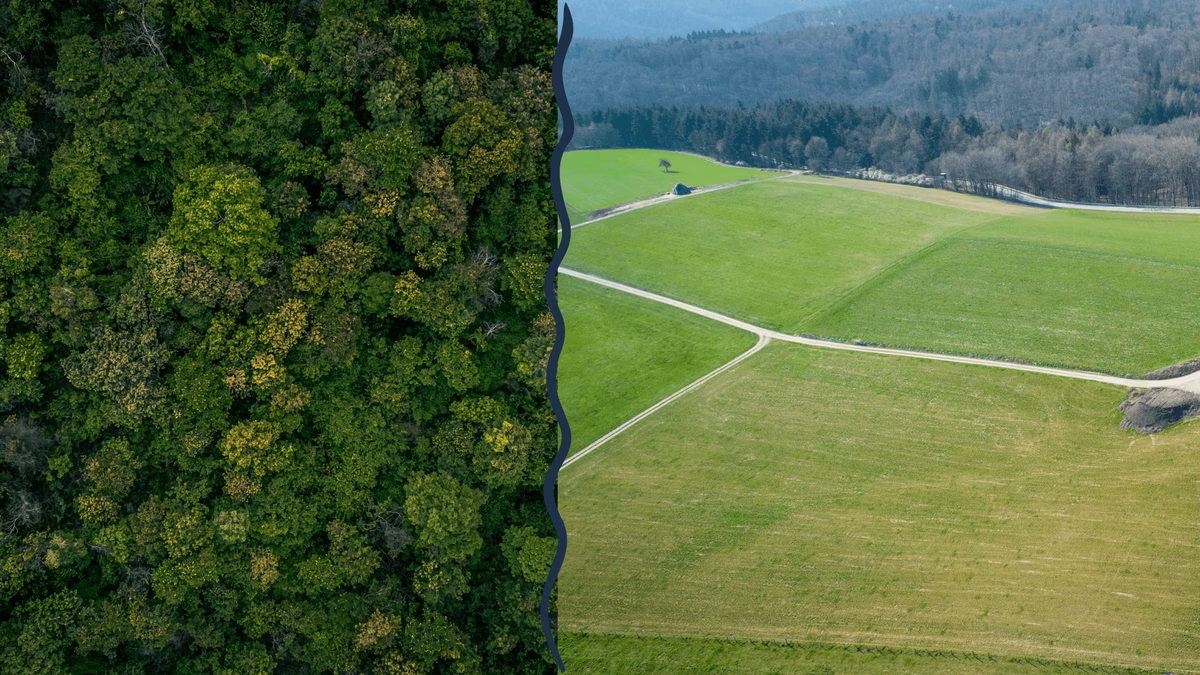
Areas on which no closed tree layer grows permanently or on which intensive permanent cultivation prevents a natural forest structure are typically not classified as "forest". These non-forest areas include arable land, pastureland, plantations for agricultural crops (except for woodland plantations used for forestry), permanent crops such as orchards and vineyards or urban green spaces.
However, if, for example, an area is converted to agricultural use after the cut-off date, this is expressly considered "deforestation" within the meaning of the EUDR and is therefore subject to the deforestation-free requirements for land origin. A special case are forestry tree nurseries or Christmas tree plantations, which must be considered in a differentiated manner depending on their structure and permanence. The decisive factor is always the individual case, which requires planning certainty and may necessitate legal advice.
Agricultural land under the EUDR
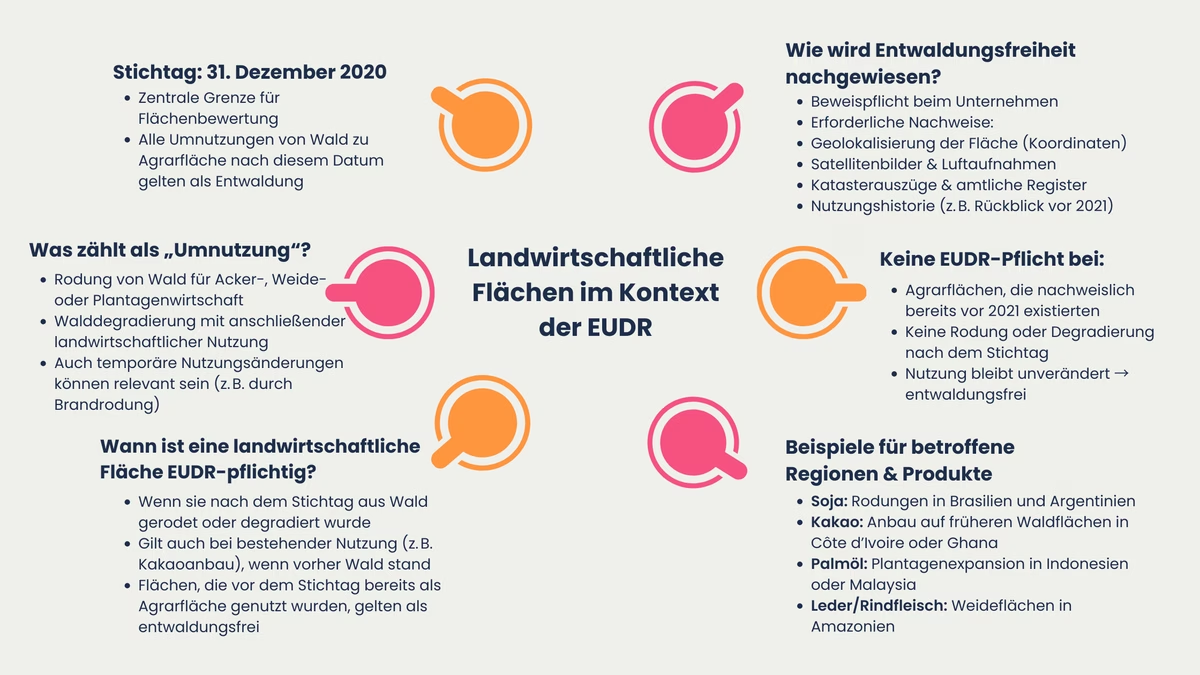
Agricultural land is always the focus of attention in connection with the EUDR if land conversions were carried out or are planned after December 31, 2020. The question of when an agricultural area falls under the EUDR or not is therefore closely linked to the history of use and the origin of the land.
Repurposing is crucial
From a business perspective, the most critical factor in the origin of land is the so-called conversion, i.e. the change in land use from forest to arable land or pasture. If deforestation or degradation has taken place after the cut-off date and the land was subsequently used for agriculture, products produced on it are covered by the EUDR and are only considered deforestation-free if the conversion took place before the cut-off date. Practical examples include Brazilian soy farms whose land was still covered by forest before 2021 and which now produce agricultural commodities for export to Europe after deforestation. The same applies to the cultivation of cocoa in West Africa on areas of former forest. Only products from agricultural land that was already in use before the cut-off date may be placed on the EU market in future without EUDR-relevant evidence.
In its FAQ on the EUDR, the European Commission expressly emphasizes that if a forest area is converted to agricultural land after the cut-off date, all products from the land area are subject to EUDR and are therefore not considered deforestation-free. The origin of the land, including the time stamp of use, thus becomes the linchpin of compliance.
EUDR-relevant crops and raw materials
Not every agricultural crop is covered by the EUDR. The regulation currently focuses in particular on raw materials such as palm oil, soya, wood, coffee, cocoa, rubber and cattle, as well as relevant products and goods made from them (such as beef, leather products or goods made from wood). However, the crops mentioned above already account for a large proportion of global causes of deforestation. This means that a company that sources, markets or sells coffee or cocoa from Colombia, soy from Argentina, palm oil from Indonesia or leather from Brazil, for example, must consistently prove that the products originate from areas without deforestation after the deadline. The EUDR thus explicitly requires the origin of the land to be traced back to the specific area of origin.
No obligation for existing agricultural use before the cut-off date
Agricultural land that was already clearly classified as agricultural land within the meaning of the EUDR before the cut-off date of December 31, 2020 and on which no conversion of forest has taken place since then is considered "deforestation-free". There is no obligation for such areas to be subsequently deforestation-free, provided this can be documented. The practical organization of the verification is usually carried out using a combination of geolocation data such as satellite data, remote sensing and state cadastral data. It is particularly helpful to refer to historical aerial photographs, which can be used to provide good evidence of use even before the cut-off date. Companies should attach importance to the transparency, plausibility and up-to-dateness of the documentation in order to rule out any subsequent complaints.
Do products produced in the EU also have to be deforestation-free?
The scope of the EUDR is explicitly global: it covers all products that are to be offered or exported on the European internal market, regardless of the country in which they were originally produced.
Country of origin does not matter
Neither the country of origin nor the main place of production are decisive for the applicability of the EUDR. Rather, the decisive factor is the place of origin and the question of whether deforestation or forest degradation (e.g. due to large-scale logging, wildfires or other ecological damage) has occurred there after December 31, 2020.
This means that products originating from Polish, German, French or Italian (forestry) operations are equally subject to the obligation to provide evidence of their deforestation-free origin.
This applies in particular to timber products (logs, sawn timber, furniture), but also to agricultural commodities such as soy, maize or beef if these were grown or produced on cleared forest areas after the cut-off date.
Examples for clarification
A German sawmill that purchases spruce logs from a forest owner, for example, must prove that the forest in question existed on the cut-off date, fulfilled at least the EUDR structural characteristics and has not been subject to conversion since then. The same duty of care applies to a German chocolate factory that imports cocoa mass from Côte d'Ivoire. Regardless of certificates such as FSC, PEFC or UTZ, the EUDR requires documented land origin and data on sustainable use throughout the entire production cycle.
Even in the case of intra-Community deliveries (e.g. from Sweden to Germany), companies are obliged to make the EUDR-compliant origin of the raw timber transparent on the basis of specific area references. There is no exception; state protected areas (e.g. in Natura 2000 areas) are also affected by the obligation to provide evidence if logging or product extraction is planned there.
Recommendations for companies
The EUDR regulations and the strict deadlines for implementation require companies to take a systematic, holistic approach. Seamless tracking of the origin of the land and ensuring EUDR deforestation-free certification are thus becoming a strategic success factor in the supply chain.
Supply chain analysis starts with the origin of the land
Companies should systematically record their entire supply chain (own production, suppliers, intermediaries) with regard to the origin of the land. This requires identifying the agricultural and forest areas of all (upstream) suppliers, documenting usage histories and checking them for any conversion events since the reporting date. Anyone involved in the import business must also take local regulations and ownership structures into account and commit their suppliers to applicable standards. In practice, it is advisable to start by setting up a "land origin database" in which all directly and indirectly used land, the origin of the raw materials and the usage history are recorded transparently. Supplementary contracts with suppliers can help to ensure the issuing of corresponding certificates and EUDR compliance.
Use of digital tools for area verification
Digital tools for verifying the origin of land are becoming increasingly important, especially in globally diversified supply chains. Platforms such as Global Forest Watch work with state-of-the-art remote sensing data - including high-resolution satellite images, drone flights and GIS-based monitoring tools. They make it possible to monitor areas dynamically, on a daily basis and with high precision, thereby efficiently fulfilling the verification obligations of the EUDR. In the EUDR module of the lawcode Suite, you also have the option of documenting the cultivation area of your raw materials with the help of geodata. Companies are also increasingly relying on blockchain-based tracking solutions, which can be used to automatically document value creation stages and delivery routes. The European Union will also provide a central database and reporting tool in which all proof of land origin and EUDR deforestation-free status must be uploaded. Digital integration reduces the effort involved, reduces sources of error and enables fast, audit-proof checks.
What to do in case of uncertainty?
Particularly in the border area between forest and agricultural land, in the case of changes of use or historically uncertain documented areas, experts advise an individual legal examination and coordination with specialized consultants. Uncertainties can be dispelled through proactive communication with the authorities, by applying for official confirmation of land use or by consulting independent experts. Companies should document every questionable case in concrete terms (e.g. by comparing aerial photographs, satellite references, official register extracts, expert opinions) and make binding agreements with their suppliers today to clarify the origin of the land. Where no conclusive historical data is available, the most relevant evidence should be combined, processed without contradiction and actively disclosed.
To Do:
- Systematically record all agricultural and forest areas along your supply chain in a land origin database, including usage history and your suppliers' contractual obligation to EUDR compliance.
- Use digital tools such as satellite monitoring, GIS platforms or blockchain-based tracking solutions to verify the origin of land efficiently, on a daily basis and in an audit-proof manner.
- Document borderline and doubtful cases specifically by comparing aerial photographs, satellite references or official register extracts and obtain legal or expert support at an early stage in the event of uncertainties.
Conclusion
The EUDR forest definition is deliberately broad; managed and reforested areas are also considered forests, and even minor clearances after the cut-off date trigger extensive obligations to provide evidence. Companies that underestimate this risk fines or exclusion from the EU internal market.
Now is the right time to review supply chains and area portfolios, define responsibilities and use digital monitoring tools. Those who proactively address open questions, adapt supplier partnerships and carry out risk assessments will create the basis for legally compliant and future-proof EUDR compliance.
Frequently asked questions
The EUDR adopts the forest definition of the Food and Agriculture Organization (FAO): "Forest" is any area of at least 0.5 hectares with trees taller than five meters when fully grown and with a canopy cover of at least 10 percent. The decisive factor is not the use, but the actual structure of the area.
Through the analysis of historical and current area origin data (e.g. geolocation, cadastre, satellite images, aerial photographs), supplemented by precise supply chain and origin documentation. Digital monitoring tools and official confirmations significantly increase the reliability of evidence.
Anyone importing products from non-deforestation-free sources must expect official sanctions, fines, recalls and, in extreme cases, a ban on sales on the EU internal market. There is also a risk of reputational damage and civil claims.
No. The EUDR also applies to products produced in the EU and to imports. The only decisive factor is compliance with freedom from deforestation on all areas of origin since December 31, 2020.

Karim Boukaouche
LinkedInESG-Compliance Experte · lawcode GmbH
Karim Boukaouche berät Unternehmen bei der Umsetzung der EU-Entwaldungsverordnung (EUDR) und begleitet die Implementierung digitaler Lösungen für rechtssichere Lieferketten. Seine Fachbeiträge auf dem lawcode Blog verbinden regulatorische Tiefe mit praxisnahen Handlungsempfehlungen.