
 DE
DE

Important facts
- What does the reversal of the burden of proof under Section 36 HinSchG actually mean?
- If a whistleblower suffers a professional disadvantage following a report, the law automatically assumes that this is a penalty for the report. The employer must actively prove that the measure was objectively justified and had no causal connection to the report.
- When exactly does the presumption rule apply?
- The regulation applies as soon as a whistleblower suffers a professional disadvantage and claims that this disadvantage is a reaction to their previous (and protected under the HinSchG) report or disclosure.
- How can employers protect themselves effectively?
- Through absolutely complete documentation of HR measures, strict organizational separation ("firewalling") between the internal reporting office and the HR department as well as the use of a legally compliant, digital whistleblowing system for objective deadline and case management.
- Who is liable in the company if the prohibition of reprisals is violated due to inadequate organization?
- In an emergency, personal liability can directly affect the company management if organizational deficiencies or inadequate compliance structures lead to legal violations.
- Can employers restrict whistleblower protection rights through clauses in the employment contract?
- No, any contractual agreements or clauses that restrict or exclude the legal rights of whistleblowers are absolutely legally invalid.
Executive Summary
The Whistleblower Protection Act not only entails IT-related obligations for secure reporting channels, but also deeply interferes with a company's labor law tools. The core of this intervention lies in the reversal of the burden of proof under Section 36 of the Whistleblower Protection Act. If a whistleblower suffers a professional disadvantage and claims that this is a punishment for their previous report, it is legally assumed that this is an illegal reprisal.
This means for company management: Traditional labor law measures such as warnings, transfers or dismissals are made extremely difficult and become an unpredictable compliance risk. If the company is unable to rebut the legal presumption, there is a risk of compensation for material and immaterial damages as well as severe fines under Section 37 HinSchG.
In order to handle this whistleblower dismissal protection in a legally secure manner, complete performance documentation, the strict procedural separation of whistleblower officers and disciplinary superiors (firewalls) as well as professional whistleblower system software have become essential.
Never miss an update on the HinSchG again.
New specialist articles, regulatory updates and practical tips, straight to your inbox. Once a week, no spam.
§ Section 36 HinSchG in detail: The ban on reprisals and its consequences
In order to understand the scope of the reversal of the burden of proof, the legal system of the HinSchG must first be explained. The law operates with a two-stage protection mechanism that is intended to make whistleblowers unassailable for arbitrary acts.
What exactly does § 36 HinSchG regulate?
Section 36 (1) HinSchG prohibits any form of reprisal against whistleblowers. This prohibition is far-reaching and expressly includes the mere threat or attempt to take reprisals. In addition, contractual agreements that restrict or exclude the rights of whistleblowers are legally invalid.
Paragraph 2 contains the actual legal presumption rule. If a whistleblower suffers a disadvantage in the course of their professional activity following a report and claims that this is the result of their report, it is legally presumed that this is unlawful retaliation. The burden of proof thus shifts completely to the employer. The employer must provide evidence to the contrary and prove that the measure was based on sufficiently justified, objective reasons.
What is considered a prohibited reprisal?
A reprisal within the meaning of the law (Section 3 (6) HinSchG) is any act or omission in a professional context that is a reaction to a report and causes the whistleblower an unjustified disadvantage.
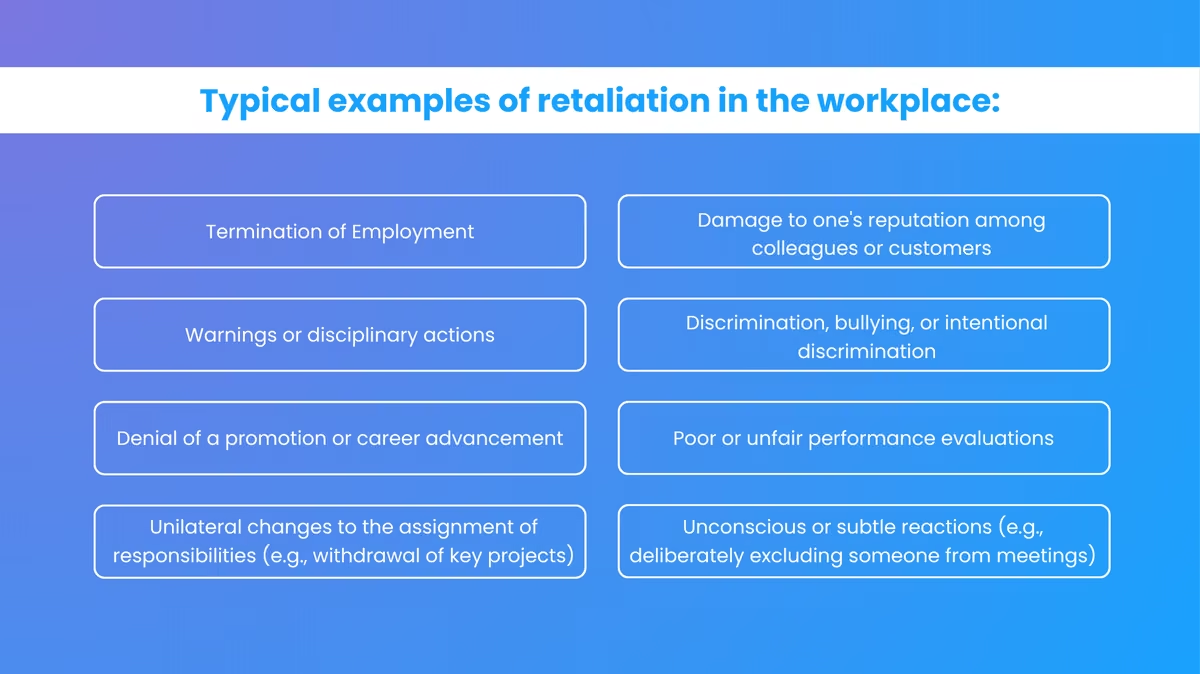
Typical examples of reprisals in everyday working life:
- Termination of the employment relationship
- Warnings or disciplinary measures
- Denial of a promotion or career advancement
- Unilaterally changed assignment of tasks (e.g. withdrawal of important projects)
- Damage to reputation among colleagues or customers
- Discrimination, bullying or targeted disadvantage
- Poor or unjustified performance appraisals
- Unconscious or subtle reactions (e.g. deliberate exclusion from meetings)
How does the reversal of the burden of proof work in practice?
The statutory presumption rule applies in a two-stage procedure in which both the whistleblower and the employer have certain obligations to provide evidence. At the first stage, the whistleblower must demonstrate that they have made a report or disclosure in accordance with the HinSchG and have suffered discrimination in the professional context. In addition, they must actively invoke the statutory prohibition of discrimination.
In the second stage, the obligation shifts to the employer: the employer must now prove beyond doubt that the measure taken was based on sufficiently justified reasons or had no temporal or factual connection with the notification.
Exception
The protection and thus the reversal of the burden of proof only apply if the reported information falls within the material scope of the law (e.g. money laundering, GDPR violations, criminal acts pursuant to Section 2 HinSchG) and the whistleblower had sufficient reason to believe that the information was true at the time of reporting. Anyone who deliberately reports false information (misuse) loses protection and makes themselves liable for damages (Section 38 HinSchG).
Important ruling on the activation of the reversal of the burden of proof
A landmark ruling by the Lower Saxony Higher Labour Court (LAG) in 2025 has specified the obligations for whistleblowers: For the reversal of the burden of proof to be triggered at all, a mere temporal connection is not sufficient. In the event of a dispute, the whistleblower must actively invoke the statutory prohibition of discrimination and also be able to prove the actual submission of the report via the reporting channel.
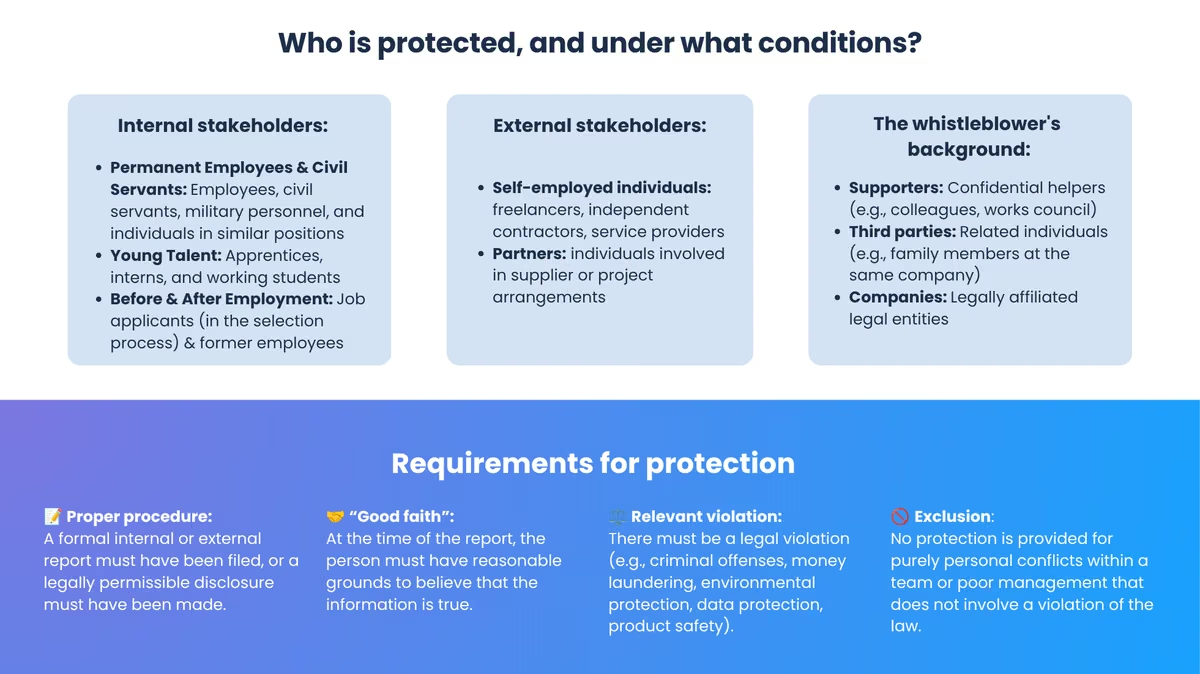
Who is protected and under what conditions?
The personal and material scope of application of the HinSchG is deliberately broad in order to guarantee complete protection.
Personal area of application
The protection extends via Section 34 HinSchG to a large number of actors in the professional environment. In addition to traditional employees, this also includes trainees, interns and working students. Civil servants, soldiers and persons similar to employees as well as former employees and applicants who are currently in the selection process are also protected.
The law also applies to freelancers, self-employed persons, service providers and persons in supplier or project constellations. Finally, the protection even extends to persons who support the whistleblower in confidence (such as colleagues or works councils), to third parties who are connected to the whistleblower (such as relatives in the same company) and to legal entities that are legally associated with the whistleblower.
Requirements for legal protection
Certain criteria must be met for the data subject to be able to claim the protection of the law and thus the reversal of the burden of proof. Firstly, a formal internal or external report or a legally permissible disclosure must have been made. In addition, the whistleblower must be acting in good faith. This means that at the time of the report, the whistleblower must have had reasonable grounds to believe that the information reported is true.
Finally, the report must concern violations that fall within the material scope of the law, such as criminal offenses, violations subject to fines, money laundering, product safety, environmental protection or data protection. Purely personal team conflicts or poor leadership without a specific breach of the law are expressly not protected.
What are the legal and financial consequences for employers?
A violation of the prohibition of reprisals under Section 36 HinSchG is not a trivial offense, but entails severe sanctions. According to § 37 HinSchG, the employer has a comprehensive obligation to pay damages. The employer is obliged to compensate the whistleblower for all financial losses incurred as a result of the reprisal. However, it is important to know that this does not give rise to a direct entitlement to new employment or a specific promotion.
Claims for damages, compensation for pain and suffering and fines
If the employer fails to rebut the presumption of reprisals under Section 36 HinSchG, the legal consequences of Section 37 HinSchG apply:
- Material damages: The employer must compensate the whistleblower for the financial loss suffered. This ranges from compensation for lost salary (in the event of unlawful dismissal) to lost bonuses or training costs.
- Non-material damages (compensation for pain and suffering): Section 37 para. 1 sentence 2 HinSchG expressly stipulates that the whistleblower can also demand appropriate monetary compensation for non-pecuniary losses. If the employee has suffered psychological distress or damage to their honor as a result of the reprisal (e.g. bullying campaign following the report), there is a risk of considerable compensation for pain and suffering.
- Additional fines (administrative offenses): Pursuant to Section 40 HinSchG, taking reprisals or even merely attempting to take reprisals constitutes an administrative offense. Fines of up to EUR 50,000 can be imposed on the persons involved (e.g. managing directors or HR managers). Under the provisions of the Administrative Offenses Act (Section 30 OWiG), this fine can be increased tenfold for legal entities (the company itself) to up to EUR 500,000.
Loss of reputation and personal liability risks for managing directors
The financial aspect is just the tip of the iceberg. In today's highly ESG-driven economy (environmental, social, governance), a whistleblower suppression lawsuit leads to a catastrophic loss of trust among investors, B2B customers and, not least, the skilled labor market.
In addition, the personal liability of the management ("directors' and officers' liability") applies. According to Section 43 GmbHG and Section 93 AktG, managing directors and board members have a duty to ensure a functioning compliance organization (duty of legality).
If an inadequate documentation policy or botched handling of Section 36 HinSchG leads to high compensation payments and fines against the company, the company can hold the managing directors liable for these damages. It is therefore the duty of the managing directors to protect the company against the risks of the reversal of the burden of proof.
Practical example: Termination following an internal notification
To illustrate this in legal practice, here is an example of a case that could be heard in German labor courts on a daily basis.
The case:
Mr. Müller, a key account manager in a medium-sized IT company, has been conspicuous for eight months due to declining sales figures and unreliability. The sales manager has noted this informally in emails to HR, but has never documented official target agreement meetings or issued warnings. On October 1, Müller anonymously reports a breach of compliance guidelines by the sales manager (acceptance of impermissible gifts from suppliers) via the company's digital whistleblowing channel. As Müller's writing style and departmental affiliation are easily identifiable, his identity is quickly treated as an "open secret" within the company, even though the reporting office maintains confidentiality.
On October 24, just three weeks later, the managing director bursts his collar due to another of Müller's mistakes. He issues an ordinary dismissal with due notice for legitimate operational or personal reasons. Müller takes legal action before the labor court and invokes the HinSchG.
The legal assessment under § 36 HinSchG:
In the regular dismissal protection process, the employer would have had to demonstrate the social justification for the dismissal anyway. However, the HinSchG now makes things highly toxic: Mr. Müller claims that the dismissal is a reprisal for his notification of October 1. According to § 36 HinSchG, the pendulum now swings fully in Müller's favor. It is up to the employer to prove beyond doubt that the dismissal is based solely on the reduced performance and has zero causality to the whistleblowing report.
However, as the employer cannot provide watertight, chronological documentation of the poor performance (employee appraisals, performance reviews, warnings) prior to the time of the report, it will fail in court. The temporal proximity between the report and the termination reinforces the legal presumption of causality. The dismissal will be invalid and Mr. Müller will also be entitled to compensation for the reprisal suffered.
Step-by-step plan: How companies can ensure legal certainty when reversing the burden of proof
To prevent the reversal of the burden of proof from becoming a boomerang under labor law, companies must act proactively long before the first report is received. The magic words are: preventive documentation and organizational firewalling.
Step 1: Complete and objective documentation of HR measures (documentation obligation)
The most important protection against Section 36 HinSchG is the ability to provide court-proof evidence of the objectivity of an HR decision. Since companies cannot know who is or will be a whistleblower, the documentation for each employee must be raised to a new level of quality.
- Put feedback culture in writing: Hallway conversations about poor performance are worthless. Instead, standardized, written performance reviews should be introduced at fixed intervals (e.g. quarterly).
- Time stamp and chronology: In order to refute the suspicion of reprisals, it is essential to show that the dissatisfaction with the employee's performance was already documented before the employee reported it.
- Transparent criteria: If bonuses are cut or promotions rejected, the criteria for this must be objective, comprehensible and documented in advance (e.g. degree of target achievement for sales quotas).
- Formulate warnings precisely: Warnings under employment law must describe in detail the place, time and nature of the breach of duty. General reprimands ("You are not concentrating on your work") are not sufficient to justify a subsequent dismissal in court, irrespective of the HinSchG.
Step 2: Strict separation between reporting office and HR department
An organizational "need-to-know" principle is recommended to prevent the accusation of retaliation from arising in the first place. If the manager or HR department issuing the dismissal was demonstrably unaware of the whistleblowing report, it cannot logically be accused of any causal connection (reprisal).
- Independent whistleblowing officer: The person in charge of the whistleblowing system (e.g. compliance officer or an external ombudsman) should ideally not be involved in operational HR decisions (hiring, dismissals).
- Strictly observe the confidentiality requirement in accordance with § 8 HinSchG: The identity of the whistleblower must not be disclosed to line managers (with legal exceptions). To this end, every flow of information within the scope of internal investigations should be precisely documented.
Step 3: Raising awareness and training managers
Many reprisals are not the result of malicious intent, but rather the ignorance of offended superiors. As soon as there is an internal investigation into a tip-off, department heads often become stressed and react emotionally towards employees they suspect of being "traitors".
- Mandatory training should be introduced for middle and senior management.
- In addition, awareness should be raised of what all falls under the broad concept of reprisals under the HinSchG (e.g. also the withdrawal of an exciting project, the refusal of home office days if these are otherwise granted, or targeted exclusion from e-mail distribution lists).
- It also makes sense to implement an escalation process: managers must coordinate with HR and Legal before taking labor law measures against employees who could potentially be involved in compliance investigations.
Step 4: Implementation of a legally compliant, digital whistleblowing system
The best legal defense is useless if the internal reporting processes are prone to errors, undocumented or insecure. An email address or a letterbox do not meet the requirements of the HinSchG in terms of data protection, confidentiality and deadline management.
With special whistleblowing software such as the Hintbox companies kill two birds with one stone: on the one hand, they fulfill the legal obligations to provide a secure, GDPR-compliant and anonymous reporting channel. Secondly, the system offers audit-proof case management. Every step of the investigation, every communication with the whistleblower and every internal measure taken is logged in an audit-proof manner with unalterable time stamps. If proceedings relating to the reversal of the burden of proof should later arise, the company can use the audit log to provide complete evidence of how the case was handled and who had access to which information and when. This is one of the strongest levers for fending off unjustified claims for damages.
Conclusion
The reversal of the burden of proof under Section 36 HinSchG is one of the most stringent and procedurally far-reaching provisions of the Whistleblower Protection Act. It shifts the legal risk of personnel measures following a whistleblowing incident entirely to the employer.
However, companies that establish a legally compliant internal reporting system, document processes properly and promote an open "speak-up" culture protect themselves effectively. A well-functioning whistleblower system should therefore not only be seen as a legal obligation, but also as a valuable tool for minimizing risk, protecting reputation and strengthening internal trust.
Legally compliant reporting system - simple with the Hintbox
Would you like to set up a legally compliant internal reporting system or do you need support in implementing the legal requirements?
Frequently asked questions
The reversal of the burden of proof turns the normal legal rules on their head: If an employee suffers a professional disadvantage (e.g. dismissal) following a compliance report, the court automatically assumes that this was an illegal punishment (reprisal) for his or her report. It is not the employee who has to prove the harassment, but the employer must prove in a court of law that his action had purely objective reasons.
The term is extremely broad. It includes obvious actions such as dismissals, warnings or salary cuts, but also includes "soft" factors. These include negative references, withholding promotions, refusing further training, unjustified transfers, damage to reputation or systematic ignoring (bossing).
In principle, yes, as long as the identity of the anonymous whistleblower becomes known later within the company or during an investigation and he or she is subsequently disadvantaged. If a company has wrongly identified a whistleblower and discriminates against them on the basis of this suspicion, they are also protected.
The law does not define a fixed deadline here (no "expiry date"). As long as a temporal and factual connection between the report and the discrimination can be plausibly established, the protection applies. In practice, however, the legal presumption of causality diminishes the more time passes between the report and the measure. If a dismissal takes place years after the notification, it becomes more difficult for the employee to assert the connection.
Absolutely. The HinSchG is not a "free pass" for bad behavior, theft or underperformance. Whistleblowers can still be dismissed or warned as normal. However, the prerequisite is that the employer can objectively prove, preferably in writing, that the measure was taken due to real misconduct and not out of revenge for the report.
The employer requires objective documents, ideally from the time before the report. This includes signed minutes of employee appraisals, verifiable and missed target agreements (KPIs), written warnings for other misconduct or detailed business evaluations if the dismissal was due to operational reasons (e.g. restructuring of entire departments, independent of the whistleblower). Witness statements are admissible, but are often weaker in labor court proceedings than hard, chronological file notes.

Karim Boukaouche
LinkedInESG compliance expert - lawcode GmbH
Karim Boukaouche advises companies on the implementation of the EU Deforestation Regulation (EUDR) and supports the implementation of digital solutions for legally compliant supply chains. His specialist articles on the lawcode blog combine regulatory depth with practical recommendations for action.