
 DE
DE


Important facts
- What is quality management (QM)?
- QM encompasses all measures to ensure and improve the quality of products and services.
- Why is quality management important?
- It helps companies to reduce error costs, make customers more satisfied and strengthen their competitive position.
- What goals does QM pursue?
- QM aims to ensure high quality, increase customer satisfaction and make processes efficient.
- Which standards are relevant?
- The most important standard is DIN EN ISO 9001, supplemented by ISO 14001, ISO 45001 and industry-specific standards.
- What trends are currently shaping QM?
- Quality control is currently being shaped above all by digitalization, artificial intelligence, big data, automation and sustainability.
Abstract
Quality management (QM) encompasses all measures with which companies ensure and improve the quality of their products and services. As a key success factor, it reduces error costs, increases customer satisfaction and strengthens the company's competitive position. The four basic principles - customer orientation, process orientation, continuous improvement (CIP) and employee involvement - form the foundation of every QM system. Internationally recognized standards such as ISO 9001, ISO 14001 or industry-specific standards such as IATF 16949 provide the framework.
Methods such as TQM, Six Sigma and Lean Management, supplemented by tools such as FMEA, Ishikawa diagrams and the PDCA cycle, have proven themselves in practice. Certifications create trust and are mandatory in many industries. The main challenges lie in the initial expenditure of resources and the permanent anchoring in the company. Digitalization, AI and sustainability are shaping the QM of the future and making it a strategic instrument for innovation and long-term success.
Quality management - definition, importance and objectives
Definition of quality management
Quality management, or QM for short, sounds like a dry day-to-day business at first. But there is a simple idea behind it: if you want to deliver good products and services, you need clear rules and processes that reliably ensure this. And not just once, but permanently. After all, customers today don't just expect something to work - they expect it to always work. This is exactly what QM is for.
Quality control not only affects a single area, but the entire company: from the development of new products, to the purchasing of materials and production, through to sales and customer service. It combines technical solutions with clear organizational processes, defines responsibilities and ensures that work processes are regularly reviewed and improved. This allows errors and quality problems to be identified at an early stage, resources to be used efficiently and risks to be reduced.
Companies are guided by international standards such as DIN EN ISO 9001, which defines exactly what an effective quality management system should look like. Such standards help to maintain uniform quality standards and create trust, both within the company itself and with customers and business partners.
Significance for companies
Quality control forms the backbone of a successful company in the long term. Particularly today, with customer requirements constantly increasing, markets becoming more global and product life cycles becoming ever shorter, systematic quality management is not a "nice-to-have", but a decisive competitive factor. Studies such as the "Cost of Poor Quality" (COPQ) by the University of Alabama show that poor quality in manufacturing companies can account for 15% to 25% of total business costs.
These costs can be significantly reduced through structured quality management, for example with testing processes, training and process optimization.
But the benefits go far beyond that:
- Fewer complaints and higher customer satisfaction strengthen trust and long-term business relationships
- More efficient processes reduce waste and conserve resources. This is a growing advantage in terms of sustainability and CO₂ reduction
- Innovation impulses arise through structured feedback from quality processes. This serves as the basis for targeted product improvements and new developments
- Stronger employer branding through transparent processes and a practiced culture of improvement. This increases the motivation and identification of the workforce, reduces fluctuation and attracts specialists
In the long term, quality management is therefore a decisive lever for successfully asserting oneself in a dynamic market environment.
Quality management objectives
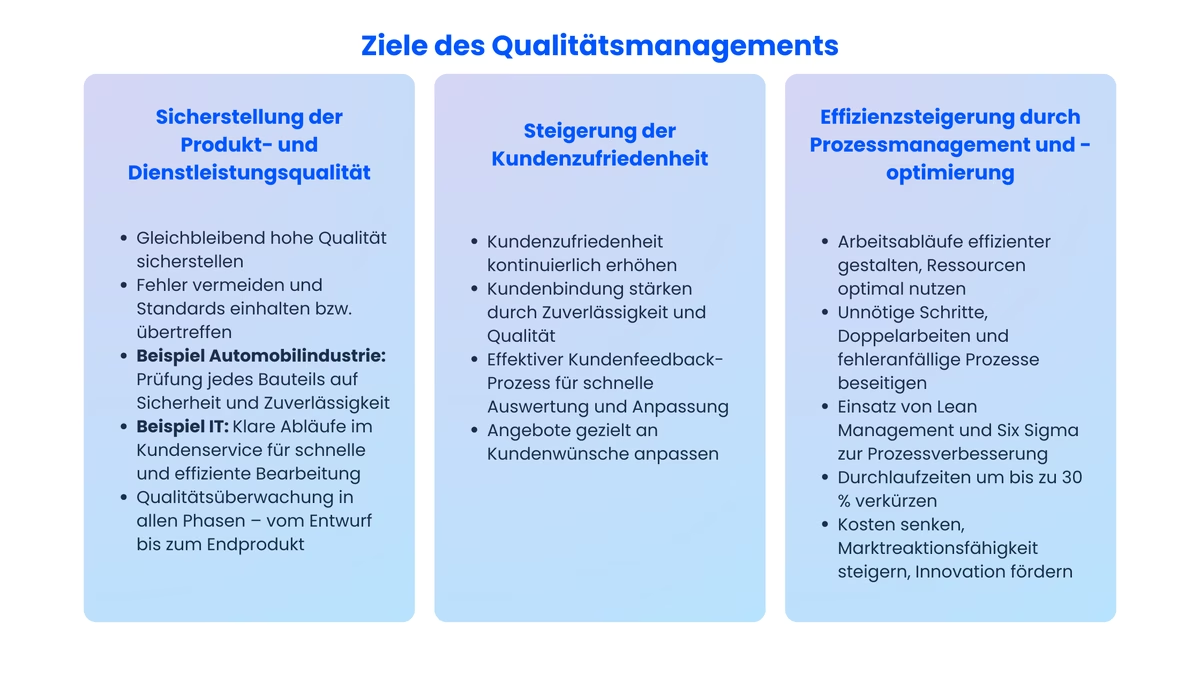
The most important goal is to ensure that products and services are always of a consistently high quality. This is not just about avoiding errors, but also about meeting and, if possible, exceeding defined standards.
A vivid example of this is the automotive industry: every part and every component is tested precisely to ensure maximum safety and reliability. In service sectors such as the IT industry, for example, quality management means that there are clear processes in customer service. This means that inquiries can be processed quickly and efficiently, which increases customer satisfaction. Ultimately, well-organized quality monitoring ensures that the quality is right at all stages of the value chain, from the first draft to the finished product or service.
An important goal of quality management is to constantly increase customer satisfaction. Satisfied customers remain loyal to a company, buy more frequently, recommend products to others and often stick with the brand even in difficult times. A key tool for this is an effective customer feedback process. It ensures that feedback is evaluated quickly and that products or services are specifically adapted to the customer's wishes.
Nobody likes to waste time or money. This is exactly where QM comes in. Unnecessary work steps, duplication of work and error-prone processes are specifically identified and eliminated. Methods such as lean management or Six Sigma help to make processes leaner and noticeably reduce throughput times. The result: fewer frictional losses, better quality and ultimately lower costs.
But what do these terms actually mean in concrete terms? Lean management essentially revolves around one question: where are we currently wasting time, materials or energy and how can we eliminate this? Six Sigma takes a different approach: statistical analyses are used to identify sources of error and optimize them until processes run almost error-free. Both approaches ultimately pursue the same goal: lower costs, faster processes and a company that can react more flexibly to market changes.
Process optimization helps to create lean and stable workflows. This makes companies more agile, more profitable and often also more innovative, as more time and resources are freed up for new ideas.
Basic principles of quality management
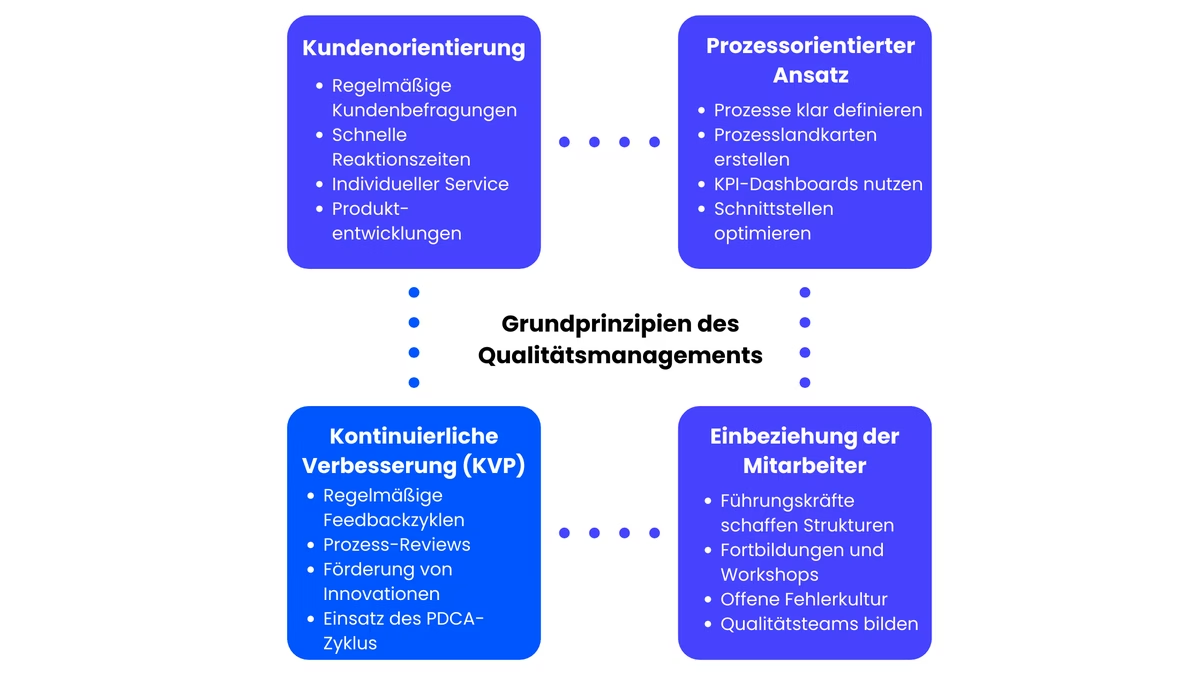
Customer orientation
An important principle in modern quality management is that all activities are geared towards the customer. This means that processes, products and services are designed to meet the current and future needs of customers.
Typical examples of customer-oriented quality management are
- Regular customer surveys to identify wishes and potential for improvement
- Fast response times for complaints or feedback
- Individual service that responds to the customer's situation
- Product developments that are directly geared to customer requirements
Companies that work in this way can constantly improve their offerings, increase customer satisfaction and build long-term customer relationships.
Process-oriented approach
Another important principle in quality management is process orientation. All processes - whether in production, logistics or service - are closely examined and coordinated. The aim is to avoid sources of error, improve handovers between departments and ensure smooth processes. This in turn is important for the strategic orientation of the company.
Typical examples of process-oriented work are
- Clearly define processes and determine responsibilities
- Create process maps to clearly visualize workflows
- Use KPI dashboards to make performance, relevance and improvements measurable
- Optimize interfaces so that information, content and materials flow without delay
On this basis, the entire value chain becomes more transparent, more efficient and continuously improved.
Continuous improvement (CIP)
Quality is not a state that can be achieved once and then ticked off. Markets change, customer requirements increase, and what is good enough today may be outdated tomorrow. This is precisely why QM relies on the continuous improvement process, or CIP for short. The idea behind it is very simple: products, services and processes are not optimized once, but are constantly questioned and developed further.
Typical examples of CIP in practice are
- Regular feedback cycles to identify and evaluate potential for improvement at an early stage
- Process reviews in which procedures are regularly reviewed and adapted
- Promoting innovation at all levels of the company
- Use of the PDCA cycle (Plan-Do-Check-Act) to implement improvements in a structured manner
- Involvement of all employees so that ideas can be realized quickly and independently
Involvement of employees
Successful quality management depends on the active involvement of all employees. Every person in the company is responsible for quality, not just the management.
Typical measures to involve employees are
- Managers create structures in which ideas and suggestions are welcome
- Further training and workshops to strengthen quality awareness
- Quality teams that work together on improvements
- Open error culture in which mistakes are learned from instead of hidden
Companies that see their employees as the most important resource in quality management benefit from greater commitment, fewer absences and greater innovative strength.
QM systems and standards
ISO 9001 and its importance
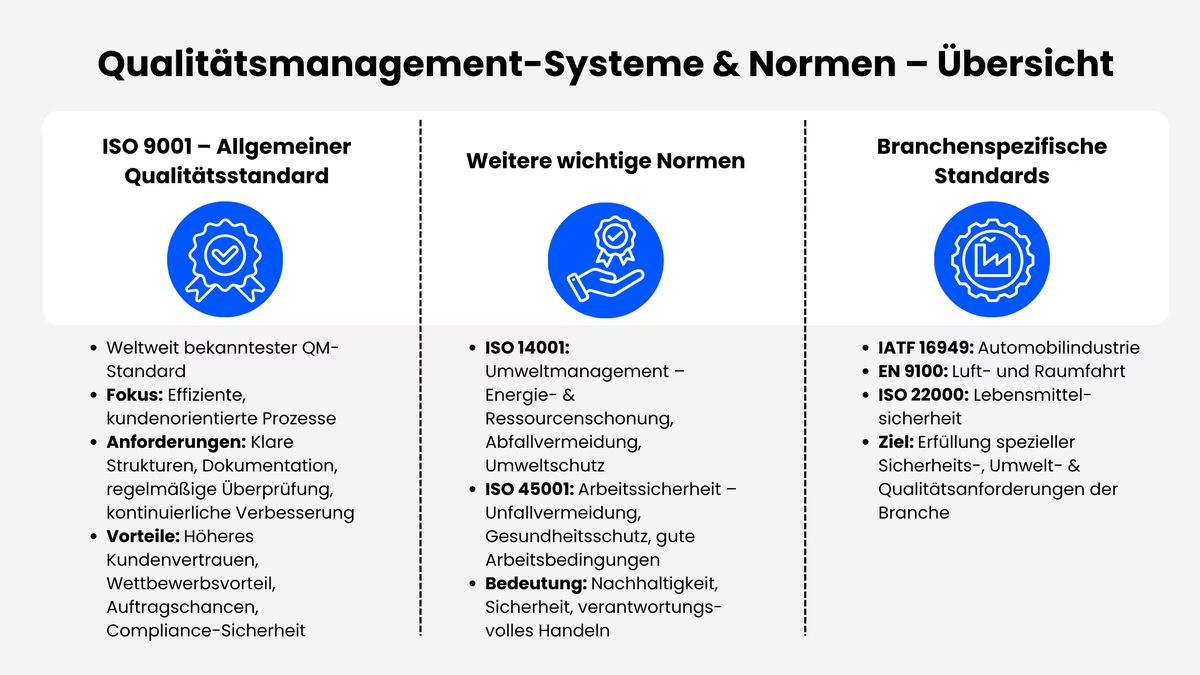
ISO 9001 is the best-known and most important standard for quality management systems worldwide. It describes how companies can design their processes efficiently and consistently align them with customer requirements. At its core, the standard focuses on clear structures, complete documentation, the regular review of all processes and continuous improvement in every area of the company.
ISO 9001 certification pays off in practice on several levels:
- More trust - customers and partners know that work is carried out according to recognized standards
- International competitive advantages - the standard enjoys a very good reputation worldwide
- Better order opportunities - in many sectors it is even a prerequisite for the awarding of contracts
- More targeted risk management and adherence to legal and contractual requirements (compliance)
Other relevant standards (e.g. ISO 14001, ISO 45001)
In addition to ISO 9001, there are many other standards that are important in quality management.
ISO 14001 deals with environmental management - i.e. how companies use less energy and raw materials, avoid waste and comply with legal environmental requirements.
ISO 45001 defines how companies create safe and healthy workplaces - from accident prevention to good working conditions.
These standards are particularly important for companies that operate internationally or work in sensitive areas such as chemicals, food production or the automotive industry. They show that a company takes responsibility for the environment and its employees. They also make it clear that quality today means more than just a good product, but also sustainability, safety and responsible action.
Today, quality means more than just a good product - it also means sustainability, safety and responsible action.
Industry-related standards in quality management
Depending on the industry, there are special standards that are tailored precisely to the requirements of that industry. In the automotive industry, for example, IATF 16949 is very common. It defines what quality management systems must look like in the global automotive industry. In the aerospace industry, EN 9100 is an important standard, while ISO 22000 is used in the food industry. This standard describes how companies ensure food safety at all stages of production.
General quality requirements are a good start, but in some industries they are simply not enough. Anyone working in aviation, food production or the automotive industry faces very specific risks and requirements. This is precisely why industry-specific standards exist: they ensure that companies not only meet basic quality requirements, but also have the specific safety and environmental requirements of their industry under control.
Quality control and assurance
Definition and differences between quality control and quality assurance
In practice, a distinction is often made between quality control and quality assurance. Quality control means that quality is checked directly, for example through product testing or so-called end-of-line tests at the end of production. Possible errors or deviations from the target state are identified and documented. Quality assurance goes one step further. It is strategic and forward-looking.
The aim is to prevent errors from occurring in the first place. This is achieved through planned and systematic measures such as training for employees, analyzing processes or preventive maintenance work on machines.
In short: quality control reacts to errors, quality assurance prevents them. This makes quality assurance the more sustainable approach to error prevention in the long term.
Steps for monitoring and controlling quality
In quality management, quality is monitored step by step. First, the company determines which quality indicators are important and how they are measured. Samples are then regularly taken, tests carried out and measurements taken during production or service provision. All deviations from the desired result are precisely recorded and investigated.
One example of this is statistical process control (SPC): Here, data is constantly evaluated in order to identify problems at an early stage. Feedback from customers and suppliers also helps to identify potential weaknesses and further improve quality.
Measures to correct quality defects
No process is perfect: quality defects and complaints are part of everyday business life. The decisive factor is how you deal with them. Instead of quickly rectifying the error and moving on, QM first asks: Why did this happen in the first place? Methods such as the Ishikawa diagram help to systematically uncover the actual causes. Only then do the concrete steps follow, whether process adjustments, employee training or technical changes.
The aim is not only to rectify the error, but to ensure that it does not occur again in the future. A healthy error culture helps to learn from problems and implement long-term improvements. Companies that consistently proceed in this way reduce their error costs and at the same time strengthen their reputation on the market.
Models, methods and tools in QM
Total Quality Management (TQM)
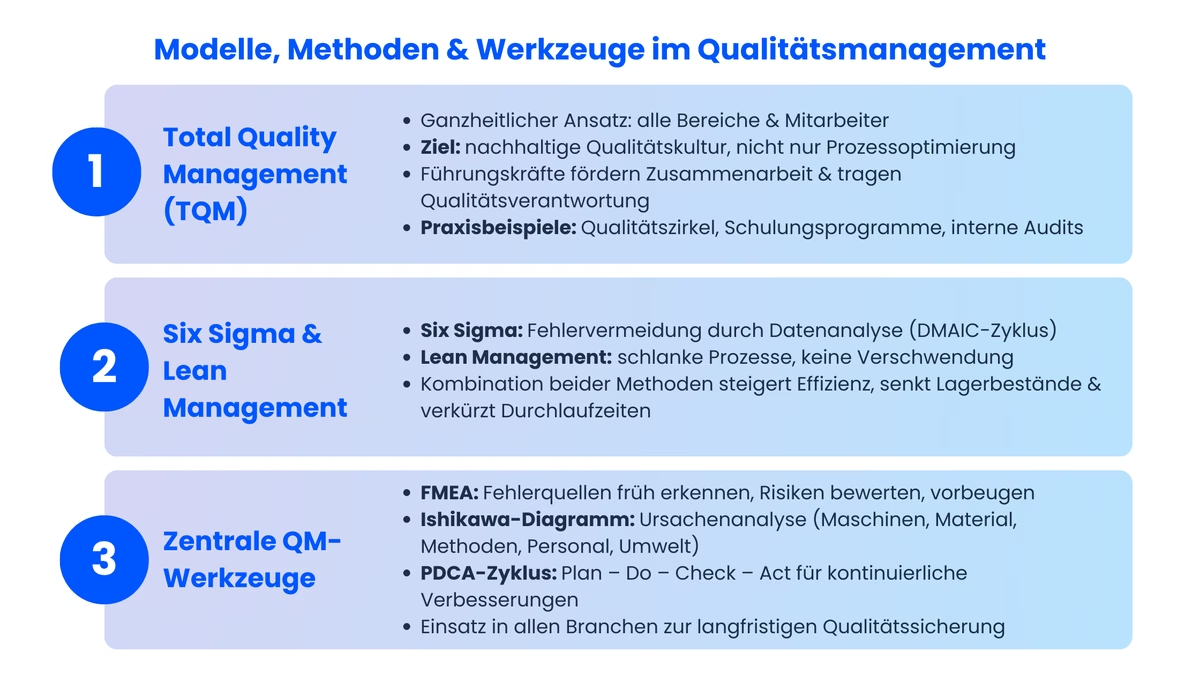
Total Quality Management, or TQM for short, is a comprehensive approach in which all areas of a company and all employees work together to permanently improve quality. The aim is not just to optimize individual processes, but to create a quality culture that is lived throughout the company. Managers play an important role in this: they are responsible for quality and promote close cooperation between all teams.
In practice, TQM is demonstrated, for example, by cross-divisional quality circles, programs to strengthen quality awareness and regular internal audits. TQM is considered one of the most sustainable concepts in quality control. Organizations such as the EFQM (European Foundation for Quality Management) use it to set standards throughout Europe for outstanding corporate management and excellent performance.
Six Sigma and Lean Management
Six Sigma is a method used to optimize processes and significantly reduce errors. The aim is to design processes in such a way that errors are virtually eliminated. It is based on the DMAIC cycle (Define - Measure - Analyze - Improve - Control). Data is collected, analyzed and used to eliminate the causes of problems in a targeted manner.
Lean management has a different focus: the aim here is to make processes leaner and avoid any kind of waste, be it time, materials or unnecessary work steps. Many companies combine both approaches in order to combine their strengths. In industry, for example, efficiency can be increased, stock levels reduced and throughput times shortened.
Tools such as FMEA, Ishikawa diagram and PDCA cycle
There are various methods in quality management that help to identify problems at an early stage, understand their causes and initiate targeted improvements.
The most important of these include:
The FMEA is used to identify potential sources of error as early as the planning phase. It evaluates the possible effects of these errors based on criteria such as severity, probability of occurrence and probability of detection. On this basis, the risk assessment is carried out, risks are prioritized and targeted measures are defined to prevent problems before they even arise.
The Ishikawa diagram graphically depicts the causes of a problem, with the diagram resembling the bones of a fish. It helps teams to systematically consider all possible influencing factors - for example machines, materials, methods, personnel or environmental conditions. This structured analysis enables teams to develop effective solutions together and take all relevant perspectives into account.
The PDCA cycle describes a structured process for improvements. Measures and targets are defined in the plan phase. In the Do phase, these measures are initially implemented on a small scale. In the Check phase, it is checked whether the implementation has achieved the desired effect. In the Act phase, successful solutions are introduced permanently and established as the new standard. As the cycle always starts from the beginning, it supports the continuous improvement of processes.
These tools are used in almost all sectors, from industry and the service sector to healthcare, and form an important basis for ensuring and continuously improving quality in the long term.
The role of certifications
Importance of certification for companies
Certifications play an important role, both for companies and for their partners and customers. They show the outside world that a company complies with defined quality standards such as ISO 9001. This is usually verified by an independent body. Such confirmation strengthens customer confidence and facilitates cooperation with other companies, including internationally. Certificates are often requested or even required in tenders. In some sectors, they are mandatory in order to be allowed to offer certain products or services at all.
Certification process and requirements
The path to certification consists of several steps. First, a quality management system is set up in the company and all important processes are recorded in writing. This is followed by internal audits to check whether processes and documents comply with the specifications. In the next step, an independent certification body visits the company.
It carries out an external audit and checks whether all the requirements of the relevant standard, for example ISO 9001, are met. If the audit is successful, the company receives the certificate. Such a certificate is usually valid for three years. To ensure that it remains valid, surveillance audits are carried out every year. This ensures that the quality standards are maintained at all times. This regular inspection and improvement process is an integral part of every QM certification.
Advantages of certification for the market position
Certification makes a company more credible and helps it stand out from the competition. Customers and business partners can be sure that the company works according to fixed rules and that the quality is right. ISO 9001 certification in particular is often used in marketing and sales, for example as a promise of quality or to win new markets. Studies show that over 80 percent of certified companies are more successful on the market as a result and have significantly increased their turnover. Certification is therefore worthwhile in most cases and also ensures greater success in the long term.
Advantages and disadvantages of QM
Advantages
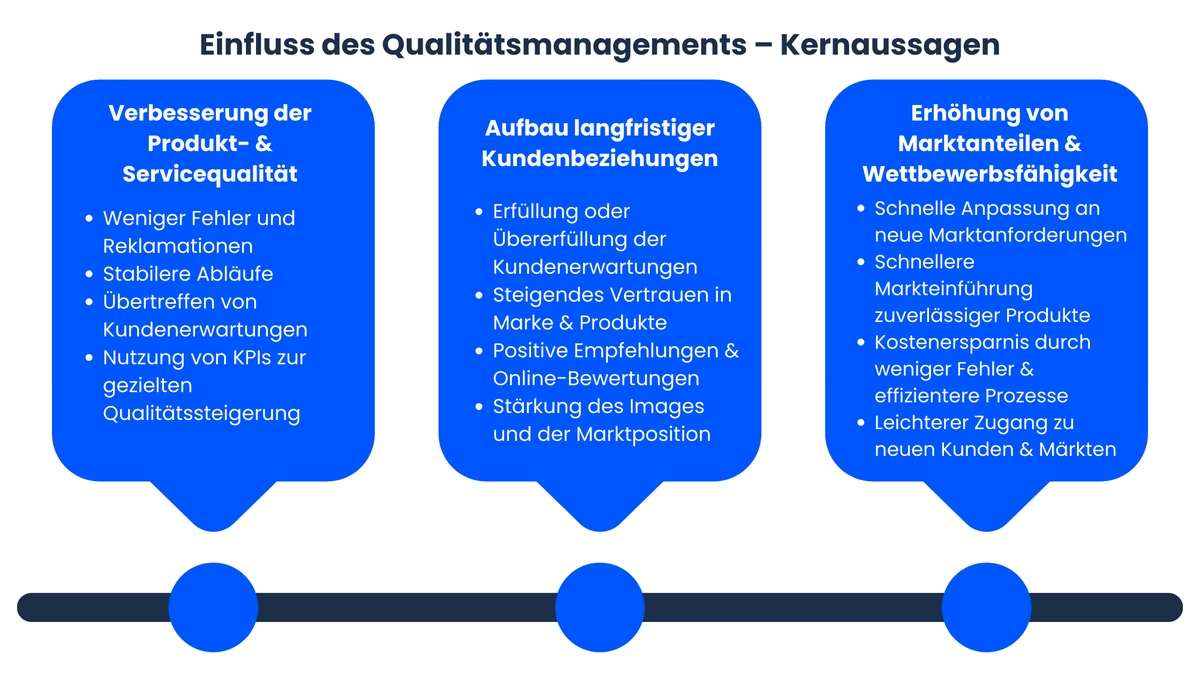
Good quality management not only ensures better products and services, it also means that errors occur less frequently, complaints are reduced and company processes become more stable. In markets with strong competition, this is an important advantage: customers are more satisfied and their expectations can even be exceeded. Many industries, from medical technology to services, now work with clearly defined key quality indicators (KPIs). These show exactly how QM is implemented in practice and how product and service quality can be improved in a targeted manner.
Well-organized quality management helps to build long-term customer relationships. If a company reliably meets or even exceeds its customers' expectations, trust in the brand, the products and the company itself grows. Customers who are convinced of the quality often remain loyal. They give positive feedback, recommend the company to others and also share their positive experiences online, for example on review platforms. This not only ensures a better image, for example in the press, but also strengthens the company's competitive position in the long term.
Companies with a strong quality culture have a clear competitive advantage. They can adapt more quickly to new market requirements, bring reliable products to market faster and save costs thanks to fewer errors and efficient processes. This allows them to grow in the long term. Well-implemented quality management often leads to higher market shares. According to studies, such companies not only manage to retain their existing customers, but also win new customers more easily and enter new markets.
Challenges in the implementation of a QM system
Employee resistance to change
The introduction of a quality management system is often accompanied by major changes in the company. Some employees initially have concerns because they fear new processes, functions or more documentation work. Open communication is particularly important to alleviate these concerns. The objectives and benefits should be clearly explained. Training, further education and training courses that are geared towards the needs of employees help them to get started. In addition, involvement in the continuous improvement process increases motivation and acceptance within the team.
Management plays a key role: managers must act as role models, actively support change and show that quality management benefits everyone in the company. This is how the system can be sustainably anchored.
High expenditure of resources
Especially in the beginning, quality management and risk assessment can cost a lot of time and money. Qualified specialists, suitable software solutions, training and consistent documentation of all processes are required. For small and medium-sized enterprises (SMEs), it is often a challenge to determine the right scope and depth of the QM system.
Good planning helps here. Companies should regularly check the benefits of the system and adjust the scope if necessary. The targeted use of external consultants can also be useful to facilitate the introduction and avoid overloads.
Ensuring continuous improvement
Once a system has been introduced, it is often difficult to keep motivation high for further improvements. Standing still is detrimental to the success of the system. It is therefore important to regularly review familiar processes, support new ideas and motivate the team to make long-term improvements.
For example, an active suggestion system, regular internal audits and projects for new solutions help us to achieve this. In this way, continuous improvement remains an integral part of the corporate culture and quality management is constantly evolving.
Trends and developments
Digitization and automation
Digitalization is bringing major changes to quality monitoring. Today, digital tools record quality data seamlessly, from the first stage of production to the finished product. Automatic inspections, sensors in production systems and artificial intelligence help to detect errors in real time. This allows companies to adapt processes immediately. If the quality management software is linked to the ERP system, documentation becomes easier. At the same time, transparency increases and administrative costs are significantly reduced.
Data analysis and AI in quality management
Big data and artificial intelligence (AI) offer new opportunities, as the analysis of large volumes of data enables companies to identify patterns and trends that indicate errors, waste or opportunities for improvement. AI systems, for example in mechanical engineering, report quality problems automatically or even make adjustments themselves. This makes QM less reactive and more proactive. Simulation models can also help to reduce risks as early as the planning phase. Products can be tested virtually before they are launched on the market.
Sustainability and environmental standards as part of quality management
Sustainability and environmental protection are now an integral part of quality management. Companies not only have to prove the quality of their products, but also demonstrate that their processes are environmentally friendly. This is why environmental management systems such as ISO 14001 are increasingly being combined with traditional QM systems. Customers and business partners are also paying more attention to compliance with social and ecological standards. Quality management therefore no longer just stands for flawless products, but also for responsible and sustainable action.
Conclusion
Today, quality management is no longer an optional extra, but a central element for long-term corporate success. It ensures that products and services are of consistently high quality, customers are more satisfied and processes function more efficiently. Through clear structures, defined processes and orientation towards recognized standards such as ISO 9001, companies create transparency, reliability and trust, both internally and with customers and partners.
Anyone who sees quality management only as a tool for error prevention is wasting enormous potential. Because when done well, QM is much more than that: it drives innovation, optimizes processes and creates the basis for sustainable growth. The prerequisite for this is that it is truly lived: by all employees, with a genuine desire to improve and open to current developments such as digitalization, AI and sustainability. Companies that implement this consistently notice it in two places at once: in the short term through fewer errors and leaner processes, and in the long term through loyal customers and a strong market position.
Frequently asked questions
Quality management is more than just a department or a checklist. It encompasses all measures and structures that a company uses to ensure that its products and services are of a consistently high quality, from planning and implementation to continuous improvement. And the decisive factor: It doesn't just affect individual areas, but the entire company, from management level to the last employee.
A well-established QM system brings more than just flawless products. Processes become more transparent, error costs are reduced and customer satisfaction increases because quality is not left to chance but is systematically assured. In addition, there is a stronger market position, which in many cases can also be proven in black and white: through certification.
The difference is simpler than it sounds: quality control looks back - it checks whether a product or service meets requirements after it has already been created. Quality assurance, on the other hand, thinks ahead. It does not ask "Did a mistake happen here?", but "How do we prevent it from happening in the first place?", for example through clear standards, targeted training or optimized processes.
There is no legal obligation for certification. In practice, however, things often look different: Anyone working in the B2B sector or applying for public tenders will sooner or later find that an ISO 9001 certificate or a comparable industry-specific standard is simply a prerequisite. Not a formal must, but in many cases a decisive factor.
In the past, quality data was recorded, evaluated and documented manually. This was a time-consuming process with plenty of room for error. Today, it is done in real time. Digital platforms, big data and artificial intelligence make it possible to identify problems before they even arise. For companies, this means fewer rejects, faster processes and QM that no longer lags behind but thinks ahead.

Matthias Klein
LinkedInESG-Compliance Experte · lawcode GmbH
Matthias Klein berät Unternehmen bei der Umsetzung von Supply Chain Gesetzen wie der CSDDD und begleitet die Implementierung digitaler Lösungen für rechtssichere Lieferketten. Seine Fachbeiträge auf dem lawcode Blog verbinden regulatorische Tiefe mit praxisnahen Handlungsempfehlungen.