 DE
DE


Important facts
- What is the PPWR?
- An EU regulation that uniformly regulates packaging and packaging waste.
- When does it become binding?
- From August 12, 2026, with further obligations in subsequent years.
- Who is affected by the EU Packaging Regulation?
- All companies that place packaged goods on the market in the EU.
- What's new?
- Packaging is considered an independently regulated product.
- How are duties assigned?
- Via clearly defined roles along the supply chain.
- What do companies need to do?
- Evaluate, document and verify packaging in relation to the product.
Abstract
The Packaging and Packaging Waste Regulation (PPWR, Regulation (EU) 2025/40) replaces special national regulations and introduces a uniform system for design, labeling, verification and responsibilities. Packaging is thus treated as an independently regulated product for the first time.
Obligations do not apply across the board to companies, but to specific products according to the respective role as producer, manufacturer, importer or distributor. Incorrect role classifications are among the greatest compliance risks and can lead to sales stops, sanctions and reputational damage.
Implementation will be staggered, with binding core requirements from August 12, 2026. The greatest effort is not in individual detailed specifications, but in setting up reliable packaging data, clear responsibilities and audit-proof processes. Those who clearly define roles, contractually secure supply chains and systematically align packaging with PPWR criteria reduce risks and create the basis for competitive, recyclable packaging solutions.
What is the PPWR? Definition, objectives and background
Definition: The PPWR as the new European packaging regulation
The Packaging and Packaging Waste Regulation, or PPWR for short, is the new European packaging regulation. It officially came into force on February 11, 2025 and will be binding in all EU member states from August 12, 2026. Unlike the previous Packaging Directive 94/62/EC, the PPWR applies directly and creates a uniform legal framework for packaging throughout the EU for the first time.
The regulation applies to all packaging, regardless of material or sector, and covers product packaging as well as secondary packaging and transport packaging. It is aimed at all companies that design, manufacture, fill or import packaging or place packaged goods on the market in the EU under their own brand.
The aim is to significantly reduce packaging waste and thus strengthen the circular economy. The aim is to reduce packaging waste by 15% across the EU by 2040. For companies, this means new obligations, but also the need to adapt packaging, processes and responsibilities to the upcoming requirements at an early stage.
Key objectives of the PPWR
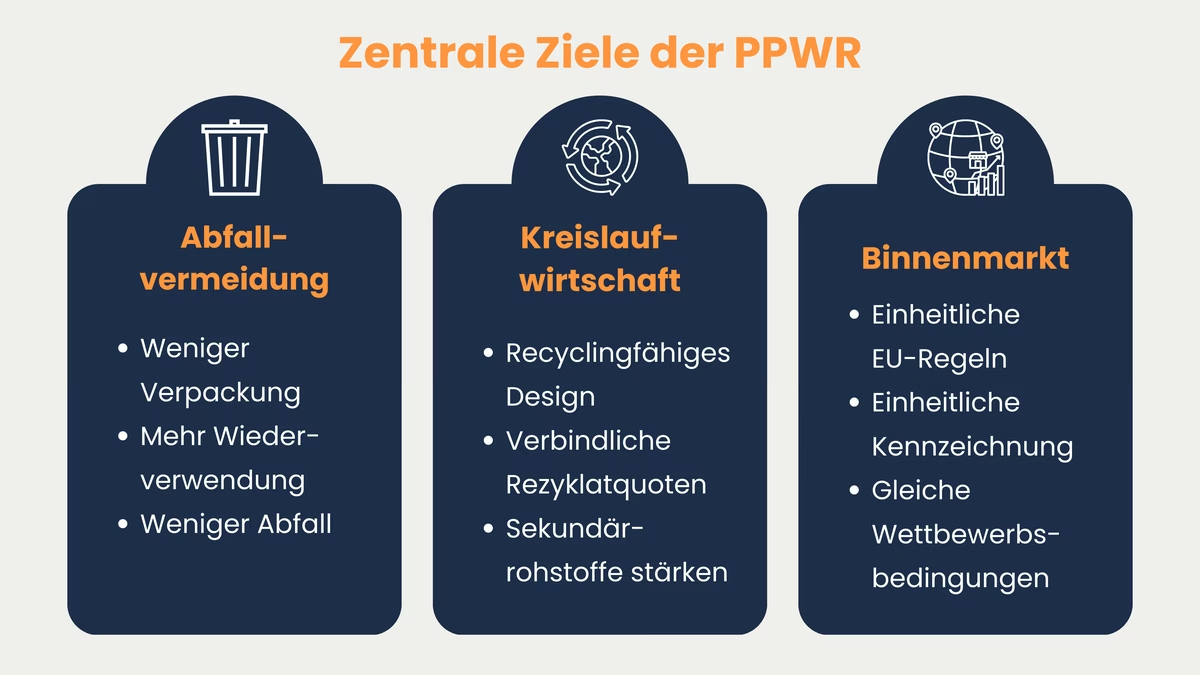
With the PPWR, the EU is pursuing the goal of fundamentally changing the way packaging is handled. The focus is on the transition to a functioning circular economy in which packaging generates less waste and remains in the material cycle for longer.
- Reduce packaging waste: One aim is to reduce packaging waste overall. The aim is to significantly reduce the amount of waste by setting targets for avoiding unnecessary packaging and for reuse. The background to this is the trend of recent years: without additional measures, packaging waste in the EU would continue to rise.
- Improve recyclability: At the same time, the PPWR focuses on better recyclability. Clear design requirements and binding recyclate quotas are intended to ensure that packaging can actually be recycled and that high-quality secondary raw materials are created in the process. In this way, the EU aims to reduce dependence on primary materials and strengthen the market for recycled materials.
- Standardize the internal market: A third key objective of the PPWR is a single internal market. The Packaging Ordinance replaces different national regulations with common EU-wide rules. Uniform labeling and information requirements are intended to make implementation easier for companies and ensure a level playing field in all member states.
In summary, the Packaging and Packaging Waste Regulation is intended to enable growth and innovation without increasing resource consumption and packaging waste. Sustainability thus becomes an integral part of the product and packaging strategy.
Recyclate quotas for plastic packaging
Recyclate quotas determine how much recycled material a packaging must contain. In other words, they stipulate the minimum proportion of recycled material rather than virgin raw material. The aim is to make recycling economically viable and reduce the use of primary materials. According to the PPWR, binding minimum recycled content only applies to plastic packaging and will be introduced in two stages. The decisive factor here is whether the packaging has direct contact with the packaged product (contact-sensitive) or not.
From January 1, 2030, plastic packaging must contain between 10% and 35% post-consumer recyclate (PCR), depending on the category. For contact-sensitive PET packaging, such as food packaging, for example, a quota of 30% applies. For non-contact-sensitive packaging, the requirements are up to 35%. These quotas will increase further from January 1, 2040.
Important: The exact calculation methods and verification requirements will be specified in delegated acts to be adopted by January 2029 at the latest.
Why the PPWR affects companies structurally
The PPWR (Regulation (EU) 2025/40) tackles where decisions about packaging are actually made. It shifts responsibility along the supply chain and makes it clear that packaging compliance does not just start at the end, but already in product development, purchasing and brand management. Specifications on recyclability, the use of recyclates, reuse or certain disposable packaging can only be implemented if these areas are involved at an early stage.
At the same time, the PPWR requires clear and reliable data. Companies must be able to prove at any time what materials their packaging is made of, how high the weight and recycled content are and what role they play for a specific product. This role can be that of a producer, manufacturer, importer or retailer.
This has a direct impact on internal structures:
IT systems, master data, supplier relationships, quality management and compliance processes must be set up in such a way that information can be consistently recorded, updated and checked. The PPWR thus becomes a governance task that is as much about market access, cost control and reputation as it is about ecological impact.
Why the EU has introduced new packaging rules
The previous EU Packaging Directive largely left the specific form to the member states themselves. In practice, this led to different definitions, deadlines and verification requirements. Particularly with regard to extended producer responsibility, licensing systems and labeling, each EU country has found its own ways to implement this. A uniform packaging directive will prevent this.
At the same time, packaging volumes continued to rise. In the EU, over 80 million tons of packaging waste were recently generated each year. While paper and cardboard achieved comparatively high recycling rates, the recycling of plastic packaging lagged significantly behind. Although the directive set targets, it hardly had a sufficient steering effect. The result was a system with a growing administrative burden, limited ecological effect and increasing complexity for companies.
Different national rules as an obstacle to competition and compliance
For companies operating across national borders, the national differences in the directive became a real locational disadvantage. Identical products had to be labeled, registered and documented differently depending on the country of sale.
Typical challenges were:
- Different labeling and disposal instructions
- Various registration and reporting obligations
- Deviating data formats and reporting obligations
This patchwork led to higher costs, made it difficult to work efficiently in larger quantities and weakened the effectiveness of recycling because packaging was not uniformly recognizable. Small and medium-sized companies in particular faced significantly higher barriers to market entry as a result.
The PPWR addresses this by creating uniform definitions, clear roles along the supply chain and harmonized labelling and information requirements.
Packaging as the key to the European circular economy
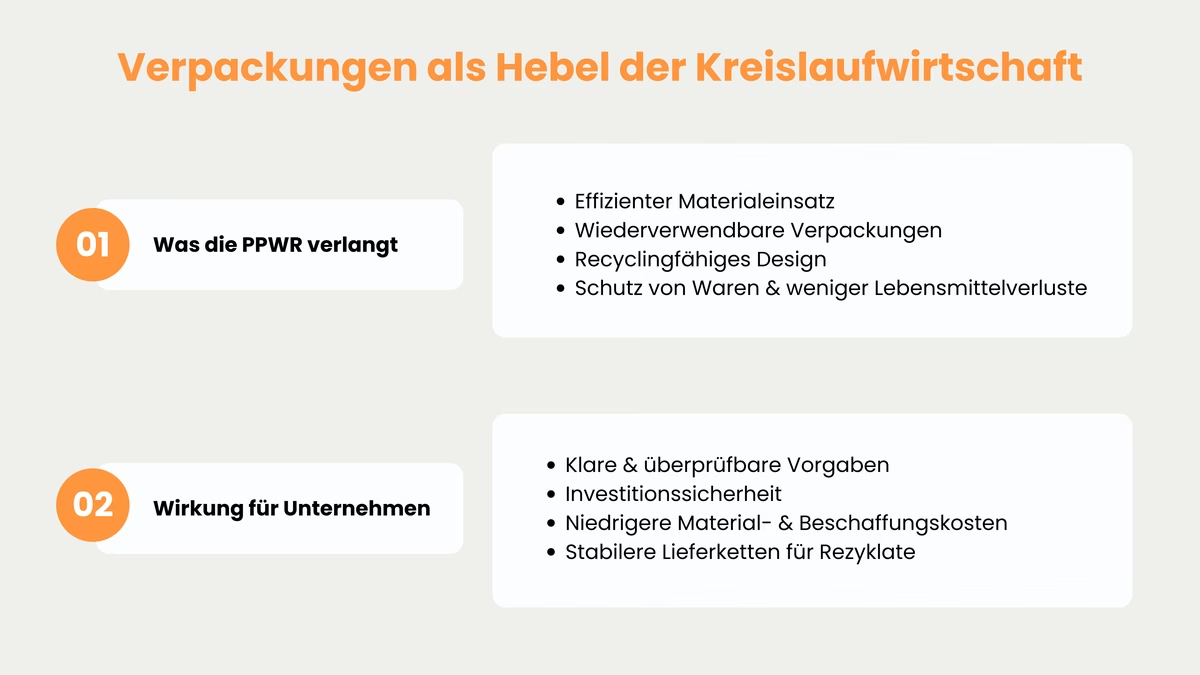
Packaging is ubiquitous, easily standardized and circulates in large quantities. This is precisely why the EU sees it as a key lever for the transition to a circular economy.
With the PPWR, packaging should be designed in such a way that it:
- Use material efficiently
- Enable reuse
- Support high-quality recycling
- protect goods and reduce food losses at the same time
The PPWR complements other EU initiatives, such as ecodesign, life cycle assessment and green claims, with clear and verifiable requirements. It sends a clear signal to companies to invest at an early stage. Those who rely on recyclable packaging, reliable packaging data and stable supply chains for recycled materials can reduce costs and secure supply in the long term - especially if the demand for recycled materials continues to rise due to binding quotas.
Digital product passport and QR code obligations: What companies need to know from 2027
The PPWR is gradually introducing binding requirements for the digital labeling of packaging. What was previously voluntary will now become mandatory: in future, packaging must bear machine-readable codes that provide structured information on materials, recyclability and disposal. The introduction will be staggered in three stages.
From February 2027: EPR labeling via QR code
From February 12, 2027, Member States may require packaging that falls under an EPR system (extended producer responsibility) to bear a digital label. This should only be permitted in the form of a QR code or a comparable open and standardized technology (Art. 12 para. 9, Regulation (EU) 2025/40).
The requirement is initially optional at national level. However, as soon as a Member State introduces it, the form is mandatory: separate national symbols or labels that could mislead consumers about recyclability or reusability are no longer permitted.
For companies that are active in several EU markets, this means that they must actively monitor the national implementation decisions of their sales countries in order to be able to react in good time.
From August 2028: Harmonized labelling on material composition mandatory
From 12 August 2028, all packaging placed on the market must bear a harmonized material composition label. The aim is to provide consumers across the EU with standardized information on how to separate waste correctly.
Depending on the type of packaging, information on compostability, reusability or recycled content is also mandatory. For certain information, such as on reuse, digital provision via QR code or another open data carrier is mandatory.
At the same time, waste containers for separate packaging collection must also be provided with harmonized markings that match the packaging labels from this date.
From February 2029: Labeling for reusable packaging
Reusable packaging placed on the market from February 12, 2029 must also bear a label informing consumers of its reusability (Art. 12 para. 2, Regulation (EU) 2025/40).
What this means for companies in practice
The staggered labeling requirements affect packaging design, master data and supplier relationships at the same time. Designs must provide space for QR codes and standardized symbols, which must be clearly visible and permanently legible. Behind this is data: Material compositions, recycled content and disposal instructions must be complete and up-to-date for each packaging. It is important to note that the PPWR stipulates open, standardized technologies; proprietary labelling systems do not meet the requirements.
Timetable and PPWR deadlines
Entry into force and start of application of the Packaging Ordinance
The PPWR has already come into force as an EU regulation, but its obligations do not come into effect at once. The legislator has deliberately provided for transitional periods so that companies can adapt their packaging, processes and data structures.
It is important to distinguish between entry into force and application:
- February 11, 2025: Entry into force of the PPWR
- August 12, 2026: Start of mandatory application of central requirements
From the date of application (August 12, 2026), companies must be able to prove that their packaging meets the basic requirements of the EU Packaging Regulation. This includes clearly defined roles, complete packaging data and traceable documentation.
Staggered implementation instead of a single cut-off date
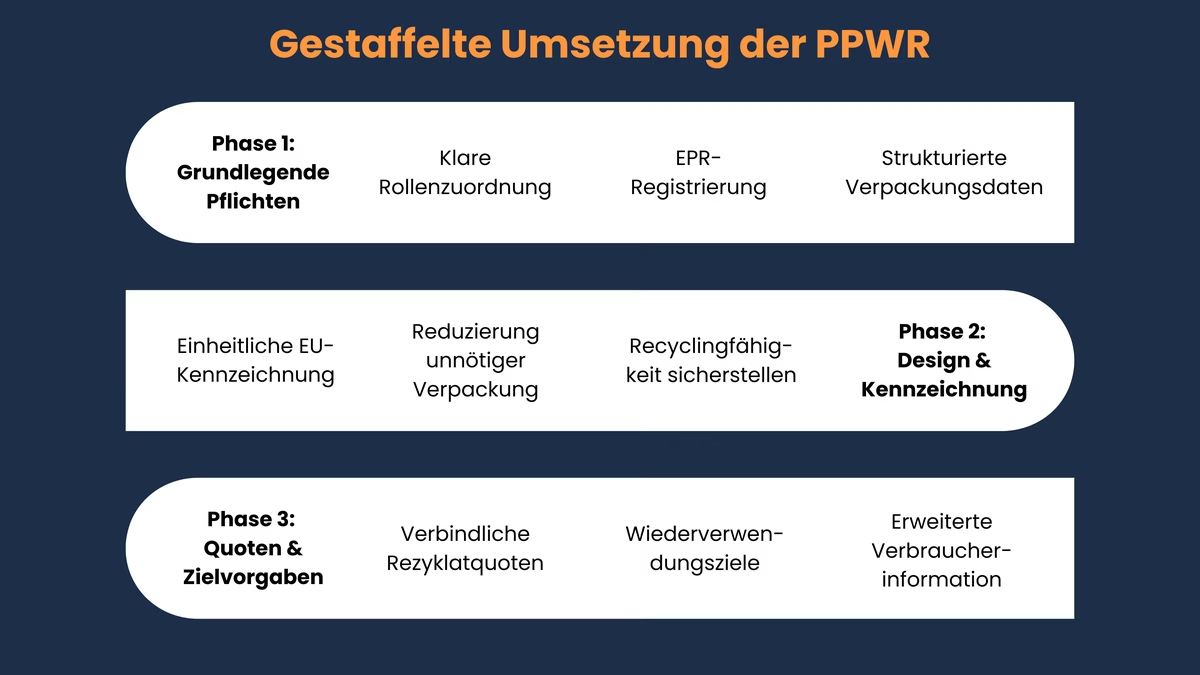
The PPWR does not apply from a single fixed cut-off date. Instead, the requirements are introduced gradually. Which obligations apply and when depends on how complex they are to implement technically and organizationally.
Three phases can be distinguished:
- Basic obligations
Clear assignment of roles, registration as part of extended producer responsibility, provision of structured packaging data. - Design and labelling requirements
Specifications for recyclability, limitation of unnecessary packaging volumes and EU-wide harmonized labelling requirements, which will be specified in the following years. - Quotas and targets
Binding recyclate quotas for plastic packaging, reuse quotas in certain sectors and comprehensive information requirements for consumers.
Many technical details are defined via delegated acts. This allows the EU to continuously adapt criteria to the state of the art and the market without changing the basic framework of the regulation.
What will be prohibited from January 1, 2030
The PPWR not only stipulates how packaging must be designed. It also bans specific packaging formats from January 1, 2030. Only single-use plastic packaging is affected in certain areas of application (Annex V, Regulation (EU) 2025/40). Companies in the catering, hotel and food retail sectors should check at an early stage whether their product range is affected.
Prohibited as of January 1, 2030:
- Hospitality industry - single-serve packaging: Disposable plastic packaging for condiments, sauces, coffee creamers, sugar and spices served in the hospitality industry
- Hotels - small toiletries packaging: Disposable plastic bottles for shampoo, hand and body lotion and individually wrapped bars of soap
- Food retail - fruit and vegetables: single-use plastic packaging for unprocessed fruit and vegetables weighing less than 1.5 kg
- Gastronomy - food and beverages on site: disposable plastic packaging for food and beverages consumed directly at the point of sale
- Retail - bundling films: disposable plastic outer packaging used exclusively to bundle several individual products at the point of sale
Note: The bans do not apply to composite packaging with a plastic content of less than 5%.
In addition: ban on deceptive packaging
The ban on excessive packaging will also apply from 2030. Packaging that feigns a larger volume than the contents justify due to double walls, false bottoms or unnecessary layers of material will not be permitted. An upper limit also applies to outer packaging, transport packaging and e-commerce packaging: the empty space may not exceed 50% of the total volume.
Why early preparation is crucial
The greatest effort does not come from individual bans or labeling, but from the creation of reliable data on packaging and products. Companies must be able to prove at any time what materials their packaging is made of, how high the recycling percentage is and what role it plays for the respective product.
Those who act early gain several advantages:
- More time for design iterations and material tests
- Better negotiating position with suppliers and recyclate providers
- Lower risk of short-term changes shortly before deadlines
- Clearly documented role assignment instead of later corrections
If you start early, you avoid short-term emergency solutions and can gradually integrate the PPWR requirements into existing processes. This ensures greater planning security and reduces costs and compliance risks in the long term.
Who is affected by the PPWR?
Principle: Anyone who places packaged goods on the EU market is affected
The Packaging Ordinance affects almost every company that makes packaging or packaged goods available on the EU internal market. The decisive factor is not who produces the packaging, but who places it on the EU market for the first time. This means that significantly more players are coming into focus than before.
In addition to traditional packaging manufacturers and bottlers, the following are particularly affected:
- Brand owners who sell products under their own name
- Retail companies with own brands
- E-commerce companies and marketplace operators
- Importers of packaged goods from non-EU countries
The PPWR consistently links obligations to roles along the supply chain. It starts where decisions on packaging design, material use, labeling and market entry are made and where the relevant information is available.
Why a company can take on multiple roles
In practice, supply chains are rarely clearly structured. Many companies take on different functions depending on the product, brand or distribution model. It is precisely this reality that the PPWR addresses.
For example, a company can be considered a producer for its own brands because its name appears on the packaging, while it only acts as a distributor for other products if it sells branded goods within the EU. If packaged goods are imported into the EU from a third country, the same company also assumes the role of importer. This happens regardless of where the packaging design originated.
Platform and marketplace models in particular show that companies can take on multiple roles. Depending on how contracts are structured, where goods are stored and who organizes shipping, a company can be legally considered a retailer, importer or, in certain cases, even a producer of the packaging.
The PPWR thus makes it clear that roles are not fixed company characteristics, but product and context-dependent assignments. They must be reassessed for each product and can overlap several times within a company.
Product-related instead of company-related consideration
An important change in the Packaging Ordinance is that companies are no longer categorized across the board. The decisive factor is not what a company is in principle, but what role it plays for a specific product and its packaging.
One and the same company can therefore:
- be responsible for a private label as a producer
- apply as importer for imported goods
- only act as a dealer for branded goods available throughout the EU
This product-related view requires more transparency in the master data and clear documentation of the respective role. This is the only way to correctly assign obligations such as labeling, registration as part of extended producer responsibility and financial contributions. If this clarity is lacking, gaps in responsibility arise, which is one of the greatest compliance risks under the PPWR.
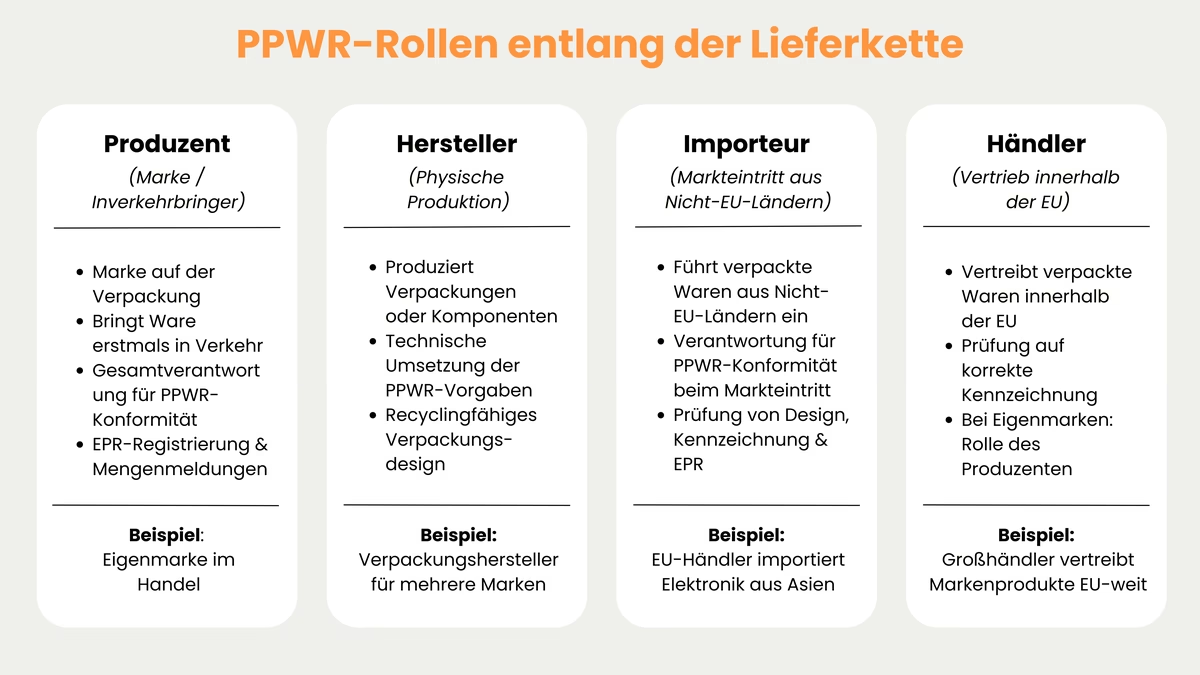
PPWR roles explained: responsibilities along the supply chain
According to the PPWR, the producer is the company whose name or brand appears on the packaging and which makes the packaged goods available on the EU internal market for the first time. This role is central, as it bears the most responsibility. Producers must ensure that the packaging meets the material and functional requirements of the EU Packaging Regulation, is correctly labeled and fulfills all information requirements.
This also includes participation in extended producer responsibility schemes. Producers must register, report packaging quantities and bear the costs for collection and recycling. To do this, they need reliable data from their packaging and material suppliers, which they must check and document in a traceable manner.
The PPWR thus clearly shifts responsibility to the brand. Even if packaging is designed or manufactured externally, the producer remains responsible for ensuring regulatory compliance.
Example: A retail company sells food under its own brand. Even if packaging and filling are carried out by external service providers, the retail company is considered the producer because its brand appears on the packaging.
Manufacturers are the companies that physically produce packaging or packaging components. Their responsibility lies primarily in the technical implementation of the PPWR specifications. They must design packaging in such a way that it is recyclable, unnecessary combinations of materials are avoided and weight and volume specifications are met.
In practice, this makes manufacturers important partners for producers. They influence whether recycled materials can be used, whether packaging is easy to sort and whether the design enables subsequent recycling. The collaboration therefore goes beyond purely functional and cost issues and increasingly also takes recyclability and legal requirements into account.
Example: A packaging company produces plastic trays for various brands. It does not place any packaged goods on the market itself, but as the manufacturer it is responsible for the technical design of the packaging and its recyclability.
Importers take on a particularly demanding role. They are considered to be the distributor when packaged products from a third country are imported into the EU for the first time and no other EU-based player assumes this role. This means that they are responsible for packaging that is often designed outside their direct sphere of influence.
Importers must ensure that packaging meets the PPWR requirements before it is sold in the EU. This includes requirements for design, labeling, language and the visibility of information as well as the fulfillment of EPR obligations (extended producer responsibility) in the respective countries. If documents are missing or incomplete, the goods cannot be placed on the market or must be adapted later at great expense.
Example: A European electronics retailer purchases packaged devices from a supplier in Asia. When the goods enter the EU, the retailer becomes the importer and must ensure that the packaging complies with PPWR requirements.
Retailers and distributors are not purely passive players under the PPWR. Even if they neither manufacture nor import packaging, they must check that the products they sell are correctly labeled and have no obvious conformity defects.
Special care is required for private labels. In these cases, retailers are considered producers and assume all corresponding obligations. In addition, they must pass on relevant information along the supply chain and quickly implement new regulatory requirements in their product ranges. Those operating in several EU countries must also ensure that language and design requirements are correctly taken into account in product data and packaging.
Example: A wholesaler buys packaged branded products from an EU manufacturer and sells them on in several member states. He is considered a distributor and must check whether the labeling and product information comply with the respective national requirements.
How companies determine their PPWR role: Role classification in practice
The determination of the role in the Packaging Directive does not start at company level, but always at product level. The decisive factor is who makes a packaged product available on the EU internal market for the first time and under which name or brand it is offered. This often already determines whether a company is considered a producer.
In addition, the origin of the goods should be checked. If a product is imported into the EU from a third country, the importer assumes responsibility for PPWR compliance - regardless of who developed the packaging or design.
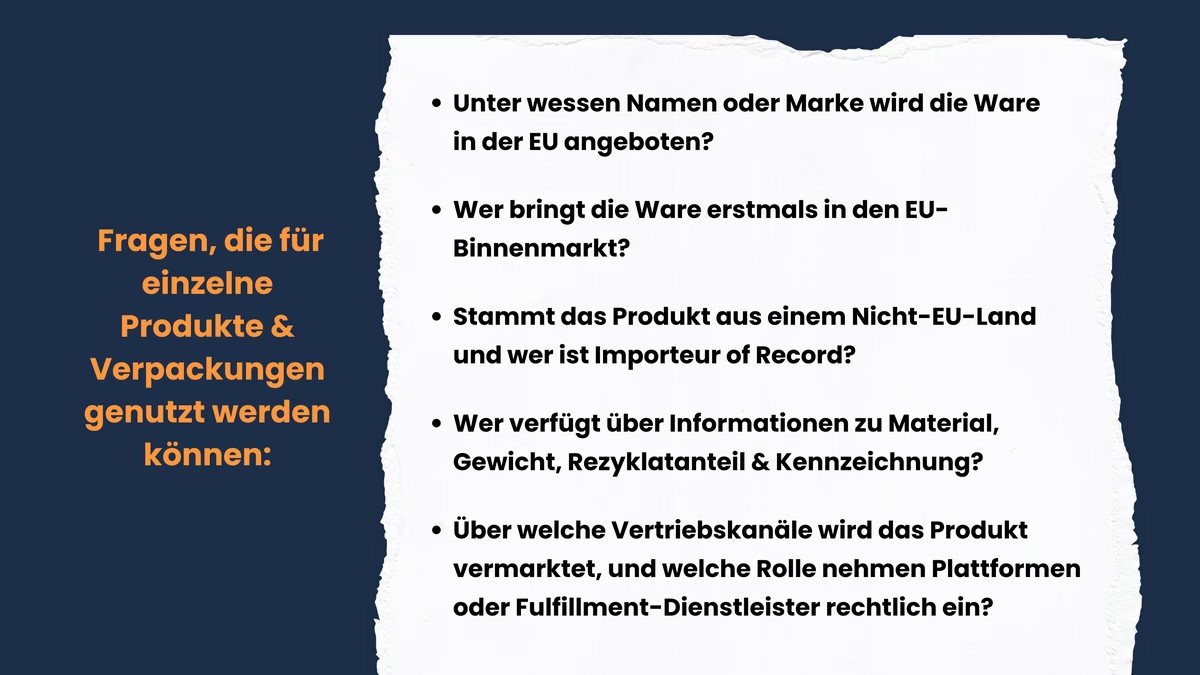
A structured sequence of key questions that is applied in the same way for each product is helpful:
- Under whose name or brand is the product offered in the EU?
- Who brings the goods into the EU internal market for the first time?
- Does the product originate from a non-EU country and who is the importer of record?
- Who actually has reliable information on material, weight, recycled content and labeling?
- Which sales channels are used to market the product, and what is the legal role of platforms or fulfillment service providers?
The answers are used to create a role profile for each product. This is not permanently fixed. Changes to the product range, suppliers or sales can change duties and should therefore be reviewed regularly.
Typical misconceptions and how companies can avoid them
In practice, role classification rarely fails due to a lack of will, but rather due to false assumptions.
Misconception 1: "The responsibility lies with the packaging manufacturer."
→ Although the manufacturer has technical obligations, the brand owner bears the overall regulatory responsibility.
Misconception 2: "Fulfillment service providers or marketplaces automatically assume PPWR obligations."
→ Without a contractual arrangement, the responsibility remains with the goods owner.
Misconception 3: "A single registration is sufficient."
→ The PPWR requires continuous updating of data and evidence.
To avoid these risks, roles must be clearly and systematically documented. In practice, it helps to add PPWR-relevant information to the article master data, such as the role per product, EPR registrations, material and weight data as well as valid markings. This information should be backed up by clear regulations in the supplier contracts.
Clear approval processes are also necessary. Packaging should only be used once all requirements have been met and the evidence is complete. Clean and comprehensible documentation facilitates audits, reduces liability risks and ensures transparency throughout the entire supply chain.
Risks and sanctions
Incorrect role classification: the central compliance risk of the PPWR
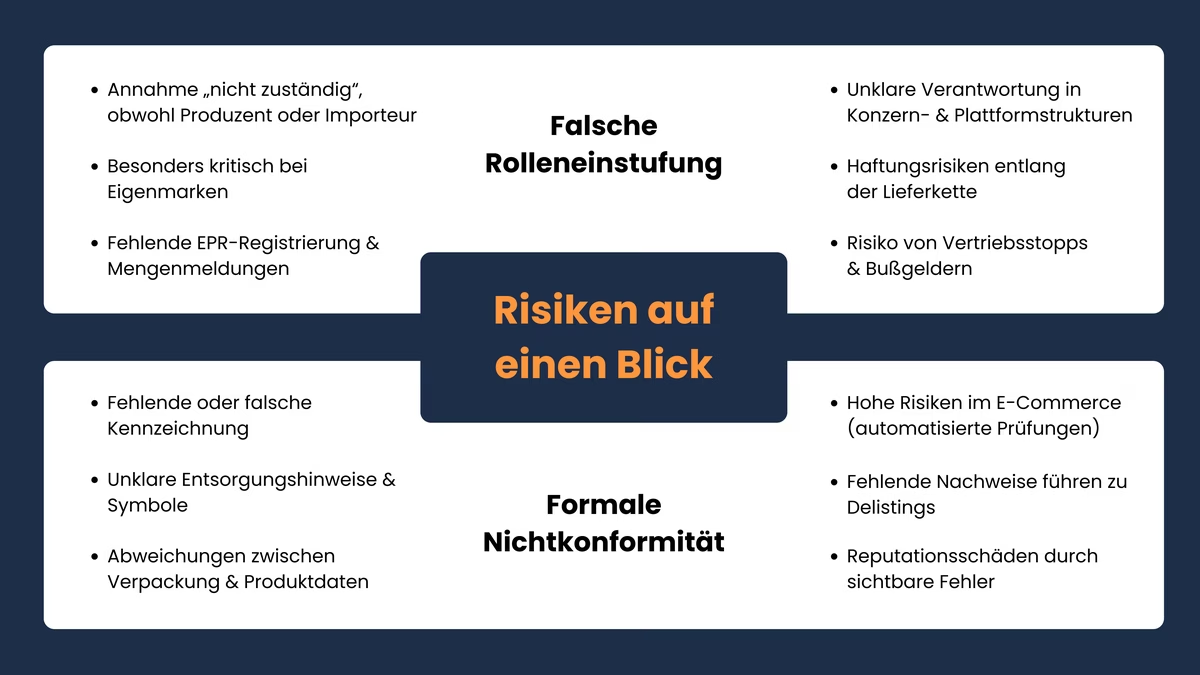
The greatest risk under the PPWR does not arise from individual detailed specifications, but from an incorrect or incomplete classification of one's own role. Anyone who assumes that they are not responsible for certain obligations, even though they are legally considered a producer or importer, exposes themselves to considerable compliance risks.
⚠️ Own brand risk: Anyone who has their brand on the packaging is considered a producer - regardless of who manufactures or fills the packaging.
⚠️ Group structure risk: Distributed responsibilities do not protect against liability. The PPWR assigns duties to roles, not departments.
⚠️ Outsourcing risk: Anyone who outsources operational tasks retains regulatory responsibility - provided they control the brand, market access or imports.
Formal non-conformity: If labeling, data or evidence is missing
In addition to role allocation, formal requirements pose a significant risk. The PPWR introduces harmonized labelling and information requirements that must not only be implemented correctly, but also completely, visibly and consistently.
Incorrect or incomplete labeling is considered non-compliant. This also applies if the packaging is basically recyclable. This includes missing language, incorrect symbols or unclear disposal instructions. Discrepancies between packaging and product data are also problematic. The risk is particularly high in e-commerce because information is checked automatically.
PPWR compliance is now also an economic factor. Trading partners and brands demand clear evidence of recyclability, recycled content and EPR registrations. If this information is missing or contradictory, products are not listed, are subject to conditions or are brought to market late.
The external impact should not be underestimated either. Packaging is a visible carrier of sustainability promises. Errors on the packaging or inconsistent information damage consumer trust and can have a greater impact on a company's reputation than breaches in the supply chain.
Sanctions: What happens if you violate the PPWR
The PPWR does not set uniform EU-wide levels of fines. Instead, it obliges the member states to issue their own sanction regulations by February 12, 2027. The requirement for these national regulations is clear: the sanctions must be effective, proportionate and dissuasive.
The PPWR goes one step further for certain violations: a fine is mandatory for non-compliance with Articles 24 to 29, i.e. violations of packaging bans, empty space requirements and reuse obligations. If national law does not provide for a fine, the competent authority must initiate fine proceedings before a national court.
What is actually threatening:
As the national sanction regulations in Germany, Austria, France and other member states have not yet been fully adopted, it is not possible at this stage to specify binding fine amounts. Based on the regulation and comparable EU regulations, the following consequences are to be expected:
- Fines under national packaging or waste legislation, the amount of which varies depending on the severity of the infringement and the Member State - industry sources speak of ranges from thousands to potentially millions of euros for serious or repeated infringements
- Distribution bans for non-compliant packaging until the requirements are met
- Recall orders by market surveillance authorities in the event of persistent infringements
- Delistings by trading partners or marketplaces that enforce their own compliance requirements
- Reputational damage due to negative ESG ratings and public reporting
Important note for practitioners: As the sanctions are designed differently at national level, companies operating in several EU countries may be confronted with different enforcement practices and fine frameworks. It is advisable to monitor the national implementation laws in the relevant distribution countries as soon as they are adopted.
Examples from the supply chain
A food retailer sells yoghurt under its own brand, although production and filling are carried out by an external dairy company. From the perspective of the PPWR, the retailer is considered a producer as its brand appears on the packaging and it is making the product available on the EU internal market for the first time under its own name.
They therefore bear overall regulatory responsibility for the packaging. It must ensure that design and recycling requirements are met, labeling is correct and all EPR obligations are complied with. The dairy company acts as the manufacturer and is responsible for the technical implementation, but does not assume primary legal responsibility.
The challenge arises in the mixed product range. If the same retailer sells branded products from other manufacturers at the same time, they are merely a retailer. In practice, these different roles must be clearly mapped for each article so that obligations, data and proofs are not mixed up.
An electronics retailer operates its own online store and also a marketplace for other suppliers. For products that they sell themselves, they are either a producer or a retailer, depending on the brand. For third-party products, their role depends on whether they are responsible for the sale themselves or only act as an intermediary.
If goods come from a third country and no EU-based player acts as an importer, the retailer can also take on the role of importer, for example if they act as importer of record or physically import the goods. Irrespective of this, additional obligations arise in shipping due to shipping packaging, for which the operator is responsible. Clear contractual regulations, unambiguous role assignments at item level and IT-supported checks before shipping are necessary to avoid incorrect assignments.
A fashion company has its collections manufactured in Asia and imports them directly into the EU to sell them under its own brand. In this case, the company is both producer and importer. It is responsible for all levels of packaging, from hangtags and protective film to shipping cartons.
This often brings to light details that were previously hardly considered. Materials of polybags, labels or fastening elements can influence recyclability and make adjustments necessary. Working with a European partner instead, who acts as importer of record, shifts the import responsibility, but not the brand owner's producer obligations. In practice, the quality of contracts, specifications and approval processes determines whether these complex roles are managed properly or lead to compliance risks.
Conclusion
The PPWR creates order in an area that has long been characterized by special national rules. It defines clear roles, bundles obligations and establishes a uniform basis for design, labeling and verification. In the long term, this reduces duplication of effort and strengthens the European single market.
In the short term, the regulation initially means more work. Packaging data must be collected, supply chains re-regulated, designs adapted and internal processes coordinated. However, anyone who sees the PPWR purely as a compliance task is overlooking its potential.
Packaging is a visible and easily controllable lever for material efficiency, cost reduction and risk minimization. Companies that clarify their roles at an early stage, clearly define responsibilities and develop realistic implementation roadmaps gain room for maneuver. The PPWR is therefore less of a hurdle than an orientation framework for a market in which sustainability is increasingly becoming a competitive factor.
Frequently asked questions
PPWR stands for Packaging and Packaging Waste Regulation, the EU regulation on packaging and packaging waste. It replaces the previous Packaging Directive and is directly applicable law in all member states. The aim is to avoid packaging waste, increase reuse and recycling rates, strengthen recyclate markets and stabilize the internal market through harmonized rules.
The PPWR will be implemented gradually. Central obligations will apply in all EU member states from August 12, 2026. Further requirements, such as those relating to design, labeling and recyclate and reuse quotas, will follow in stages over the following years. Companies should plan early and keep an eye on the dates of the delegated acts.
All companies that place packaging or packaged goods on the market in the EU are affected, regardless of size, sector or distribution channel. This includes brand owners who act as producers, packaging manufacturers, importers from non-EU countries as well as retailers and distributors within the EU. The decisive factor is always the specific product and the role that a company plays in relation to this product.
The producer is the company that makes a packaged product available on the internal market for the first time under its name or brand and bears overall responsibility for conformity, registration and data reporting. The manufacturer physically produces the packaging and is responsible for technical compliance with the design criteria. An importer is someone who makes packaged goods from a third country available in the EU for the first time and thus assumes responsibility for market entry. Retailers and distributors sell packaged goods within the EU and must ensure that no recognizably non-compliant products end up in their product range; in the case of private labels, they take on the role of producer.
The role assignment is product-related. Check in whose name the goods are provided in the EU, where they come from, who designs the packaging and who is the legal importer of record. Store this information in your master data, link it to EPR registrations and proof of material, weights, recycled content and labeling and secure it contractually with your suppliers. A clear, documented role logic for each article is the basis for legally compliant PPWR compliance.

Larissa Ragg
LinkedInMarketing Managerin · lawcode GmbH
Larissa Ragg verantwortet die Content-Strategie bei lawcode und erstellt Fachbeiträge zu den Themen EUDR, ESG-Compliance, HinSchG, Supply Chain und CSRD. Ihre Beiträge auf dem lawcode Blog machen komplexe regulatorische Anforderungen verständlich und liefern Unternehmen praxisnahe Orientierung.