 DE
DE

Important facts
- What is the Forced Labor Ordinance?
- An EU proposal to ban products from forced labor throughout the supply chain, regardless of whether the work takes place inside or outside the EU.
- What is the goal?
- The regulation is intended to combat modern slavery, protect human rights and ensure fair trading conditions.
- Who is affected by the regulation?
- It applies to all companies that import products into the EU or sell them in the EU - regardless of size or sector.
- How does it work?
- Authorities investigate suspected cases and can have the affected goods banned, stop their distribution/export and order their removal from the market.
- What is considered forced labor?
- Forced labor is work that is enforced through coercion, threats, debt bondage or the exploitation of dependencies (according to the ILO definition).
- Which regions and sectors are particularly affected?
- Regions such as Xinjiang and sectors such as textiles, agriculture, electronics and construction are particularly risky.
- When does it apply?
- The Council of the European Union adopted the regulation on November 19, 2024 and it will become applicable 3 years later.
Abstract
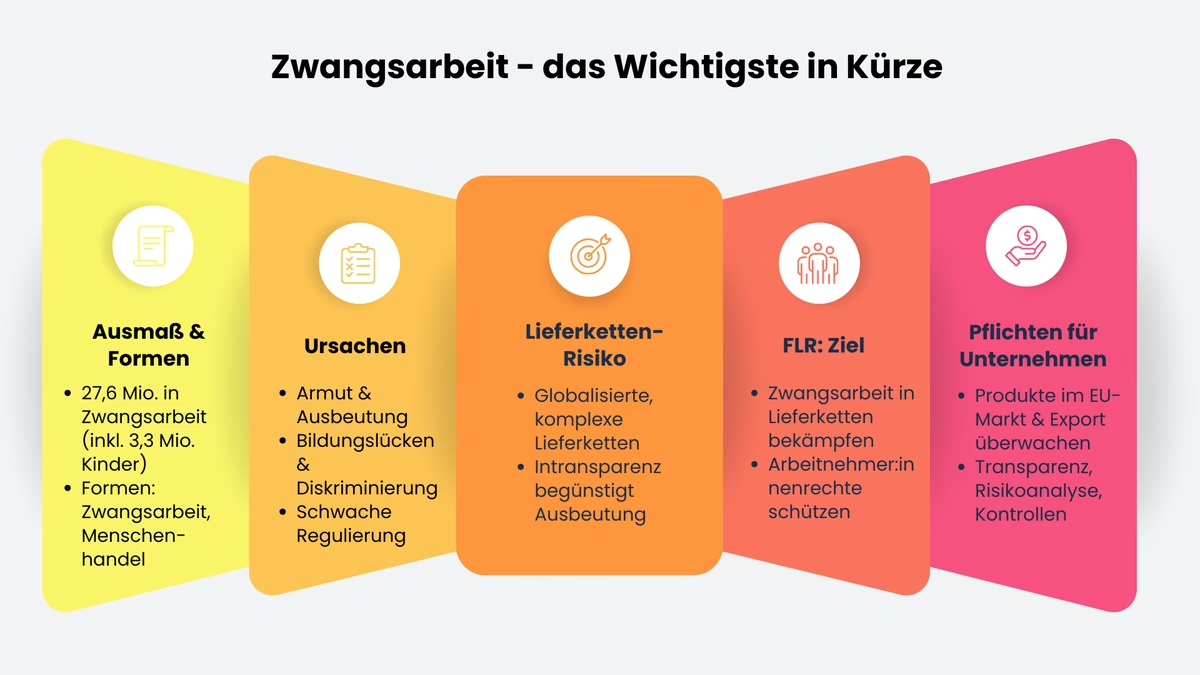
Millions of people worldwide are affected by modern slavery. The ILO estimates that around 27.6 million people live in forced labor, including 3.3 million children. Modern slavery manifests itself in forced labor, human trafficking and debt bondage, among other things.
The causes range from poverty, discrimination and a lack of education to inadequate regulation. Globally networked supply chains can also facilitate exploitation and there are also cases in Germany, for example through labor exploitation and forced prostitution.
The EU Forced Labor Regulation (FLR) aims to combat forced labor in supply chains by establishing clear rules and measures. Companies must assess risks, monitor their supply chains and ensure that products sold on the EU market or exported do not originate from forced labor. Controls, audits and effective compliance processes are key instruments, as is international cooperation, to put a sustainable end to exploitation.
Update from 19.11.2024
On 19 November 2024, the Council of the European Union adopted the regulation governing the handling of products manufactured using forced labor. Once the regulation comes into force, products manufactured using forced labor may neither be sold nor imported. The ban applies to all sectors and products manufactured worldwide.
Around 27.6 million people worldwide, including 3.3 million children, are affected by forced labor. With the EU Forced Labor Regulation, the EU wants to send a clear signal for the protection of human rights and fair trade conditions. This regulation helps to promote decent working conditions and hold companies accountable that do not carefully monitor their supply chains.
How is the ban enforced?
- New database: The EU will set up a database for high-risk products to identify suspected cases.
- Investigations: The EU Commission investigates suspected cases outside the EU. National authorities are responsible for suspected cases within their borders.
- Cooperation: EU Member States and the Commission exchange information in order to pursue infringements.
- Uniform decisions: A ban by a national authority automatically applies throughout the EU.
The regulation will now be signed by the President of the European Parliament and the President of the Council. It will then be published in the Official Journal of the EU. It enters into force on the following day and becomes applicable three years later.
The definition of modern slavery
Estimates by the International Labor Organization (ILO ) show that around 27.6 million people worldwide are trapped in forced labor, including 3.3 million children.
In today's world, there are various forms of modern slavery that exploit people in the most brutal ways. Millions of victims, including women and children, suffer from forced labor and human trafficking. The International Labor Organization (ILO) defines modern slavery and slave trade as a blatant violation of human rights that exists worldwide. The precise definition of modern slavery plays a central role in drawing attention to the various forms of slavery and developing effective countermeasures. Every single case of forced labor is one too many, and it is time to take joint action against this abhorrent practice.
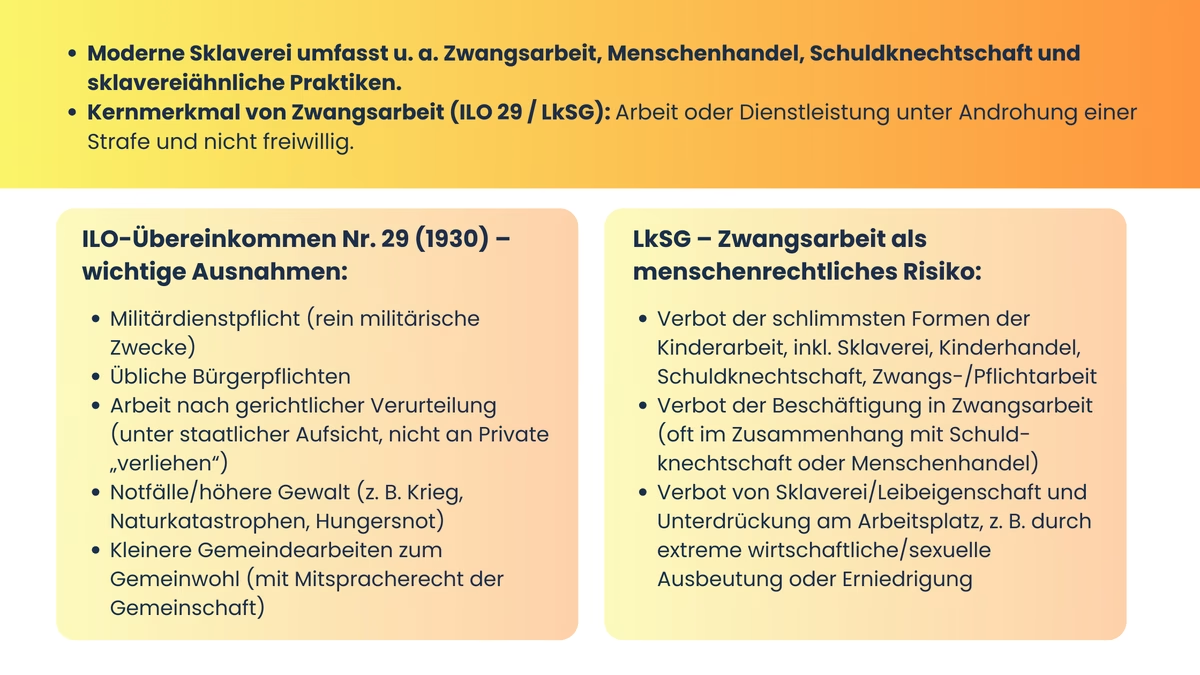
The concept of forced labor is defined by law, including in ILO Convention No. 29.
What is modern slavery?
Definition of forced labor according to Art. 2 para. 1 of the ILO Convention:
- For the purposes of this Convention, "forced or compulsory labor" means any work or service which is exacted from any person under the menace of any penalty and for which the said person has not offered himself voluntarily.
- However, "forced or compulsory labor" within the meaning of this Convention shall not include
- any work or service on the basis of the laws on compulsory military service, insofar as this work or service serves purely military purposes
- any work or service that is part of the normal civic duties of citizens of a country with full self-government
- any work or service required of a person on the basis of a court conviction. However, it is a condition that this work or service is carried out under the supervision and control of the public authorities and that the convicted person is not hired out to individuals or private companies and associations or otherwise made available to them
- any work or service in cases of force majeure: in the event of war or if calamities have occurred or are imminent, such as conflagration, flood, famine, earthquake, devastating human or animal diseases, sudden appearance of wild animals, insect or plant plagues, and in general in all cases in which the life or welfare of all or part of the population is threatened
- minor community work that directly serves the good of the community, is carried out by its members and can therefore be counted as part of the normal civic duties of members of the community. The prerequisite is that the population or their direct representatives are entitled to express their opinion on the necessity of the work.
Forced labor as a human rights risk according to § 2 para. 2 no. 2-4 LkSG:
(2) A human rights risk within the meaning of this Act is a situation in which there is a sufficient probability of a violation of one of the following prohibitions due to factual circumstances:
- ...
- the prohibition of the worst forms of child labor for children under the age of 18; this includes Article 3 of Convention No. 182 of the International Labor Organization of 17 June 1999 concerning the Prohibition and Immediate Action for the Elimination of the Worst Forms of Child Labor (BGBl. 2001 II p. 1290, 1291):
- all forms of slavery or practices similar to slavery, such as the sale of children and child trafficking, debt bondage and servitude, and forced or compulsory labor, including the forced or compulsory recruitment of children for use in armed conflict;
- the prohibition of the employment of persons in forced labor; this includes any work or service that is required of a person under threat of punishment and for which he or she has not voluntarily made himself or herself available, for example as a result of debt bondage or human trafficking;
- the prohibition of all forms of slavery, slavery-like practices, servitude or other forms of domination or oppression in the workplace, such as extreme economic or sexual exploitation and humiliation.
Slavery is unfortunately still an existing phenomenon today. Modern slavery refers to situations in which people work under duress, are deprived of their freedom and have no control over their working conditions. This can take various forms, such as forced labor, human trafficking, debt bondage or forced prostitution.
Victims of slavery are often trapped in a vicious cycle of exploitation and violence, with no means of escape. In many cases, they are kept in conditions that violate their basic human rights. The right to decent working conditions, fair pay and humane treatment is often disregarded. This not only leads to the exploitation of workers, but also to a violation of international occupational health and safety standards.
Modern slavery can be found in various industries such as agriculture, textiles, construction, care and others. It is important to realize that slavery still exists today and measures must be taken to combat this crime and protect the victims.
What are the signs of forced labor?
The signs of forced labor are diverse and can manifest themselves in different ways. The International Labor Organization (ILO) has developed various criteria to identify forced labor. Identifying cases of forced labor requires a precise and sensitive approach as well as an awareness of the various manifestations of this problematic practice. The presence of a single clue in a specific situation may in some cases indicate the presence of forced labor. On other occasions, however, several signs may need to be considered together to indicate a case of forced labor.
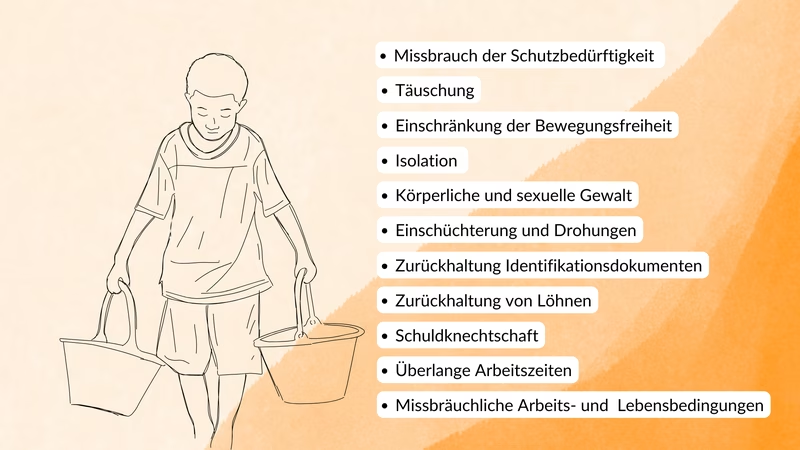
The critical indicators according to the ILO are
In today's society, certain people are at a higher risk of becoming victims of forced labor. In particular, people who are in a more vulnerable position due to a lack of livelihood options, language or legal barriers, belonging to minorities or physical limitations run the risk of being exploited. Exploitation of this vulnerability by employers can lead to a person being forced into forced labor. It is particularly worrying when employees are not only dependent on their employer for their job, but also for housing, food and employment for their family.
The misleading recruitment of workers through false promises about their working conditions and pay leads to them being trapped in exploitative conditions. These deceptive recruitment practices deny workers the opportunity for free and informed consent. Deceptive recruitment practices can include false promises about many aspects, such as working conditions, wages, type of work or housing. If the workers had been informed of the truth, they would never have accepted the job offer.
Forced laborers can be detained and monitored to prevent escape attempts. If workers are not free to enter or leave the work premises, this indicates forced labor. Surveillance cameras and guards inside the workplace as well as escorts outside the site are common control measures for forced laborers.
In many cases, victims of forced labor are isolated in remote locations and have no contact with the outside world. They may not even know where they are or how to seek help. The workplace may be far from residential areas and access to transportation may be limited. Even in densely populated areas, workers may be isolated, for example by being locked inside. Often, business premises are not registered, making it difficult to monitor them and protect workers.
These forms of exploitation include the forced consumption of drugs or alcohol in order to gain control over those affected. Violence can also be used to force workers to perform unwanted acts, such as sexual assault or the obligation to do housework in addition to their regular duties. Abduction is an extreme form of violence in which a person is held against their will and forced to perform forced labor.
In addition to physical violence, other common threats used against workers include reporting them to immigration authorities, firing family members, or revoking "privileges" such as the right to leave the workplace. Additionally, constant insults can act as psychological coercion to increase workers' sense of vulnerability. To properly assess the credibility and impact of these threats, it is important to look at them from the worker's perspective, taking into account individual beliefs, age, cultural background and social and economic status.
The safekeeping of identity documents or other personal valuables by employers can be considered an indicator of forced labor if employees cannot freely access them and fear losing their jobs if they wish to do so.
Employees may be forced to stay with violent employers while waiting for their outstanding wages. Irregular or late payment of wages does not automatically mean that it is forced labor. However, the situation is different if wages are systematically and deliberately withheld in order to force workers to stay and deprive them of the opportunity to change employers.
Forced laborers are often forced to work to pay off debts they have accumulated due to advances or loans to cover various costs such as recruitment or transportation. Debts can increase as a result of the manipulation of accounts, especially if the workers are illiterate. Children can even be recruited for their parents' debts. This leads to a vicious cycle of debt bondage that is difficult to break out of.
Forced laborers can be forced to work excessively long hours that exceed the legally prescribed limits. They are denied breaks and days off, they have to cover for absent colleagues and may have to be ready to work around the clock. Basically, if employees have to work more overtime than is permitted, under threat of consequences such as dismissal or in order to receive at least the minimum wage, this is considered forced labor.
Employment may take place in conditions that are degrading or dangerous (without adequate protective equipment) and in violation of labor laws. Workers may suffer from inhumane living conditions, for example in overcrowded and unhealthy conditions without any privacy. Although miserable working and living conditions alone do not necessarily indicate forced labor, abusive conditions should be considered a warning sign of possible forced labor.
Background and distribution
Causes and extent
The causes and extent of modern slavery are complex and alarming. Despite international efforts and legal measures, the problem remains widespread. Millions of people, including women and children, are held captive in various forms of forced labor and exploitation around the world. The victims of modern slavery suffer under inhumane conditions and have limited opportunities to free themselves from this situation.
One of the main causes of modern slavery is the economic exploitation of vulnerable population groups in particular. People in situations of poverty, unemployment or lack of education are often exploited as they are willing to work under exploitative conditions out of desperation. This economic pressure and the prospect of a better life lead to people being forced into dangerous and inhumane working conditions, which form the basis for modern forms of slavery.
Globalization and the pressure on companies to cut costs and maximize profits often lead to working conditions that promote modern slavery. Complex supply chains often put workers in precarious situations without adequate rights or pay.
An important aspect that contributes to modern slavery is the inadequate legal regulation and enforcement of labor rights in many countries. There is often a lack of clear laws to protect workers from exploitation and inhumane working conditions. This gives unscrupulous employers and companies the opportunity to exploit workers and force them into a kind of modern slavery. This legal vacuum allows them to violate basic human rights without being held accountable. The lack of effective legal regulation thus creates an environment in which modern slavery can thrive.
Social structures also play a role in maintaining modern slavery. Discrimination based on gender, ethnicity or social background means that certain population groups are particularly at risk.
It is important to understand these complex causes and take action to effectively combat modern slavery. Only through joint efforts at a political, economic and social level can we create a world in which exploitation and oppression no longer have a place.
Where does slavery still exist today?
Slavery still exists in some parts of the world today, particularly in countries such as North Korea, Mauritania and Eritrea. In these regions, there are reports of modern forms of slavery, including forced labor, debt bondage and human trafficking. Those affected are often poor and vulnerable, which enables the perpetrators to exploit and enslave them. Walk Free estimates that on any given day in 2021, around 50 million people were living in modern slavery. This number exceeds ILO estimates and can be explained as follows: 28 million people were in forced labor, while 22 million were in forced marriages.
The Walk Free Foundation's Global Slavery Index is a report that quantifies the number of modern slaves in 160 countries worldwide. It is based on a variety of data sources and serves to raise awareness of this pressing issue. A key aspect of the Global Slavery Index is the methodology used to collect and analyze the data. The data is based on thousands of interviews with survivors collected through nationally representative household surveys in 75 countries, as well as country risk assessments. The final result is an index value that corresponds to an estimated value for the prevalence of modern slavery per 1000 inhabitants in the country in question.
According to the 2021 report, modern slavery is most widespread in North Korea, followed by Eritrea, Mauritania, Saudi Arabia, Turkey, Tajikistan, the United Arab Emirates, Russia, Afghanistan and Kuwait. The data refer to 1000 inhabitants. North Korea is at the top with a value of 104.6 and over 2 million people affected.
Although forced labor is mainly found in low-income countries, there is a strong link to demand from higher-income countries. The complex and opaque supply chains created by the production and transport of goods between countries - from the sourcing of raw materials to manufacturing, packaging and transportation - are often linked to forced labor. A frightening example: In 2021, G20 countries imported $468 billion worth of goods produced under conditions of modern slavery. According to the organization International Justice Mission, which frees people from slavery worldwide with its important work, every German indirectly owns 60 to 70 slaves through this consumption.
No country in the world is free from modern slavery. There are people living in modern slavery all over the world. Regardless of their size, population or economic situation, this insidious crime spreads across national borders and permeates global supply chains. Even here in Germany, there are cases of exploitation and forced labor that are not always obvious. Although Germany has a good ranking of 158 out of 160, it is estimated that around 47,000 people are affected by modern slavery in this country, according to Walk Free. This figure is mainly made up of labor exploitation and forced prostitution. The number of unreported cases could even be higher, as cases of exploitation and forced labor often remain hidden and are difficult to detect.
Forced labor today: Which areas of work are affected?
In today's world, modern slavery unfortunately occurs in many forms and areas of work. According to the International Labor Organization, forced labor takes place in the private sector, affecting 17.3 million people, excluding commercial sexual exploitation. In addition to the textile industry, agriculture, mining, construction, domestic workers and the food and electronics industries are also heavily affected. In these industries, people are often forced to work under exploitative conditions without receiving adequate pay or labor rights.
These are often hidden forms such as forced prostitution, forced labor on fishing vessels or in the home, which are less obvious but still represent extreme exploitation and mistreatment of people. These less obvious forms of exploitation and oppression of people must also be brought into focus in order to put an end to these inhumane practices.
EU Forced Labor Regulation
The EU Forced Labor Regulation in the fight against modern slavery
As previously highlighted, according to the ILO, almost 28 million people worldwide are in forced labor. The goods they produce also reach the European market via global supply chains.
The EU Forced Labor Regulation (FLR) plays a key role in the fight against modern slavery. Through clear regulations and measures, it aims to combat forced labor throughout the entire supply chain. Companies are obliged to report transparently on their suppliers and their working conditions in order to prevent exploitation and forced labor. The regulation sets clear standards and penalties for violations in order to protect the rights and dignity of workers. It applies to all products manufactured under forced labor that are sold in the EU, exported from the EU and sold outside the EU (including online trade). The legislation also applies to all sectors of the economy.
Through consistent implementation and monitoring, the EU Forced Labor Regulation can help protect millions of victims of modern slavery worldwide and create a future without forced labor.
On 14 September 2022, the Commission proposed a ban on the sale of goods produced using forced labor on the European market. On March 5, 2024, the representatives of the European Parliament (EP) and the Council of the EU reached a provisional agreement in the trilogue negotiations on this ban. In the end, the EU Parliament voted in favor of the regulation on March 23, 2024 with 555 votes in favor, 6 against and 45 abstentions.
The Council of the European Union adopted the regulation on November 19, 2024. Unlike directives, regulations do not have to be transposed into national law, but apply immediately after they enter into force. The regulation enters into force on the day after its publication in the Official Journal of the EU. Publication is expected before the end of this year. However, according to the current draft regulation, it will not apply until three years after entry into force in the member states, i.e. probably not until November 2027.
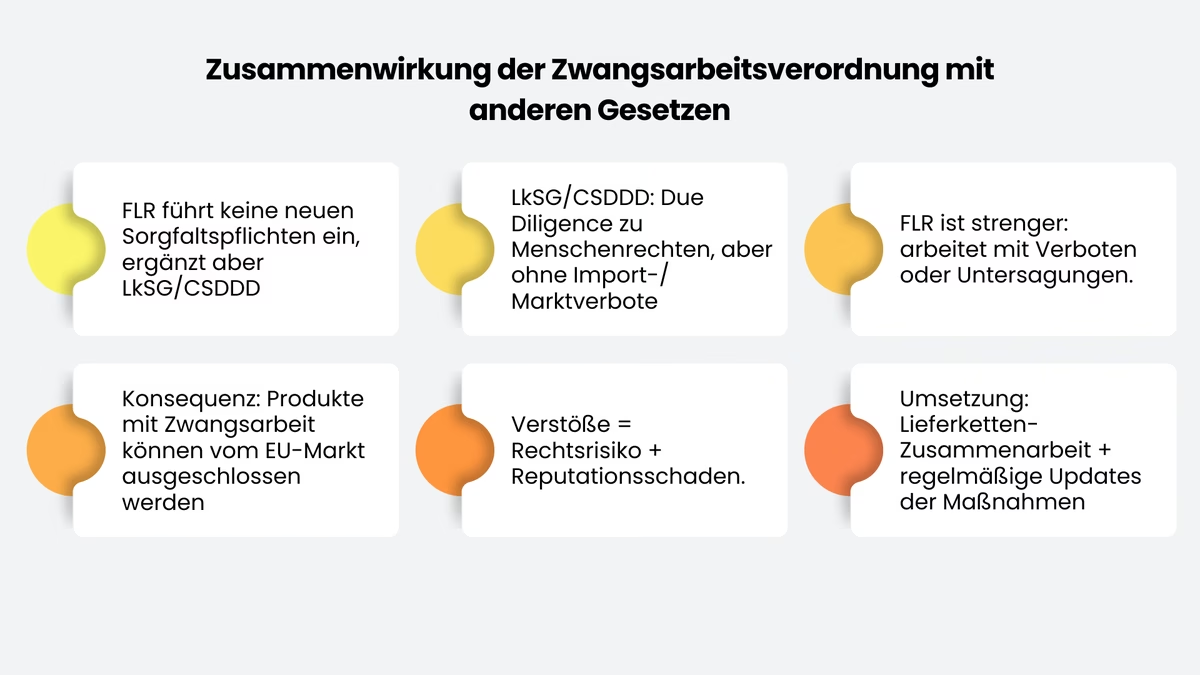
How does the Forced Labor Ordinance interact with other laws?
Although the Forced Labor Ban Regulation does not introduce any new supply chain-related due diligence obligations, in many cases the EU Forced Labor Regulation applies in conjunction with existing due diligence obligations (e.g. from the Supply Chain Due Diligence Act (LkSG ) and the Corporate Sustainability Due Diligence Directive (CSDDD)). These laws oblige companies to ensure compliance with human rights and labor standards along their entire supply chain. Nevertheless, both laws lack concrete measures against forced labor, such as an import ban or more extensive regulations. The Forced Labor Regulation therefore represents an extended duty of care to ensure that forced labor has no place in EU value chains. In contrast to the LkSG and the CSDDD, it regulates the issue in a stricter manner with prohibitions and bans, which represents important progress.
Companies that violate these laws not only risk legal consequences, but also reputational damage. It is therefore important that companies keep an eye on the EU Forced Labor Regulation, the Supply Chain Due Diligence Act and the Corporate Sustainability Due Diligence Directive and take appropriate measures to comply with these regulations.
In practice, this means that if the existing due diligence obligations (CSDDD and LkSG) do not lead to an end to forced labor in the supply chain, these products can be excluded from the EU market in accordance with the EU Forced Labor Regulation. As a result, forced labor should be excluded from the supply chain without exception. However, effective implementation of these measures requires close cooperation along the entire supply chain as well as regular review and updating of due diligence obligations.
Evaluation and outlook
The FLR has both advantages and disadvantages. One of the main advantages is that it serves to protect workers from exploitation and forced labor. Companies are now legally obliged to ensure that their employees work under fair conditions. This promotes human rights and social justice. Another benefit is that the regulation requires companies to be more transparent about their labor practices, which can increase consumer confidence. Thus, the Forced Labor Regulation can help raise public awareness of labor rights and ethical labor practices. Consumers are sensitized and have the opportunity to consciously choose products and services from companies that are actively committed to fair working conditions. This not only leads to a positive corporate image, but can also contribute to social change with regard to labor standards in the long term.
However, the EU regulation has been criticized for not fully protecting human rights and for not being ambitious enough. Although the regulation represents a glimmer of hope for those affected, reparation measures have not been introduced. This is criticized by the European Network of National Human Rights Institutions (ENNHRI), as the lack of redress measures could lead to companies merely getting rid of problematic cooperation without achieving any real improvements for those affected. Remediation is an important aspect of ensuring that the ban on products covered by the EU Forced Labor Regulation does not only lead to superficial changes in supply chains, but also to real change. Adequate redress could consist of those affected being given back their identity documents and outstanding wages, being freed from debt bondage and seeing a marked improvement in their working and living conditions.
What other laws are there against forced labor?
There are other laws that combat forced labor and provide important protections for workers. These laws set standards to effectively combat and eliminate forced labor in all its forms. These international provisions are critical to achieving global outlawing of forced labor and upholding fundamental human rights.
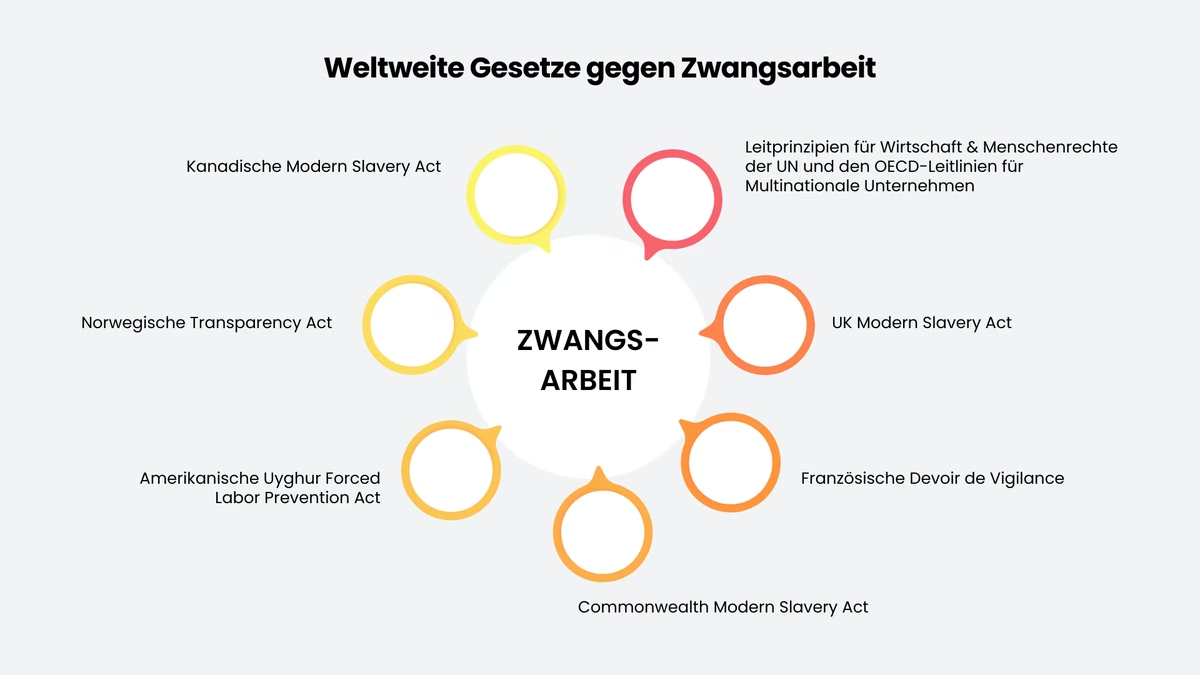
The following is a non-exhaustive list:
Laws against forced labor
Voluntary commitments from the United Nations Guiding Principles on Business and Human Rights and the OECD Guidelines for Multinational Enterprises
The UK Modern Slavery Act of 2015 requires companies with a turnover of more than 36 million pounds to publish an annual modern slavery statement. This statement should provide information on what measures the company is taking to prevent modern slavery and human trafficking in its supply chain. In addition, companies must be transparent about how they ensure that no form of forced labor or child labor is used in their production processes.
The French Devoir de Vigilance (Duty of Care Act) of 2017 introduced proactive measures for companies to protect human rights. With the "Duty of Care", companies with at least 5,000 employees in France and 10,000 worldwide must take steps to prevent human rights violations and communicate them transparently.
The Commonwealth Modern Slavery Act 2018 requires companies with an annual turnover of more than 100 million Australian dollars to take measures to prevent modern slavery and human trafficking as part of their business operations. This act includes mandatory disclosure of company activities and the introduction of internal control mechanisms to identify and prevent breaches of the regulations.
The U.S. Uyghur Forced Labor Prevention Act aims to prevent the import of products made by forced labor of Uyghurs from the Xinjiang region of China. Companies that manufacture or sell such products have the burden of proof and are obliged to prove that their products were not manufactured using forced labor from Xinjiang. The law also provides for penalties for companies that violate these regulations. It serves as an important step in the fight against human rights violations and exploitation in the region.
The Norwegian Transparency Act (entered into force in 2022) requires larger companies to disclose information about their business practices to ensure that they act ethically and responsibly. To be classified as a larger company, they must meet or exceed two of the following three conditions: 50 full-time employees (or equivalent annual working hours), an annual turnover of at least NOK 70 million and a balance sheet of at least NOK 35 million. Companies are then required to publish an annual human rights compliance statement and respond to requests to disclose their efforts. The public has the right to request this information, which is a special feature of Norwegian law.
The Canadian Modern Slavery Act (Bill S-211) came into force on January 1, 2024. The law requires companies to take measures to prevent forced labor and child labor in their supply chains. Violations are punishable by fines. Transparent reporting on compliance is expected from companies in order to effectively support the fight against forced labor and child labor.
The role of companies in combating modern slavery
Companies play a crucial role in the fight against modern slavery. By implementing strict guidelines and control mechanisms, they can ensure that forced labor has no place in their supply chains. Transparency and due diligence are essential to prevent exploitation. As key players in the business world, companies have a responsibility to uphold human rights standards and actively work against forced labor. It is time for companies to take their social responsibility seriously and stand up for the rights and dignity of all people.
What obligations do companies have?
- Although the FLR is not expected to apply until mid-2027, work on product-related risk management should start now. It is essential that the company creates the necessary compliance structures in good time in order to meet the obligations resulting from the Forced Labor Regulation. Failure to do so may not only result in serious sanctions, reputational damage and competitive disadvantages, but also import bans.
- It could be challenging if the provisions of the German Supply Chain Due Diligence Act, the EU Forced Labor Regulation and the CSDDD overlap. It would therefore be important to conduct an in-depth analysis with other relevant regulations, such as on conflict minerals.
- In order to ensure that their own products can continue to be sold, it is essential for companies to carefully examine and exclude the risks of forced labor in their supply chain. The analysis of these risks and the implementation of risk mitigation measures are therefore becoming increasingly important.
- Comprehensive monitoring and regular audits are crucial to ensure compliance with this regulation and to ensure that human rights standards are met.
- Even if the EU Commission or national authorities are responsible for providing evidence of forced labor in the supply chain, companies are included in the investigations. You have the opportunity to provide your own evidence of compliance with the ban on forced labor, for example by implementing standards and certificates. By presenting such evidence, you can not only strengthen your credibility, but also gain the trust of your stakeholders.
Conclusion
Modern slavery affects millions of people - and it exists not only in distant countries, but also in Europe and in our immediate surroundings. This is why decisive action is needed at several levels: International cooperation is key to uncovering forced labor, protecting those affected and implementing effective prevention measures. Organizations such as the ILO do important work here, for example through common standards, the exchange of best practices and the strengthening of legal frameworks.
At the same time, legal requirements such as the EU Forced Labor Regulation (FLR) create a clear framework for companies. It increases the pressure to make supply chains more transparent, to consistently assess risks and to take human rights due diligence seriously. In this way, the regulation can help to reduce exploitation in global value chains and promote an economy based on responsibility, fairness and transparency in the long term.
A future without forced labor is possible if we act together and stand up for the protection of human rights. Only through united efforts can we create a world in which no one is exploited.
Frequently asked questions
Art. 3 of the Regulation prohibits the import, making available on the Union market and export from the EU of products manufactured using forced labor.
Art. 2 lit. a Regulation defines forced labor: "Forced labor" is defined as forced or compulsory labor, including child forced labor, within the meaning of Article 2 of Convention No. 29 of the International Labor Organization of 1930 concerning Forced or Compulsory Labor.
Article 2(c) of the Regulation defines due diligence as follows: "Due diligence obligations in relation to forced labour" means the efforts of economic operators to implement binding requirements, voluntary guidelines, recommendations or practices aimed at identifying, preventing, minimizing or eliminating the use of forced labour in products to be placed, made available or exported on the Union market.
Art. 2 lit. h of the Regulation addresses all economic operators: "economic operator" means any natural or legal person or any association of persons who places or makes available products on the Union market or exports products from the Union. In addition, Art. 2 lit. i to m of the Regulation defines economic operators in more detail, meaning that manufacturers, producers, product suppliers, importers and exporters are covered by the Regulation.
Art. 2 lit. f of the Regulation defines the product: "product" means any product which has a monetary value and as such may be the subject of commercial transactions, regardless of whether it is extracted, harvested, produced or manufactured, including the working or processing of a product at any stage of its supply chain.
Art. 2 lit. g of the Regulation describes in more detail which products are covered: "product produced by forced labor" means a product for which forced labor has been used, in whole or in part, at any stage of its extraction, harvesting, production or manufacture, including the working or processing of a product at any stage of its supply chain.
Art. 2 lit. h of the Regulation defines the supply chain: The "supply chain" means the system of activities, processes and actors involved in all upstream stages of making the product available on the market, i.e. the extraction, harvesting, production and manufacture of a product or parts thereof, including the working or processing of a product at any of these stages.
-> "Product" is therefore a versatile term that encompasses any tradable good with a monetary value, regardless of its origin or processing stage in the supply chain. The definition focuses on the diversity and trade aspect of products along their supply chain. This emphasizes the complexity and diversity of the term, which encourages companies to take a holistic view of their supply chains and create transparency about them.
Art. 4 of the Regulation refers to cases in which a product is offered for sale at a distance: Where a product is offered for sale online or by any other means of distance selling, the product is deemed to be made available on the market if the offer is made to end-users in the Union. An offer for sale shall be deemed to be made to end-users in the Union if the economic operator concerned directs its activities in any way to one or more Member States.
Consequently, online retailers are also clearly affected by the requirements of the regulation.
The subject matter of the Regulation is provisions prohibiting economic operators from placing on the Union market, making available on the Union market or exporting from the Union market products subject to forced labor, with the aim of improving the functioning of the internal market and contributing to the fight against forced labor, Art. 1 of the Regulation.
However, according to Art. 1 (2) of the Regulation, the Regulation does not apply to the withdrawal of products that have already reached the end consumer on the Union market. This serves to protect consumers.
The actions are described in more detail in Art. 2 VO:
→ Art. 2 lit. d Regulation: "Making available on the market" means any supply of a product for distribution, consumption or use on the Union market in the course of a commercial activity, whether in return for payment or free of charge.
→ Art. 2 lit. e Regulation: "Placing on the market" means the first making available of a product on the Union market.
→ Art. 2 lit. s Regulation: "Products entering the Union market" are products from third countries that are placed on the Union market or are intended for private use or private consumption within the customs territory of the Union and are to be placed under the customs procedure "release for free circulation".
→ Art. 2 lit. t Regulation: "Products leaving the Union market" are products that are to be placed under the "export" customs procedure.
The companies are to be supported by various measures. These include a database (Art. 8 of the Regulation), an information portal (Art. 7 of the Regulation) and guidelines (Art. 11 of the Regulation), which are to be made available on a central website (Art. 12 of the Regulation). The introduction of the database and the information portal aims to enable the assessment of violations and to monitor the risk of forced labor with the help of verifiable and updated information. This information could include reports from the International Labor Organization (ILO). Furthermore, the Commission plans to provide guidelines to serve as additional guidance for economic operators and competent authorities. These guidelines will include best practices for ending and eliminating forced labor.
Furthermore, according to Art. 6 of the Regulation, a Union network against forced labor shall be established. The aim is to serve as a platform for structured coordination and cooperation between the competent authorities of the Member States and the Commission and to streamline the enforcement procedures of this Regulation in the Union in order to improve the effectiveness and consistency of enforcement, according to Art. 6 (2) of the Regulation. In this respect, the network is to be composed of representatives of the individual Member States, representatives of the Commission and, where appropriate, representatives of the customs authorities, in accordance with para. 3. The exact scope of tasks is determined by Art. 6 para. 7 of the Regulation.
The competent authorities are named in Art. 5 (1) of the Regulation: Accordingly, Member States shall designate one or more competent authorities responsible for fulfilling the obligations set out in this Regulation. The designated competent authorities of the Member States and the Commission shall cooperate closely and shall be responsible for the effective and uniform application of this Regulation throughout the Union.
The allocation of investigations in individual cases depends on whether the alleged forced labor takes place outside the territory of the Union or within the territory of a Member State, Art. 15 of the Regulation. The Commission is the lead competent authority outside the territory of the Union (para. 1), while the Member States are the competent authority for suspected forced labor on their own territory (para. 2). In order to ensure uniform and efficient implementation of this Regulation, the Commission and the competent authorities shall cooperate closely and provide mutual assistance, Art. 16 (1) of the Regulation.
A risk-based approach should be taken when determining the likelihood of a breach of Art. 3 of the Regulation by the competent authorities and the Commission, Art. 14 (1) of the Regulation.
The assessment is based on the following criteria in accordance with Art. 14 (2) (a) to (c) of the Regulation:
(a) the extent and severity of the alleged forced labor, including whether forced labor imposed by government authorities may be a cause for concern;
(b) the quantity of products placed or made available on the Union market:
c) the proportion of the final product that is suspected to have been produced by forced labor.
All relevant, factual and verifiable information available to the competent authorities and the Commission must be used in the assessment in accordance with Art. 14 (3) of the Regulation. Such information can, for example, come from the database pursuant to Art. 8 of the Regulation (b) or the information portal pursuant to Art. 7 of the Regulation (a), but also from consultations with stakeholders such as civil society organizations and trade unions (f).
First of all, there needs to be a suspicion. If there is a suspicion of a violation of the Forced Labor Ordinance, it is crucial that the authorities conduct a thorough investigation to determine the likelihood of the violation. This examination of the probability is called a preliminary investigation. If the suspicion is confirmed, a detailed main investigation follows. The relevant standards for the investigation are Art. 17 to 20 of the Regulation.
- Art. 17 VO
Art. 17 para. 1 of the Regulation requires that the lead competent authorities must conduct a preliminary investigation before initiating an investigation pursuant to Art. 18 para. 1 of the Regulation (main investigation). This means that they request information from the economic operators to be assessed and, where applicable, from other product suppliers about the relevant measures they have taken to identify, prevent, minimize, eliminate or remedy the risk of forced labour in their business activities and supply chains in relation to the products to be assessed.
According to para. 2, the economic operators must respond within 30 working days from the date on which they received the request. For the further preliminary investigation, the lead competent authority then has 30 working days to carry out and complete its risk investigation on the scale in accordance with Art. 14 of the Regulation (para. 3). If the authority comes to the conclusion that there is no reasonable suspicion of a breach of Article 3 or that the reasons that led to a reasonable suspicion have been eliminated, the authority does not initiate an investigation in accordance with Article 18 of the Regulation, according to para. 5.
- Article 18
However, if it is established in accordance with Art. 17 para. 4 of the Regulation that there are reasonable grounds to suspect a breach of Art. 3 of the Regulation, the competent authority shall initiate a (main) investigation in relation to the products and economic operators concerned and inform the economic operators concerned by the investigation within three working days of the date of the decision to initiate such an investigation, Art. 18 para. 1 of the Regulation.
The economic operators concerned must then, at the request of the lead competent authority, provide all information relevant and necessary for the investigation, including information identifying the products to be investigated and, where applicable, the part of the product to which the investigation should be limited, as well as the manufacturer, producer or supplier of those products or parts thereof (para. 3).
The authority shall primarily focus on the economic operators concerned by the investigation at the points in the supply chain that are closest to the point of suspicion and shall take into account, as far as possible, the size and economic resources of the economic operators (para. 3). This means, in particular, the question of whether the economic operator in question is an SME, the quantity of the products concerned, the complexity of the supply chain and the extent of the suspected forced labor (para. 3).
According to paragraph 4, a time limit of at least 30 and at most 60 working days is set for the transmission. However, economic operators may request an extension of this time limit with appropriate justification.
- Article 19
According to Art. 18 para. 6, 19 para. 1 of the Regulation, on-site inspections are also possible. However, according to Art. 19 para. 3 of the Regulation, there is a special feature with regard to risks outside the territory of the Union, so the Commission may carry out all necessary checks and inspections, provided that the economic operators concerned give their consent and the government of the third country has been officially informed and raises no objections. Where appropriate, the assistance of the European External Action Service may be requested.
- Article 20
The authority's decision on the procedure is made within the framework of Art. 20 of the Regulation. According to para. 2, it must be emphasized that the authorities can also determine a violation of Art. 3 of the Regulation on the basis of other available information if it was not possible to obtain information and evidence from the economic operators in accordance with Art. 17 para. 1 and Art. 18 para. 3. This concerns the following cases according to para. 2 lit. a to e:
a) refuses to provide the requested information without sufficient justification, or
b) fails to provide the requested information within the set deadline without providing sufficient justification, or
(c) provides incomplete or incorrect information in order to block the investigation; or
d) makes misleading statements or
e) otherwise obstructs the investigation, including in cases where the risk of forced labor imposed by public authorities is identified during the preliminary investigation or the investigation.
→ According to paragraph 3, an investigation shall be terminated if no infringement can be established. However, it should be noted that the termination does not preclude the initiation of a new investigation in relation to the same product and the same economic operator if new relevant information becomes available.
→ If the suspicion is confirmed, a decision shall be issued in accordance with para. 4, which shall include the following:
(a) a prohibition on the placing or making available on the Union market of the products concerned and a prohibition on their export;
(b) an order to the economic operators subject to the investigation to withdraw from the Union market the products concerned that have already been placed or made available on the market or to remove content from an online interface that relates to the products concerned or their listing;
(c) an order to the economic operators concerned by the investigation to withdraw the products concerned from the market in accordance with Article 25 or, where the components of a product found to be in breach of Article 3 can be replaced, an order to withdraw the relevant components of the product from the market.
Exceptions to this are possible if this is necessary to avoid disruption to a supply chain of strategic or critical importance to the Union, according to para. 5.
Right of the economic operator to be heard, Art. 16 (2) of the Regulation
According to this standard, the lead competent authorities must guarantee the economic operator's right to be heard at all stages of the procedure.
Support of contact point, Art. 17 para. 2, 18 para. 3 Regulation
Where necessary, economic operators have the possibility to request assistance from a contact point in accordance with Art. 10 with regard to cooperation with the lead competent authority in the preliminary and main investigation.
Review of the decision, Art. 21 VO
Economic operators for whom the suspicion of forced labor has been confirmed have the possibility to request a review of the decision pursuant to Art. 20 in accordance with Art. 21. It should be noted that the economic operator must provide significant new information. According to para. 2, this decision should be issued within 30 working days of receipt of the request for review. In addition to this possibility of review, according to para. 5, courts can also be called upon to review the procedural and substantive legality of the decision.
Further details on enforcement are set out in Art. 23 et seq. VO.
According to Art. 22 para. 1 lit. b of the Regulation, the decision must contain a reasonable time limit, not less than 30 working days, within which the economic operators must comply with the orders. If an economic operator does not act within this period, the competent authorities are responsible for enforcing the decision, Art. 23 para. 1 of the Regulation. According to para. 2, the authority has the right to impose sanctions on the economic operator either directly, in cooperation with other authorities or by application to the competent judicial authorities in accordance with Art. 37 of the Regulation.
Furthermore, the competent authority, in coordination with all other competent authorities, is responsible for enforcing take-back in accordance with Art. 24 (2) of the Regulation and, in accordance with Art. 20 (4) (c), for withdrawing products from the market in accordance with Art. 25 of the Regulation. In this case, withdrawal from the market means recycling or, if this is not possible, rendering the products unusable. Perishable products are withdrawn from circulation by donating them to charitable purposes or purposes in the public interest or, if this is not possible, by rendering them unusable.
According to Art. 37 of the Regulation, the Member States shall lay down rules on penalties. These must be effective, proportionate and dissuasive in accordance with Art. 37 (2). The following aspects must be taken into account:
a) Seriousness and duration of the infringement;
(b) relevant previous infringements by the economic operator;
c) the extent of cooperation with the competent authorities;
(d) any other mitigating or aggravating circumstances in the particular case, such as financial benefits gained or losses avoided directly or indirectly as a result of the breach.

Larissa Ragg
LinkedInMarketing Managerin · lawcode GmbH
Larissa Ragg verantwortet die Content-Strategie bei lawcode und erstellt Fachbeiträge zu den Themen EUDR, ESG-Compliance, HinSchG, Supply Chain und CSRD. Ihre Beiträge auf dem lawcode Blog machen komplexe regulatorische Anforderungen verständlich und liefern Unternehmen praxisnahe Orientierung.